

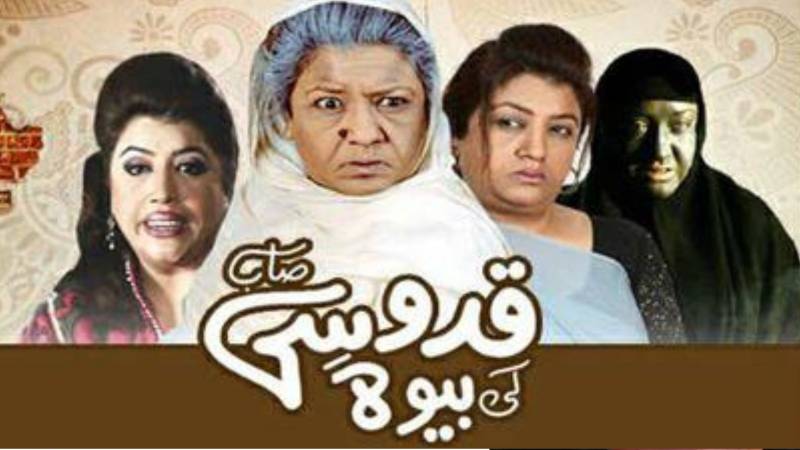
There is a scene in Quddusi Sahab Ki Bewah that is easy to watch without quite seeing what it contains. Wadood Ahmed, the only son of the widow Shakooran, is sitting with Rooh Afza, the daughter-in-law from upstairs, discussing clothes and gossip and the small vanities of daily life. They are best friends. The drama presents this as unremarkable. Nobody in the mohalla stops to comment. The camera does not linger meaningfully. The scene simply happens, and then the story moves on.
What that scene quietly and without announcement contains is a gender-nonconforming man in the middle of mainstream Pakistani prime-time television, being loved by everyone around him and by the audience watching at home.
Faseeh Bari Khan has been doing this for years. Across his body of work, he has written characters who live at the edges of what Pakistani society considers acceptable: widows with desires, women who speak without softening their words, men who feel no obligation to perform the “rough and tough” their world expects of them.
He never marks these characters as exceptional. He never makes their difference into a lesson or a tragedy. He simply places them in the middle of a story and lets them live there, as though their presence requires no justification because it does not.
This is, if one pauses to consider it, a rather extraordinary thing to do with a comedy on mainstream Pakistani television.
The reason it works, and the reason it has worked so consistently across dramas and decades, is that Faseeh Bari Khan understands something about laughter that more earnest writers do not. Laughter disarms. A drama that sets out to change minds about gender or class or the cruelties of community life risks the very resistance it is trying to overcome; the audience knows it is being lectured and closes itself off accordingly.
But a drama that makes you fall in love with a character before you have had the chance to decide whether you approve of him bypasses that resistance entirely. By the time Wadood has made you laugh, he has already made his home in your affections. The question of what he represents arrives, if it arrives at all, too late to matter.
This is not accidental craft. Reading Faseeh Bari Khan’s work with any attention reveals a writer who is extraordinarily precise about what his comedy is doing and why. The humour in Quddusi Sahab Ki Bewah is not decoration placed around a story. It is the story’s structural logic, the means by which difficult things are made sayable, and marginal people are made central, in a media landscape that would otherwise have no space for them.
He says it through a joke. He has always said it through a joke. It is the only way, in the world his dramas inhabit, that such a thing can be said at all
Consider Shakooran herself, who is both the drama’s greatest comic creation and its most quietly political one. She is a widow in a lower-middle-class urban mohalla, which means she occupies a social position her world does not quite know what to do with. She is the head of a household but has no husband; she has authority within her own walls but is perpetually subject to the judgment of the street outside. The drama mines this for extraordinary comedy. Her schemes to marry off her daughters, her negotiations with the mercurial Aqeela Bhabi, her operatic anxieties about respectability: all of it is genuinely, consistently funny.
But beneath the comedy, Faseeh Bari Khan is showing us something true and not particularly funny at all. Shakooran has absorbed the values of her mohalla so completely that she has become their most tireless enforcer.
She polices her daughters not because she is cruel but because she has learned, with great thoroughness, that a woman’s safety in her world lies in her family’s reputation, and reputation is a thing the street can take away at any moment. Her anxious, exhausting vigilance is not a character flaw. It is a rational response to the conditions of her life.
The drama gives us both things at once, the comedy and the critique, and does so without ever pausing to explain itself. This is Faseeh Bari Khan’s most consistent literary quality: a refusal to translate his work into a message. He trusts the audience to hold the laughter and the sadness together, to find Shakooran funny and to understand her, to love Wadood without a lecture on how he deserves love.
It is a quality that places him, in the view of this writer, among the more serious literary minds working in Pakistani television, which is not a category that criticism has been generous in populating.
He is discussed, when he is discussed, as a master of comic timing and Urdu dialogue, a chronicler of lower-middle-class life, a writer with an ear for the rhythms of the street. All of this is true. But it stops short of what his work actually is: a sustained, elegant, and remarkably effective engagement with the question of who gets to exist in Pakistani public life, and on what terms.
The answer his dramas propose, advanced not through argument but through character, not through statement but through the simple act of showing us people and asking us to recognise them, is that the answer should be: everyone!
He says it through a joke. He has always said it through a joke. It is the only way, in the world his dramas inhabit, that such a thing can be said at all.