

A nuclear war did not break out between India and Pakistan when the Pakistani army attacked Indian positions in Kargil in the spring of 1999.
Yet the threat of a nuclear war hangs in the air since the two neighbors have not been able to peacefully resolve their differences. What will happen if such a war does break out? I decided to dive into that topic by putting a few questions to Professor Robock, a Distinguished Professor in the Department of Environmental Physics at Rutgers University. He also edits the Reviews of Geophysics.
In 2019, he published a paper assessing the consequences of a nuclear war between India and Pakistan. The scenario was, interestingly, set in the year 2025.
Faruqui: More than a quarter century has passed since the Kargil war occurred. Yet a nuclear war has not occurred. Why?
Robock: I hope our work, publicising the potential horrific impacts, has made it less likely.
Faruqui: What can be done to prevent a nuclear war from ever breaking out in the Subcontinent? Is nuclear disarmament a realistic goal?
Robock. Yes, the existence of nuclear weapons means that they can be used. As Beatrice Fihn said, when accepting the 2017 Nobel Peace Prize for the International Campaign to Abolish Nuclear Weapons: “The story of nuclear weapons will have an ending, and it is up to us what that ending will be. Will it be the end of nuclear weapons, or will it be the end of us? One of these things will happen. The only rational course of action is to cease living under the conditions where our mutual destruction is only one impulsive tantrum away.”
Why do only nine nations have nuclear arsenals today? Why do the other 184 nations choose not to have them? Some are in alliances with nuclear nations, but most feel safer and wealthier without them. Ninety-four nations have signed the “Treaty on the Prohibition of Nuclear Weapons,” telling the nuclear states to get rid of theirs, to make themselves and the entire world safer. Instead, both India and Pakistan are increasing their nuclear arsenals.
The infrastructure of the nations would be shattered – no trains, electricity, cell phones, internet, or banks. Large agricultural areas would be rendered unfit for planting for years
Faruqui: What will be the consequences for the people of India and Pakistan if a nuclear war breaks out?
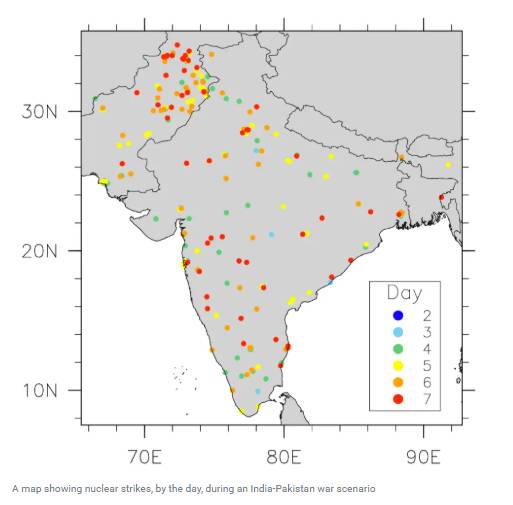
Robock: It would be an unprecedented catastrophe. The impacts would depend on how the war would proceed, how many weapons would be used, what would be the size of the weapons, and what would be the targets. We have analysed several different scenarios. If 250 15 kiloton weapons (the same size as the one dropped on Hiroshima in 1945) were used, the direct effects of blast, fires, and radioactivity would kill about 50,000,000 people, the same number as died in all of World War II. If 50 kiloton weapons were used, 100 million people would die from the direct effects. In addition, large numbers of people would be injured, with no hospitals, doctors, or nurses to care for them. The infrastructure of the nations would be shattered – no trains, electricity, cell phones, internet, or banks. Large agricultural areas would be rendered unfit for planting for years.
Faruqui: Will other nations also be affected?
Robock: Yes, the rest of the world would still be devastated, even if the Indo-Pakistan War does not trigger other countries to get involved. The smoke from the fires generated by the attacks on cities and infrastructure would rise into the upper atmosphere, the stratosphere where there is no rain to wash it out and persist for years. It will blow around the entire world.
The smoke would absorb sunlight, heating the stratosphere and destroying ozone layers, and also preventing the light from reaching the ground making it cold and dark. The cooling would lead to instant climate change. It would be unprecedented in recorded human history. It would be colder than the Little Ice Age. The impacts on food production would sentence one to two billion (1,000,000,000 to 2,000,000,000) people to starvation around the world, even if no bombs were dropped there. There would also be enhanced ultraviolet radiation reaching the surface, because of ozone depletion, and that would do further damage to surviving animals, including humans, and plants.
Faruqui: What can be done to prevent such a war? Should the US play a leading role to bring India and Pakistan to a negotiating table?
Robock: To prevent such a war, India and Pakistan would have to get rid of their nuclear arsenals. They could follow the example of Brazil and Argentina, who at one time were both developing nuclear weapons. Both countries pursued independent nuclear programs in the 1970s and 1980s, fueled by regional tensions and concerns about each other's intentions. While neither country is known to have ever actually built a nuclear weapon, they developed the technology to potentially produce fissile material. A shift towards cooperation occurred in the late 1980s, leading to the creation of the Brazilian-Argentine Agency for Accounting and Control of Nuclear Materials (ABACC) to ensure transparency and prevent proliferation. And they have been cooperating ever since.
It would be great if the U.S. played a leading role. But the U.S. would have to set an example by first reducing its nuclear arsenal and then dismantling it. Why would India and Pakistan listen to a nation that plans to keep its weapons? It would be, “Do as I say, and not do as I do.” It would be like the U.S. sitting in a bar and telling other nations not to drink.
I hope the 2017 Treaty on the Prohibition of Nuclear War, which has been signed by 94 nations so far, will pressure India and Pakistan to listen to the rest of the world, and realise that they, and the rest of the world, will be safer without nuclear weapons.