

Pakistan today finds itself at the epicenter of a global freshwater emergency. The World Bank's Global Water Monitoring Report 2025 has sounded the alarm on continental drying, a phenomenon that is stripping away 324 billion cubic meters of freshwater annually across the world. Among the countries singled out, Pakistan is highlighted for its inefficient use of agricultural water, a revelation that has reignited debate over the country's fragile water governance.
For decades, the Indus Basin was celebrated as one of the largest irrigation systems in the world—a lifeline for millions of farmers and communities. Yet the same system is now faltering under the weight of sedimentation, outdated practices, and inequitable distribution. The report's findings force us to confront a sobering truth: Pakistan's water crisis is not simply a matter of technology but a deeply political challenge that demands urgent reform.
The intentions behind the World Bank's report appear genuine, aiming to spotlight inefficiencies and propose solutions. Still, important questions must be asked. Why is Pakistan being highlighted now when similar inefficiencies exist across South Asia? Is the emphasis on agricultural waste intended to push the country towards expensive modernization projects that may benefit contractors more than communities? Will the proposed strategies of managing demand, augmenting supply, and improving allocation translate into equitable reforms, or will they reinforce elite control over scarce resources?
These questions are critical because water policy in Pakistan has often been shaped by short-term political agendas rather than long-term sustainability, leaving ordinary farmers and rural communities vulnerable.
Comparative lessons from around the world underscore the urgency of Pakistan's predicament. California's groundwater depletion demonstrates how unchecked agricultural demand can destabilize entire economies, while the collapse of the Aral Sea in Central Asia warns against over-extraction and poor planning. In contrast, India's participatory groundwater management shows how community-led monitoring can slow depletion, and Morocco's adoption of drip irrigation has improved yields while conserving water.
Pakistan's continued reliance on flood irrigation, where more than half of the water is wasted, stands in stark contrast to these examples. The lesson is clear: Pakistan's crisis is not inevitable but the result of policy inertia and misplaced priorities. Countries that invested early in transparent monitoring and innovative practices have managed to adapt, while those that relied on ad hoc crisis responses have suffered ecological and social collapse.
The challenges Pakistan faces are formidable. Agriculture consumes more than 90 percent of the country's freshwater, yet inefficiency drains billions from the economy. Rural farmers, particularly smallholders, lack access to modern irrigation technologies, deepening inequality and perpetuating poverty. Legal and institutional frameworks remain fragmented, with provincial disputes undermining national water governance. Sedimentation in dams, barrages, and canals continues to reduce storage capacity, while groundwater extraction remains largely unchecked, threatening long-term sustainability. The World Bank warns that, without intervention, freshwater decline will disrupt jobs and ecosystems globally. For Pakistan, this translates into food insecurity, rural poverty, and a heightened risk of conflict, both within provinces and across borders.
Solutions must therefore move beyond rhetoric and into action. Pakistan needs to modernize its irrigation practices by shifting from flood irrigation to more efficient systems such as drip and sprinkler irrigation, supported by subsidies and farmer training. Community stewardship must also be strengthened by empowering local water-user associations to monitor and manage aquifers, following India's participatory model.
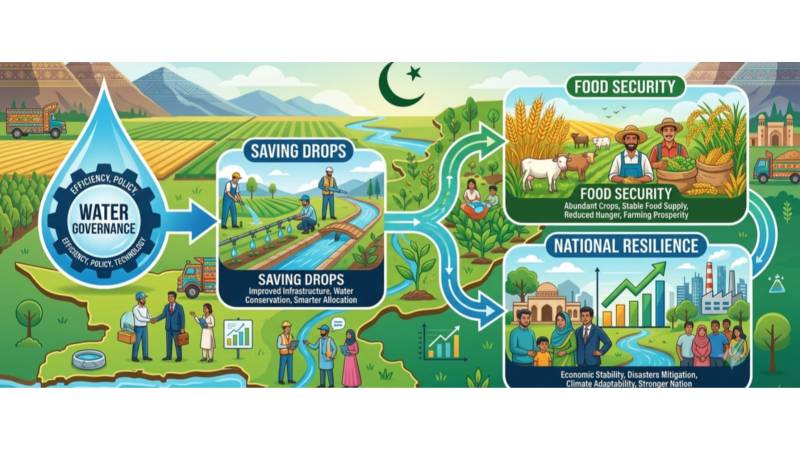
Every drop saved through better governance is an investment in Pakistan's food security and national resilience.
Nature-based solutions, including wetland restoration and aquifer recharge, should be prioritized, particularly in Sindh and Punjab, where groundwater depletion is most severe. Satellite-based monitoring, as recommended by the World Bank, should be adopted, but the resulting data must be made publicly accessible to researchers and local communities to ensure transparency and accountability.
At the regional level, dialogue with India under the Indus Waters Treaty must be revitalized to address climate-induced variability and prevent disputes from escalating. Successful models already exist. Singapore's integrated water recycling, Morocco's widespread adoption of drip irrigation, and Australia's transparent water accounting all demonstrate that policy innovation—not engineering alone—is the key to long-term resilience.
Pakistan's inclusion in the World Bank's *Global Water Monitoring Report 2025* is both a warning and an opportunity. Continental drying is not a distant threat; it is already reshaping Pakistan's agriculture, economy, and society. The path forward is clear: Pakistan must embrace governance reforms, community-led stewardship, and modern irrigation practices to avert catastrophe.
If freshwater decline continues unchecked, the economic and social costs will far exceed the investments required today. Pakistan's water crisis is solvable, but only if policymakers act decisively. Continental drying should not define Pakistan's future. Instead, it must serve as a catalyst for a new era of sustainable water governance—one that secures livelihoods, strengthens resilience, and safeguards the nation's most precious resource.