

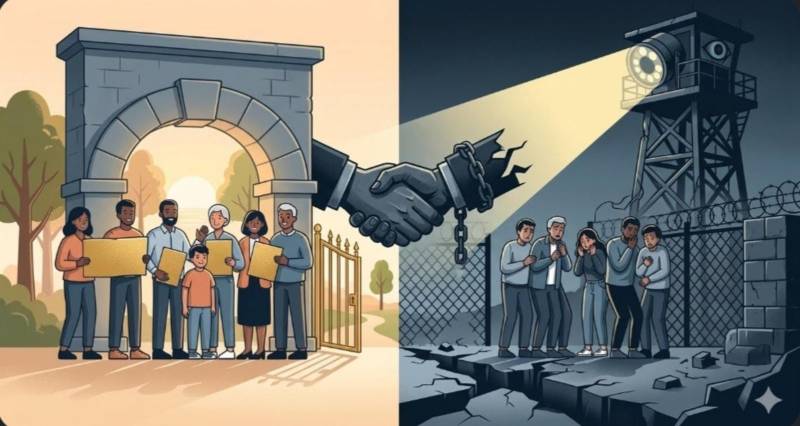
The former Federally Administered Tribal Areas (FATA) is not what the 25th Constitutional Amendment of 2018 aimed to transform it into. This amendment incorporated the area into the Pakistani Constitution, creating space for the establishment of institutions—a window of opportunity that proved to be brief, closing in August 2021, when NATO troops withdrew from Afghanistan and the Taliban regime was restored to power. The Taliban's return did not create an institutional vacuum in the merged districts; it exposed and exploited one that had never been filled.
To understand the merger's intentions, it is essential to examine how the governance process in the tribal areas differed before the amendment. The belt was administered under the Frontier Crimes Regulation (FCR), which remained in place for more than a hundred years and was characterized by collective punishment, administrative arrest, and discretionary justice rather than court-based justice. Pakistan continued this tradition between 1947 and 2018, maintaining the area under an exceptional legal and constitutional status for another 70 years. Eight years later, the legal change is complete, at least on paper. Institutional change has barely begun.
The vacuum did not remain empty. Since 2021, the number of insurgent attacks has increased in the merged districts as well as across the rest of Khyber Pakhtunkhwa, with militants also expanding their attacks to other Pakistani cities, including Islamabad and Karachi. The Tehreek-e-Taliban Pakistan (TTP) has resurged across most of the tribal belt, attacking security forces, tribal elders, and the few administrative officers working to keep civilian institutions together. However, they are not the only militant group that has increased its activities. In North Waziristan, several groups have retained their command structures. Jamaat-ul-Ahrar is carrying out attacks in Bajaur and Mohmand under its own leadership, whereas the Islamic State Khorasan Province occasionally launches attacks there, resulting in even more casualties in the same districts. Hence, the security landscape is far more fragmented than during the unified war a decade ago. There were more than 1,600 attacks in Khyber Pakhtunkhwa in 2025, the highest number in recent years and 48 percent higher than the previous year's total. The state has responded with operations, curfews, and intelligence-based actions. What it has not delivered is the one thing that would actually matter: functioning civilian institutions promised by the merger.
This gap is felt on the ground. Ibrahim Shinwari, a senior journalist who has covered the security, politics, and development of the merged districts for years, described the daily reality: "In Khyber, my home district, we cannot travel after sunset, not even me, despite being both a local resident and a journalist." He further added: "People are deeply concerned about the deteriorating security situation, but their frustrations extend beyond that... There is also growing distrust of the current government's perceived failure to prioritize the development of the merged districts and to ensure their meaningful integration into Pakistan's political, administrative, and economic mainstream."
This reality was evident in the events that unfolded in Bajaur in August last year. Bajaur is a newly merged district. It was formerly a tribal agency bordering Afghanistan, and throughout the year there had been an escalation in militant activities and a series of killings of tribal elders. In response, the administration decided to convene a peace jirga. The talks collapsed; the militants would neither surrender their weapons nor concede territory, and within days the attacks resumed. There was no police investigation to pursue, no prosecutor to act, and no court to which the community could turn. What the episode laid bare was not the failure of the jirga but the absence of any alternative.
Let us consider these institutions individually. The conversion of the Levies and Khassadars into a regular police force was legislated in 2019, but nearly 29,000 personnel were absorbed without the training, equipment, and investigative capacity that effective policing requires. Successive federal development budgets have had to allocate billions of rupees to build the police stations and posts that a functioning force needs. Regular courts now function in every merged district, but often in makeshift or converted premises; a former girls' college in Miranshah, for instance, was pressed into service as a judicial complex. Purpose-built complexes remain unfinished, some judicial officers still hear cases from adjoining settled districts, and many citizens must travel outside their own districts to seek justice. Case disposal is slow, and the number of prosecutions is even lower. Land records, whose absence remains one of the most consistent causes of conflict, still await systematic settlement, as required under the merger. Local governments—the institutions closest to disputes that later escalate—remain the weakest link in this chain.
A merger that exists in the Constitution but not in the courthouse, police station, or land records is not integration—it is citizenship on paper.
Set this institutional weakness against the current security picture of the region. Attacks in the merged districts are rising, and both civilians and security personnel are dying. The provincial police have requested an additional eight billion rupees to complete ongoing security infrastructure schemes in the merged districts after nearly all the funds released under this year's development program were spent before the projects could be completed. The need is real, and the request should be met. At the same time, however, we must recognize the underlying principle that follows: the urgent will always divert funds meant for the important. Operations consume money, jirgas absorb disputes, and the institutions meant to serve ordinary citizens—such as the judiciary, police, and local government—are postponed yet again.
The merger carried a financial promise alongside the legal and political ones. When the tribal areas were absorbed, the federation agreed to reserve three percent of the national divisible pool for the merged districts for ten years—roughly one hundred billion rupees annually—to finance the institutions the merger required. However, this promise has largely gone unfulfilled. Some provinces, notably Sindh and Balochistan, resisted surrendering a share of their receipts. The National Finance Commission (NFC) Award has not been revised to reflect the merger, leaving the country operating under a formula that expired in 2015. According to the Khyber Pakhtunkhwa government, of the roughly 360 billion rupees due to the merged districts by 2024, much never arrived. Fiscal default underlies the institutional one. Courts, police stations, and land settlement do not stall solely because of a lack of political will; they also stall because the money pledged to build them has not been delivered.
The security policy describes the correct sequence clearly: clear, hold, build, and transfer. In the merged districts, clearing and holding have been repeated at great cost. However, the building has not begun, and the transfer of military functions to civilian institutions has yet to occur. Until then, each round of clearing buys time rather than peace.
The problem is not with the jirgas. For many people, community dispute resolution is quicker, cheaper, and easier to understand than the formal justice system. As Shafiq Shinwari, a local businessman, observed, although the jirga offers "no right of appeal," unlike formal courts, many people continue to rely on it because the formal justice system in the merged districts remains slow and difficult to access. Malik Abdul Razaq Afridi, whom I recently interviewed for my research on jirgas, explained that people still take even family and property matters to the jirga because there is "no other effective alternative." This preference is rational and deserves respect. However, there is a difference between a citizen who chooses mediation over litigation and one who has no court worth approaching. The first is exercising a right; the second is being denied one. Our policy debates regularly conflate these two issues.
My interviews with young people in the merged districts, conducted for my recent book, suggest that this patience will not last for future generations. These young men and women are educated and connected, and they know their constitutional rights. They are proud of their *riwaj* (customs), but they do not accept that respect for tradition should cost them the institutions that every other district of Pakistan takes for granted.
None of these solutions is a mystery. The police transition must be completed properly. The eight billion rupees should be released but tied to a published, time-bound plan for police stations, training, and investigative capacity. Without this, development money will continue to be swallowed by operational emergencies, and nothing lasting will be built. Justice must be brought physically into the districts through judicial complexes, prosecutors, legal aid, and, above all, the settlement of land records. Community dispute resolution must not be treated as a substitute for the state's role. Jirgas and dispute resolution councils should instead be linked to courts, police, and administrative institutions, with safeguards for women and vulnerable groups, voluntary participation, and the right to appeal decisions. The aim is not to displace what people genuinely trust but to ensure that there is always something more to offer.
Bajaur showed what happens when the state relies on a single instrument and that instrument fails. The best tribute the state can pay to the elders who still step forward is to ensure that they are never again the only option. A merger that exists in the Constitution but not in the courthouse, police station, or land records is incomplete. The 25th Constitutional Amendment extended constitutional citizenship to the former FATA. Eight years later, for most people in the merged districts, that citizenship still exists mainly on paper.