

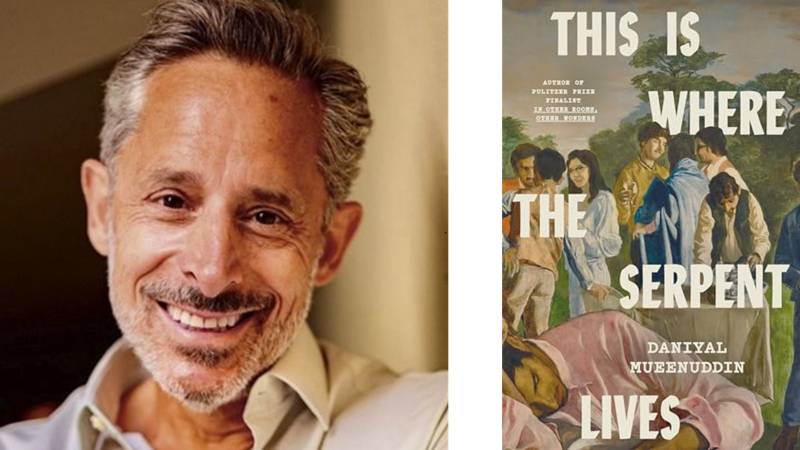
Daniyal Mueenuddin is a Pakistani-American author who writes in English. His short story collection In Other Rooms, Other Wonders has been translated into sixteen languages, and won The Story Prize and the Commonwealth Writers’ Prize and other honours and critical acclaim.
Born in Los Angeles, USA, he spent his childhood in Pakistan. At the age of thirteen, he moved back to the US, where he received higher education and worked as a journalist, director, lawyer, and businessman, before finally devoting his efforts to writing. This is where the Serpent lives is his second novel.
The book starts with the story of the orphan, Yazid in Rawalpindi who works for a tea stall and soon knows his ways around the city and is friends with the wealthy boys. He makes staunch friends with one of these boys, Zain, and even falls in love with his sister Yasmin, which has dire consequences and leads him to work for an army colonel and politician in the huge city of Lahore.
There are cleavages in the novel, as there are cleavages in Pakistani society : it’s fraught with inequality
We are then taken to the countryside, where Rustom, who has returned from studying abroad in America to look after his farm, and is dealing with the intricacies of local politics. He is too weak, he feels, for the local thugs and hires old goons to beat them up and when the situation gets out of hand, he travels to Lahore to his politically connected cousin Hisham to handle the situation for him. Hisham offers little help but instead his wife tries to matchmake for Rustom.
In the third story we are told about how two bother fall in love with Shahnaz and finally the elder one, Hisham is successful in winning her heart while the younger goes back to the U.S. and settles his life there.
The final chapter of the novel tells us about Saquib, the family staff member of Hisham and Shahnaz, their most loyal one, who is brought up on their lands and estate, does all their chores, is their most-trusted munshi and how he repays their kindnesses to him. We are even introduced to his wife Ghazala who is a strong female presence and a life of her own in the novel.
Daniyal Mueenuddin portrays the countryside and his characters in great detail and depth and the novel is a classic because it is almost as if you are transported into feudal Pakistan, one that ordinary citizens of Pakistan like myself often forget about, but one that exists even today. You are made aware of how class, culture and society leave some people marginalized while others benefit from the system of our country. And we made aware that even within that system, women are doubly marginalized and dependent on men. Both Shahnaz and Ghazala though portrayed as tough and confident at the end of the day are both dependent on their husbands to run their households. And Shahnaz’s husband Hisham is shown to be openly disloyal while she suffers, in the marriage.
There are cleavages in the novel, as there are cleavages in Pakistani society. It’s fraught with inequality. Those who provide labour are paid so much less, and sometimes never paid at all by feudal systems, for generations, and Mueenuddin points this out to us in a subtle manner. Everyone in the novel knows their place, and when Saquib tries to leave his station, he is taken to the Police Office and I would advise you to get a hand to the book to read his fate. I was left trembling when I read Mueenuddin’s story for I live in the same country and I know that even today many of my country people face the same old realities.
Mueenuddin is an elaborate story teller as the novel is laid out with extreme precision with all the characters having background stories and three-dimensional personalities. This is where the Serpent lives would make for a great TV show, if anyone is interested. As of today, it is an enthralling book, that anyone who wants to know the ‘real’ Pakistan must read. It makes one wonder, when will things change in Pakistan? Will they ever change? Or will we be caught in this feudal dynamic that suppresses the poor, women, the elderly for all time? These are questions we must ask ourselves today and questions our ruling elites must face as we are now in modern times, yet in the countryside in Pakistan, the old system remain firmly intact which means lack of freedom for so many. I fear this system is going to continue, and there is nothing we can do about it because no establishment wants to change the system, because it is also made of the same elite who suppress the masses. It is a sad state of affairs, which will continue. This is where the Serpent lives is a reminder of these massive inequalities within Pakistani and Mueenuddin is excellent at explaining them.