

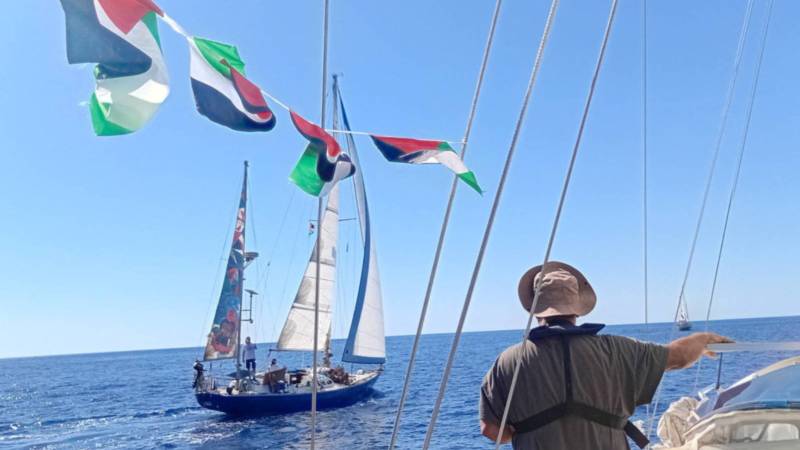
In the early hours of the beginning of October 2025, the Sumud Flotilla set sail to deliver humanitarian aid to Gaza, challenging Israel’s naval blockade that has been in place for a long time. The Mediterranean was turned into a dark scenario of confrontation amid the humanitarian vessels and Israel’s naval power. The Global Sumud Flotilla, named after an Arabic word, 'steadfastness', was on a sail to deliver medicines and solidarity to Gaza, but it met with the warships that became the rising day's headlines.
Moreover, the Global Sumud Flotilla is a civilian-led humanitarian maritime initiative to counter Israel’s naval blockades of the Gaza Strip, launched in mid-2025. It is primarily intended to deliver direct aid to the people of Gaza who are facing food shortages and humanitarian distress due to the ongoing war. On 1–2 October 2025, as Israeli naval forces intercepted the Sumud Flotilla, a peaceful movement of vessels, ripples were sent across the globe, and the world appears to be facing a dividing global opinion between those emphasising human urgency and those defending military enforcement.
Moreover, according to Al Jazeera, some of the vessels, including Sirius, Alma, and Adara, were boarded by the Israeli Navy, while one ship, the Mikeno, may have slipped into Gaza, but, unfortunately, contact was lost. Additionally, several activists are reportedly saying that drones, or shadow vessels, were already visible shadowing the convoy. Furthermore, the communication systems of a few vessels were jammed or disrupted, which was noticed earlier but condoned, according to flotilla organisers.
As the interception transpired, dozens of people faced detention, including high-profile individuals: Greta Thunberg (Swedish climate activist) and Mandla Mandela (Nelson Mandela’s grandson) were detained and transported to the Israeli port of Ashdod. Pakistan’s ex-senator Mushtaq Ahmed Khan was also caught up in the detentions.
While naval guns may rule the sea, tenacity rules the land, and people who do not give up are frequently the ones who write history
As Tel Aviv’s official statements indicate, the Global Sumud Flotilla was trying to breach an internationally recognised naval blockade and was seen as provocative. Moreover, some legal experts argue that the interception may constitute a breach of international law, but as the state is already under scrutiny for other contested actions, this event may not significantly alter its global standing.
As Israel calls it a necessary security measure, the world contemplates it as an act that deserves condemnation. The government of South Africa demanded the immediate release of activists, while Turkey reacted to it as “an act of terrorism”. Spain, Colombia, and Pakistan have called the Israeli acts illegal, and the US, a tacit supporter of Tel Aviv, has endorsed the latter’s right to enforce the Gaza blockade. Additionally, civil society groups marked the movements of the ships as a seminal step to demonstrate solidarity with Gaza, and even if the ships were stopped, the global unity in favour of the flotilla became increasingly visible. The international criticism that took the limelight is triggered by the disputed measures of Israeli forces under the pretext of lawful versus unlawful blockade.
Moving towards analysis, the incident sparks a debate between the legality of the naval blockade versus humanitarian principles. According to the United Nations and humanitarian law experts, blockades that obstruct essential aid may violate international humanitarian principles. Though Tel Aviv justifies its naval blockade, several experts argue that it contravenes humanitarian principles. The people of Gaza are surviving starvation and deaths due to a lack of access to food and drinking water. Quoting the UN Charter, International Humanitarian Law, and humanitarian frameworks like the Geneva Conventions and Red Cross principles, relief and humanitarian aid must not be prevented from being delivered timely manner to war-ridden areas. They emphasise that humanitarian activists must not be restricted from performing their tasks, and collective punishments of civilians must be obstructed.
Coming to a point, Israel’s policies appear to prioritise national security claims over international norms and humanitarian principles. Israel’s intercepting and deporting lawmakers, doctors, activists, and icons like Greta Thunberg displays internal fears: the fortified solidarity with Gaza might bring alienation to the country. Additionally, the Israeli navy demonstrated its ability to board any vessel it desired by displaying hard power across the Mediterranean. The concept of steadfastness, however, was carried by the flotilla and cannot be boarded or imprisoned. While naval guns may rule the sea, tenacity rules the land, and people who do not give up are frequently the ones who write history.
The Sumud Flotilla was about more than cargo; it displayed global solidarity with Palestinians and made it evident that Israel has strained its relations with several countries in the international arena and has deepened international criticism.
The incident might leave broader implications that are already visible in the diplomatic fallout between the countries, as well as in international law. The law is written to safeguard civilians and to ensure that the sea remains open to all passages safely. Yet a few wooden boats confronted a strong military power; the navy of Israel was caught stopping the boats carrying food and hope, and the world is forced to confront a paradox now: that the law bends to might, while morality drifts with the powerless.
A blockade and the forces may stop the boats, but solidarity still exists, and the idea does not seem to be sinking away in the near future; the Sumud Flotilla has already done what it set out to do—to remind the world that morality still floats even when humanity is intercepted. The Sumud Flotilla demonstrates that in a world of walls and warships, resilience still sails.