

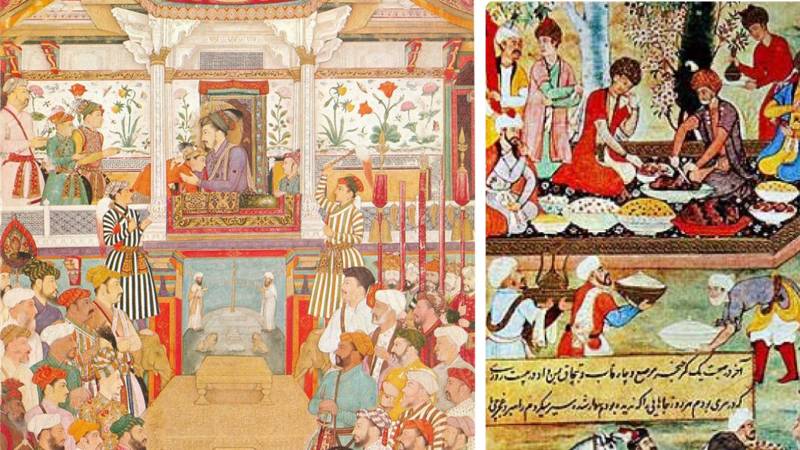
As some readers recover from indulgence in food while others rushed to make last-minute arrangements, and others still argue with family on Eid selfies, it might be interesting for them to compare their busy Eid routine with one of the most famous rulers in history. Let us take a trip to the past, to see how Shah Jahan, his court and the masses marked Eid in the 17th century.
As we know, Shah Jahan marked every aspect of his rule with a sense of majesty—and Eid was no exception. In his court, Eid-al-Adha was not merely a religious obligation but a grand spectacle of devotion, imperial power and cultural refinement.
The day began before dawn, as the emperor, dressed in the finest muslin and brocade, adorned with pearls and emeralds, made his way to the Jama Masjid in Delhi. The mosque, one of Shah Jahan’s own architectural masterpieces, served as the heart of Eid celebrations. Its vast courtyard, capable of holding thousands, would have been filled with nobles, scholars, soldiers, and commoners, all gathered to pray behind their ruler.
The Emperor’s journey to the Eid prayers would have been a grand procession. And the sight of the emperor, standing beneath the mosque’s towering domes and minarets, leading the faithful in prayer, was a powerful symbol of his role as both a spiritual and worldly leader.
After the prayers, the ritual of Qurbani—the sacrifice of an animal—was performed with great ceremony. Shah Jahan, like his predecessors, took part personally. The emperor would select a prime goat or sheep for the sacrifice. In a sight that might be familiar to the reader who goes to the Bakra market today, the imperial household had the finest livestock, often brought from distant regions, ensuring that only the best animals were offered in the name of Allah.
The meat was then divided and distributed meticulously: a portion for the royal household, a portion for the nobility, and the largest share for the poor. Shah Jahan took special care to ensure that no one in the imperial capital went hungry on Eid, a gesture that reinforced his image as a just and compassionate ruler.
The feasting that followed was nothing short of legendary. The imperial cooks, or bawarchis, worked for days in advance, preparing huge amounts of fragrant pulaos (pilaf), kebabs, rich kormas, and sweet delights like kulfi, sheer khurma and firni. We have a good idea of what the imperial menu would have looked like, thanks to the Aiwan-e-Nimat written during Jahangir’s reign, and the Nuskha-e-Shahjahani from the era of Shah Jahan.
The sight of the emperor, standing beneath the mosque’s towering domes and minarets, leading the faithful in prayer, was a powerful symbol of his role as both a spiritual and worldly leader
The food would have been rich but based on a somewhat different idea of spices and aromatics than the modern Pakistani kitchen. Saffron and turmeric would have been crucial, as would cinnamon. Garam masala, ginger and garlic would have been the main aromatics used. The tomato or the potato were not yet known, as these entered global cuisine only after the Spanish colonization of the Americas.
A common style of cooking in Shah Jahan’s era was to use slow heat, and a long finish on dum – a method that survives in modern-day “dum-pukht” dishes. We find recipes for dishes like “zeer biryan,” with the meat cooked in dum (steaming) on top of the rice. It might remind modern readers of the “Mandi” style of rice that is common in the Arab countries of the GCC region, and which is increasingly popular in Pakistan.
The emperor’s hakims would have worked in advance to decide on a menu suitable for the health of the ruler, his family and guests. These decisions varied according to weather, divination and personal considerations. Dishes were served with great pomp and ceremony.
The emperor hosted an elaborate darbar (court) where nobles, foreign ambassadors, and distinguished guests were invited to dine. Silver and gold platters laden with delicacies were laid out, while the atmosphere would have been carried a powerful scent of saffron, rosewater, and sandalwood. The servants and guards were treated to special meals on such occasions.
Gift-giving was an essential tradition in Shah Jahan’s court during Eid. The nobility vied for the emperor’s favour by presenting him with exquisite offerings—jeweled daggers (khanjar), handwoven carpets, rare manuscripts, and even exotic animals like Arabian horses or African cheetahs. In return, Shah Jahan bestowed khilats (robes of honor), gold coins, and promotions upon his most loyal courtiers. These exchanges were not just about wealth but about reinforcing the hierarchy and loyalty that held the empire together.
Beyond the palace walls, a city like Delhi, Agra, Lahore or Kabul transformed into a carnival. Markets overflowed with fabrics, perfumes, foods and sweets, while street performers—acrobats, puppeteers, and storytellers—entertained the crowds. For the common people, Eid under Shah Jahan’s rule was a rare opportunity to participate in the empire’s prosperity, if only for a short while.
Days before the festival, the bazaars expanded beyond their usual boundaries, with makeshift stalls spilling out into streets and squares. Farmers and herders from the countryside streamed in with bleating goats and fattened sheep, their pens turning the animal markets into a lively, chaotic scene where buyers inspected teeth and hooves. Cloth merchants unfurled bolts of fine mulmul (muslin), delicate brocades, and dyed silks, while perfume vendors sold rosewater, itr and sandalwood paste to families preparing for the festivities.
Children would have enjoyed sticky treats and wooden toys like whistles, spinning tops, and miniature animals; made by artisans who worked through the night to meet the demand. Beggars and holy men might have been seen making their way through crowds, while street performers—snake charmers, monkey-tamers, acrobats, and storytellers—drew rings of onlookers.
Despite the festive atmosphere, it is important to remember that the spiritual essence of Eid remained central. Shah Jahan, despite his love for grandeur, was a devout Muslim who observed ritual Islamic practices and would have placed great importance on the festival’s deeper meaning—the willingness to sacrifice in submission to God. He is known to have spent hours in private prayer and encouraged Quranic recitations and scholarly discourses in his court.
His daughter, Princess Jahanara, a deeply spiritual figure in her own right, often organized charitable distributions, ensuring that women and children, especially widows and orphans, were not forgotten in the festivities.
Shah Jahan’s reign was at the peak of Mughal cultural and architectural achievement, and Eid-al-Adha under his rule symbolized that golden age. Under the generous patronage of the imperial court, the act of sacrifice was elevated into a grand public ritual, and here even the poorest subject could feel – if only for a fleeting moment – the warmth of the emperor’s benevolence.