

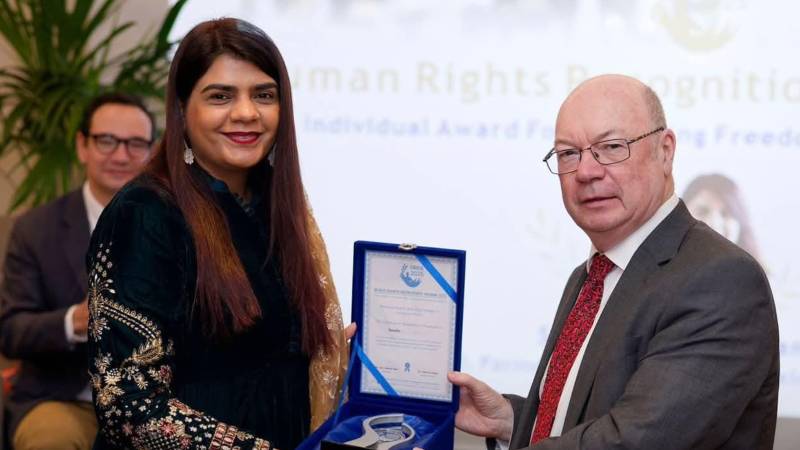
Sonal Dhanani, founder and chief executive officer of the Parindey Wellbeing & Development Foundation, has been awarded the Human Rights Recognition Award by the Geneva Centre for Human Rights and Dialogue. The award was presented at a ceremony held in Geneva, Switzerland, in recognition of her work in youth empowerment, peace-building, and digital civic engagement in Pakistan.
Karachi-born Dhanani has been widely acknowledged for initiating projects that engage young Pakistanis in inclusive dialogue, climate justice advocacy, and social cohesion. Her work focuses on creating safe digital spaces that encourage civic participation while addressing structural inequalities affecting youth.
Speaking to this correspondent, Dhanani said, “This recognition belongs to the countless young people who dare to speak up for a more just and peaceful Pakistan. Together, we are shaping a digital future where every voice can contribute to climate action and community resilience.”
Founded in 2018, the Parindey Wellbeing & Development Foundation works across Pakistan to address social injustices related to mental health, gender equality, and peace-building. Through innovative online platforms and grassroots initiatives, the organisation promotes civic dialogue and equips young people with tools to lead community-based change.
Dhanani’s recent research, funded by the Association for Asian Studies, was presented earlier this year at a conference in South Korea. The study focuses on decolonising climate information in Pakistan by integrating indigenous knowledge and local community perspectives into climate discourse, to make climate policy more accessible and effective for vulnerable populations.
The Human Rights Recognition Award underscores the growing international visibility of Pakistan’s youth-led digital rights and development sector. Dhanani’s work demonstrates how technology, when paired with inclusive policy frameworks and community participation, can advance human rights, gender equality, and climate justice.
Parindey’s initiatives have reached thousands of young people across the country, providing mental health support, gender-sensitive programming, and platforms for peaceful civic engagement. The foundation continues to expand its network through partnerships with local non-governmental organisations, academic institutions, and international donors.
Representatives from the Sindh Human Rights Commission and several civil society organisations congratulated Dhanani on the achievement, describing it as a moment of pride for Pakistan and a testament to the country’s emerging youth leadership on global human rights platforms.