

“The world is in greater peril from those who tolerate or encourage evil than from those who actually commit it”—Albert Einstein
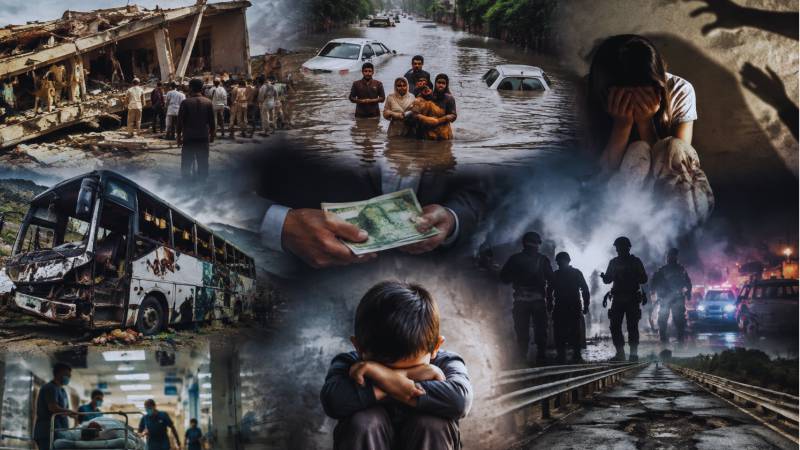
The greatest danger to society is not that evil exists, but that good people gradually cease to be disturbed by it. A house collapses, burying an entire family beneath its own roof. Torrential rains and flash floods claim more lives. A child is abused. Another woman is murdered in the name of honour. A bus plunges into a ravine because someone ignored the most elementary safety standards. Another corruption scandal erupts. Another act of terrorism is reported. Another life is lost because a hospital lacked medicines, an ambulance arrived too late or a bridge should never have remained open.
Headlines change, victims change, geography changes but our response does not. For a few hours we express outrage, post condolences on social media, forward videos and render customary prayers. Television channels organise noisy debates, politicians exchange accusations, officials announce inquiries, committees are formed and promises are made. By the following morning another story replaces the previous one and the earlier one takes backstage. None of these tragedies frightens as much as this disturbing pattern. The abnormal no longer appears abnormal. Death has become a statistic. Corruption has become routine. Violence has become breaking news. Negligence has become a way of life. Most alarming of all, indifference has quietly become a social habit.
The greatest danger confronting a society is not inflation, political instability or even crime. It is the gradual erosion of its moral sensitivity. A society begins to decline the day preventable tragedies cease to provoke collective introspection and become merely another item in the daily news cycle. Every civilisation faces adversity. Floods, earthquakes, epidemics, tsunamis and accidents have accompanied humanity throughout history. What distinguishes healthy societies from declining ones is not the absence of tragedy but the refusal to accept preventable suffering as inevitable.
Some societies investigate every major disaster until lessons are learnt. Regulations are strengthened. Institutions are reformed. Accountability is enforced. Public memory remains alive because every lost life is considered worthy of remembrance. Other societies merely move on and we have become remarkably skilled at it.
A collapsed building is blamed on fate rather than illegal construction, weak regulation or official negligence. Flood devastation is attributed entirely to nature while forgotten drainage systems, encroachments and poor urban planning escape scrutiny. Road accidents become the fault of destiny instead of reckless driving, defective roads or ineffective enforcement. Even avoidable deaths are frequently wrapped in the comforting language of inevitability. Fate becomes the easiest refuge for human irresponsibility. Yet no civilisation has ever progressed by confusing negligence with destiny. What is more concerning is the subtle psychological transformation taking place within us. Human beings are not born indifferent. Compassion is among our most natural instincts. We instinctively comfort a crying child, rush to help an injured stranger or grieve with a bereaved family. Indifference is acquired. Repeated exposure to suffering without meaningful accountability gradually desensitises individuals. The first tragedy shocks us. The tenth disturbs us less. By the hundredth, we scarcely notice.
Even avoidable deaths are frequently wrapped in the comforting language of inevitability.
That is how societies lose not only their emotional sensitivity but eventually their moral compass. History repeatedly demonstrates that great civilisations seldom collapse overnight. Their decline usually begins long before their institutions fail. It begins when ethical standards weaken, when public outrage becomes selective, when truth is sacrificed for convenience and when citizens gradually accept as normal what previous generations would have regarded as intolerable.
No law can compel compassion. No constitution can legislate conscience. No government, however efficient, can save a society whose citizens have ceased to care. This is not merely a failure of public administration. It is a failure of collective consciousness. Every tragedy should force us to ask uncomfortable questions. Could this have been prevented? Who should be held accountable? What institutional weaknesses permitted it? What must change before another family suffers the same fate? Instead, we often ask only one question: What is the next headline?
Perhaps this explains why similar disasters continue to recur. Buildings collapse because lessons were never learnt from previous collapses. Floods become deadlier because recommendations made after earlier catastrophes remain buried in official files. Corruption survives because yesterday's outrage fades before today's scandal emerges. Violence persists because collective memory has become painfully short.
Societies that forget too quickly are condemned to repeat their mistakes indefinitely. The problem is not merely institutional failure. It is moral fatigue. When citizens become emotionally exhausted, outrage becomes temporary, sympathy becomes performative and accountability becomes negotiable. That is a dangerous condition for any nation. The true measure of a society is not how loudly it celebrates its achievements but how deeply it mourns avoidable suffering and how determined it remains to prevent its repetition. Perhaps we need to pause before rushing to the next headline. Perhaps we need to recover the ability to be genuinely shocked. Not because perpetual outrage is healthy, but because indifference is fatal.
The greatest threat to any civilisation is not the criminal who commits an atrocity, nor the corrupt official who neglects his duty, nor even the natural disaster that exposes institutional weaknesses. It is the ordinary citizen who gradually ceases to be disturbed by any of them. A society does not collapse the day corruption begins, the day injustice is committed or the day innocent lives are lost. It begins to collapse the day these things cease to shock us. Perhaps the question before us is not whether our institutions need reform. They certainly do. The more urgent question is whether our conscience still possesses the capacity to awaken. For if we have indeed normalised the abnormal, then the gravest crisis confronting us is not political, economic or administrative. It is profoundly human.