

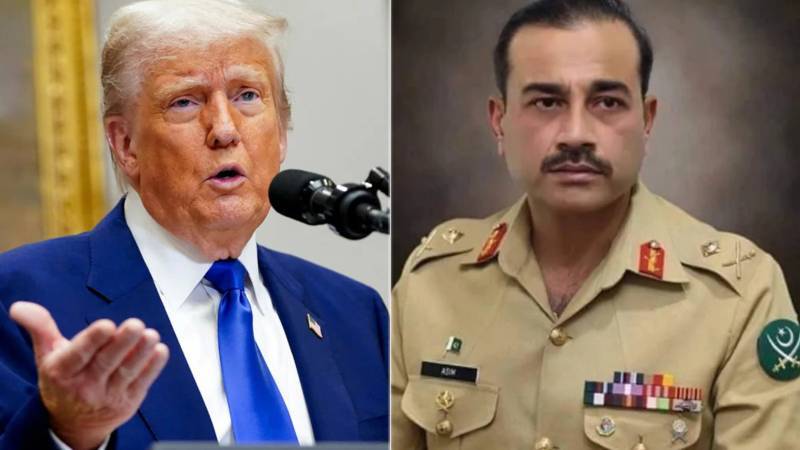
It was the first week of March this year when newly elected US President Donald Trump, during his first address to Congress, said something that left many in Pakistan stunned.
“And I want to thank especially the government of Pakistan for helping arrest this monster,” he stated, revealing the capture of an Afghan national allegedly involved in planning the deadly Kabul airport bombing of August 2021.
The statement was surprising on many levels—especially for Pakistan’s military establishment, which had been under immense criticism ever since the imprisonment of former Prime Minister Imran Khan. A strong narrative had been built in Washington against the military, largely due to the lobbying efforts of Khan’s loyalists. These campaigns had successfully convinced several US lawmakers to submit resolutions against Pakistan’s military leadership, demand sanctions, and call for suspension of aid in protest at Khan’s arrest.
In that context, Trump’s words were the first public gesture of goodwill from his administration towards Pakistan. While some members of Congress continue to voice criticism of Pakistan's internal political situation—particularly in relation to Khan’s imprisonment—the tone from the White House marked a shift.
It also did not go unnoticed that only weeks before this statement, India’s Prime Minister Narendra Modi had visited the US and held meetings with the newly elected president. Even so, it was Pakistan that managed to seize the diplomatic moment and transform it into a broader engagement.
The Pakistani military and government quickly capitalised on Trump’s comments, moving to deepen cooperation not just on counterterrorism but also in areas like trade, mineral exploration, and energy. What looked like a sudden breakthrough was, in fact, the outcome of months of quiet preparation. This groundwork appeared to culminate in Trump’s own announcement on social media: “We have concluded a deal with Pakistan. US shall work together to develop Pakistan’s oil reserves.” In a characteristic jab at New Delhi, he added, “Someday, Pakistan may be selling oil to India.” The comment not only caught attention across South Asia but also underscored the strategic recalibration underway.
How did Pakistan pull off this unexpected diplomatic comeback? What changed—and who made it happen?
This wasn’t simply a matter of luck. According to Elizabeth Threlkeld, Senior Fellow and Director of the South Asia Programme at the Stimson Centre, Pakistan had laid the groundwork well before Trump’s re-election. It had deliberately positioned itself as more than just a traditional security partner. Islamabad had quietly engaged with the Trump team on shared strategic interests, including critical minerals, cryptocurrency regulation, agriculture, and energy cooperation. At a time when global alliances were being reshaped, Pakistan presented itself as a multidimensional partner.
Beyond policy, symbolism also played a critical role. While India had rejected any US involvement in reducing border tensions with Pakistan, Islamabad chose to publicly acknowledge and thank the Trump administration for facilitating a ceasefire. It even nominated Trump for the Nobel Peace Prize—a symbolic but calculated gesture that resonated within a White House known to value public validation. When tensions escalated again between Washington and Tehran, Pakistan quietly offered itself as a potential backchannel, drawing on its longstanding ties with Iran.
With tensions between the US and China relatively less volatile at the moment, Pakistan may find greater room to balance both relationships without having to pick sides
Threlkeld, a former US diplomat who previously served in Pakistan, says that while US interest in mineral exploration and digital infrastructure is clearly growing, both countries must remain cautious of ongoing security and logistical challenges.
She also noted that Pakistan’s deepening relationship with China remains a central variable in Washington’s strategic calculations. However, with tensions between the US and China relatively less volatile at the moment, Pakistan may find greater room to balance both relationships without having to pick sides.
While Threlkeld highlighted the broader geopolitical implications of this shift, Pakistan’s political leadership has begun to frame this evolving partnership in more long-term and economic terms. Speaking at the Atlantic Council, Deputy Prime Minister and Foreign Minister Ishaq Dar described the changing dynamic with Washington as a shift away from transactionalism. He portrayed it as a strategic alignment focused on investment, innovation, and economic cooperation.
Officially, the US has signalled its growing interest through statements and engagements: Congressmen visiting Field Marshal Munir, the Atlantic Council endorsement of broad-based cooperation, and the strategic oil-deal announcement from the White House.
These moves set the stage for what may be the most significant gesture yet: on 18 June 2025, President Trump hosted Field Marshal Asim Munir at the White House for a private luncheon—the first time a Pakistani military chief has been received in such a setting without accompanying civilian officials. Trump described it as “an honour” and credited Munir with helping avert a potential war with India during the May conflict. Both sides also discussed Iran and broader strategic ties, according to news reports.
Senator Faisal Vawda, a former federal minister assumed to be close to the ‘powerful quarters’ of the country, provided more insight into the security dimension of the reset. “For the first time in decades, Pakistan is engaging with the US on a footing of mutual respect—not under pressure or conditionalities,” he said. “We’re no longer in the ‘do more’ phase. This is a forward-looking, strategic partnership.”
The senator, while pointedly dismissing the role of the civilian government, credited Pakistan’s military leadership—particularly Field Marshal Asim Munir—for orchestrating the shift. He described it as “one of the most constructive diplomatic resets in recent memory.”
He added that under Trump’s new term, Pakistan has launched proactive cooperation with the US in key sectors including cryptocurrency regulation, digital governance, oil and mineral exploration, and bilateral trade.
“This isn’t the Pakistan of the past when Pakistan was headless,” said former minister Faisal Vawda. “We’re not just reacting to global events anymore—we’re helping shape them, as this nation now has a head in the face of Field Marshal Asim Munir.”
Perhaps most notably, Vawda suggested that during Pakistan’s recent meeting with the US president, military leadership may have raised the possibility of facilitating de-escalation between Washington and Tehran. With trust between the two countries growing, he hinted at Pakistan positioning itself for a discreet mediatory role.
Vawda, a former federal minister closely followed by national media for insights into Pakistan’s power corridors, claimed that Islamabad and Washington are currently engaged in negotiations over a long-term strategic defence agreement—a development he described as unprecedented. He asserted that such an agreement has not been pursued in the past four decades, and, if finalised, it would shape bilateral defence cooperation for the next 40 years.
“This was never achieved—not during the Cold War, nor at the height of the War on Terror,” he said. “I can’t disclose all the details at this point, but the scope and seriousness of these discussions are unlike anything we’ve seen before.”
The US State Department has yet to confirm any upcoming defence pact or visit by Pakistan’s military leadership.
According to Vawda’s recent interviews, Field Marshal Asim Munir is expected to visit the United States in the coming days. Speaking to The Friday Times, the senator confirmed the upcoming trip, describing it as “historic and unprecedented,” with the possibility of a visit to the Pentagon. He added that a reciprocal visit by a senior US delegation is also reportedly in the works—a sign, he said, of the continuity and seriousness behind this renewed diplomatic engagement.
On a lighter note, he added that Field Marshal Munir will also be seen watching cricket matches on this trip.
Multiple federal ministers were approached repeatedly for comment on the evolving US-Pakistan ties, but none had responded by the time this story was filed.