

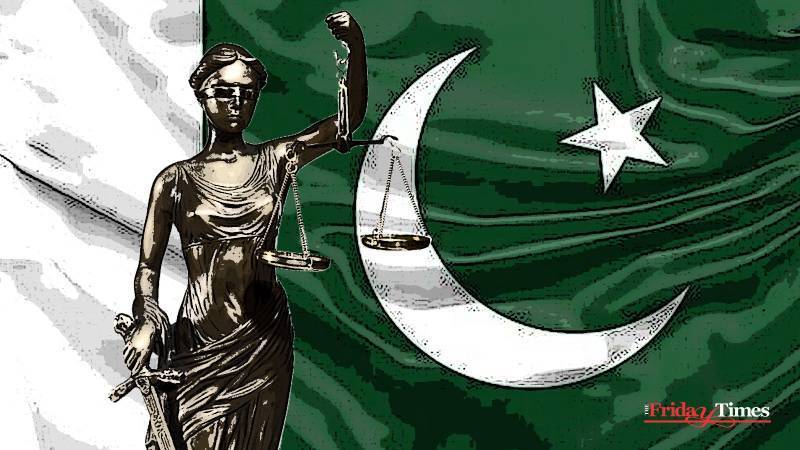
In Pakistan, the courtroom too often resembles a stage where power performs its familiar acts. Instead of being the Constitution’s last line of defence, the judiciary has frequently played the role of enabler, validating extra-constitutional adventures, disqualifying elected leaders with almost moralistic fervour, and remaining conspicuously silent when uniformed authority strained the constitutional order. This pattern, entrenched since the early years of the republic, has hollowed out judicial independence and reduced the law to a tool of convenience.
The political cost is immense. When benches invoke elastic doctrines to legitimise abrogations of the Constitution—as happened with the “Doctrine of Necessity” they do not merely decide a case; they disrupt the democratic order itself. Political disputes that should be resolved in Parliament are instead judicialised and often judicially terminated. Governments fall not by the ballot but by the bench. This is antithetical to Article 17 of the Constitution, which guarantees the right to political association, and to the democratic ethos that the judiciary is duty-bound to protect.
The rule of law suffers no less. Article 4 declares that every citizen shall be dealt with in accordance with the law, and Article 25 enshrines equality before the law. Yet the lived reality is selective enforcement: some actors remain perpetually insulated, while others, usually civilian governments, face relentless scrutiny. Courts continue to cloak such outcomes in procedural dignity, but what results is less justice and more spectacle. As Article 10A guarantees the right to a fair trial, the persistence of preordained verdicts makes that constitutional promise ring hollow. In effect, justice is staged, not served.
A judiciary stripped of independence is not a neutral institution caught in political storms; it is the storm itself
Recent events illustrate the problem vividly. When the Sindh High Court dismissed petitions concerning the academic credentials of a sitting judge, the bench insisted the matter was non-maintainable. The judge himself pleaded that he had received no prior notice from the concerned university and should at least be heard as an affected party. Yet the proceedings ended abruptly, sparking walkouts, slogans, and scenes that belonged more to a political rally than a courtroom. Even if procedurally correct, the optics were disastrous: a judiciary adjudicating questions of its own credibility in a way that appeared evasive rather than transparent. In that moment, the court offered not resolution but a performance—confirming the suspicion that law has become a self-protective façade.
The societal consequences of this dysfunction are stark. When citizens perceive the courts as partial or theatrical, they turn elsewhere for justice: jirgas, pirs, feudal patrons, or even mobs. These parallel systems operate outside the guarantees of Articles 8–28, which enshrine fundamental rights, and too often lead to outcomes marked by discrimination, coercion, or outright violence. In this vacuum, the state’s promise of justice becomes illusory, and civic trust disintegrates.
Nor is this dysfunction accidental. The internal incentive structure has long rewarded compliance and punished defiance. Judges who lent jurisprudential cover to extra-constitutional actions often received extensions, promotions, or post-retirement appointments. Those who resisted echoing the spirit of Chief Justice Dorab Patel’s dissent against martial law validation were marginalised or forced into early exits. This economy of carrots and sticks has nurtured a culture of anticipatory obedience, where conformity is currency and integrity a professional hazard.
The perils of such a compromised judiciary are profound. They include governments toppled through verdicts rather than votes; elites protected by impunity; the hollowing out of the rule of law; and citizens abandoning formal courts altogether. Article 189 makes the decisions of the Supreme Court binding on all, but when those decisions themselves seem products of expediency, the authority of law is diminished rather than reinforced. The judiciary, in such moments, ceases to be the guardian of the Constitution and becomes its most pliant interpreter.
The conclusion is unavoidable. A judiciary stripped of independence is not a neutral institution caught in political storms; it is the storm itself. It reduces the Constitution to origami, folds the rule of law into ritual, and replaces justice with its performance. The result is a republic in which law is dressed in its ceremonial attire but drained of its moral force, a façade of justice masking the triumph of power.