

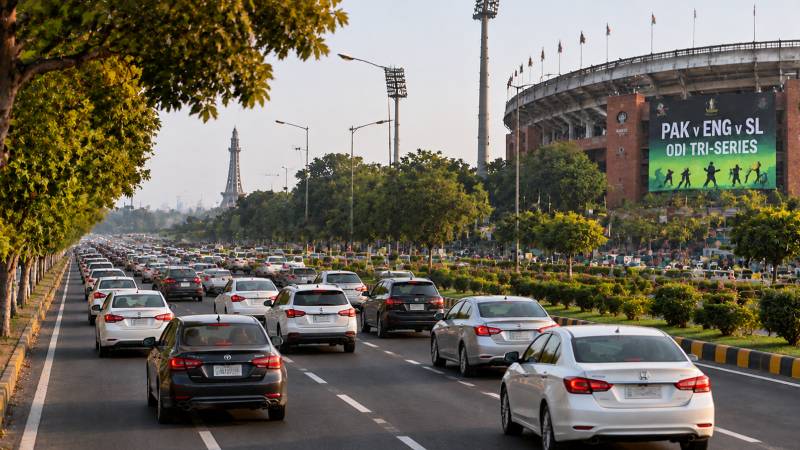
A city that must imprison its residents to entertain its guests has confused hospitality with hostility
When the entertainment of a few becomes the torment of thousands, it is no longer a celebration of sport but an indictment of governance. How many times must the citizens of Lahore be made to suffer before those entrusted with governing them realise that a city is not merely a collection of roads, buildings and recreational facilities?
It is a living organism, sustained by millions of human beings whose time, mobility, livelihood, health and personal commitments deserve consideration. Yet, whenever an international cricket tournament arrives, Lahore appears to undergo a strange transformation. Its residents become secondary occupants of their own city, their daily routines held hostage to the movements of a handful of visiting players.
In February 2024, this writer drew attention to precisely this predicament in an article titled On Sporting Events and the Public. The argument was simple: cricket is a source of entertainment, not a justification for making the lives of ordinary citizens miserable. More than two and a half years later, one is compelled to revisit the same subject, except that the situation appears to have deteriorated rather than improved. How unfortunate that what should have been an occasion for celebration has increasingly become a source of resentment!
The One-Day International tri-series featuring Pakistan, England and Sri Lanka once again brought the familiar spectacle of barricades, diversions, security convoys, traffic congestion and bewildered motorists. A journey that should ordinarily take twenty minutes consumed more than fifty. Multiply these additional thirty minutes by the number of people affected, and the magnitude of the collective waste becomes staggering. Unfortunately, there appears to be no official accounting of the economic and human cost imposed upon the city.
Consider the plight of a parent attempting to collect a child from school, an employee struggling to reach the workplace, a student appearing for an examination, or a daily-wage earner whose income depends upon reaching a destination on time. Their journeys are neither recreational nor optional. Yet each is expected to accommodate restrictions imposed in the name of security and sporting hospitality.
Far more disturbing is the predicament of ambulances caught in the resulting congestion. An emergency vehicle is not simply another automobile seeking passage. It may be carrying a patient whose survival depends upon minutes rather than hours. Can any administrator, police official or organiser confidently guarantee that the disruption caused by their arrangements will never cost someone a life? And if such a tragedy occurs, who will accept responsibility?
The official explanation invariably revolves around security. Nobody disputes the need to protect visiting teams, spectators or participants. Pakistan has worked hard to restore international cricket, and the return of foreign teams is undoubtedly welcome. However, security cannot become an unquestionable excuse for administrative excess, nor can the convenience of sporting celebrities automatically override the fundamental rights of citizens. The Constitution of Pakistan guarantees freedom of movement under Article 15, subject to reasonable restrictions imposed by law in the public interest. The question, therefore, is not whether restrictions can ever be justified. It is whether their scope, duration and consequences are reasonable, necessary and proportionate to the objective sought. Does the movement of a cricket team necessitate the effective disruption of entire neighbourhoods? Are alternative arrangements genuinely explored, or does the easiest administrative option invariably prevail? There is something fundamentally disturbing about a system in which ordinary people are expected to endure extraordinary inconveniences without explanation, compensation or meaningful recourse.
Security cannot become an unquestionable excuse for administrative excess, nor can the convenience of sporting celebrities automatically override the fundamental rights of citizens.
A person stranded in traffic cannot approach the authorities and demand reimbursement for lost working hours. A shopkeeper whose customers cannot reach the premises must absorb the loss. A schoolchild delayed by road diversions has no remedy. These individual inconveniences may appear insignificant to those enjoying official vehicles and unobstructed routes, but collectively they represent a serious failure of governance.
The irony becomes more pronounced when one considers the resources deployed to facilitate such events. Hundreds of personnel, security vehicles, administrative officers and elaborate logistical arrangements are mobilised to ensure that everything proceeds according to schedule. Yet the schedules of ordinary people are treated as infinitely adjustable. Apparently, the punctual arrival of cricketers is an administrative priority, while the timely arrival of citizens at hospitals, schools, offices and homes is their personal problem.
Why should the people of Lahore repeatedly pay this price? One cannot help wondering whether the authorities have seriously examined practical alternatives. The suggestion made in February 2024 remains pertinent: why not develop secure residential accommodation for visiting teams within the stadium complex or its immediate secured precincts, thereby minimising repeated movements between hotels and the playing venue? Such an arrangement would require planning, investment and feasibility assessment, but surely these are preferable to imposing recurring disruption upon an entire population.
A Lahore-based entrepreneur planned to build a five-star hotel with a helipad for aerial transportation of players, in the vicinity of Gaddafi Stadium and had brought in millions of dollars for the project. Yet, despite the scale of the proposed investment, regulatory hurdles ultimately killed the venture before it could take off. Other possibilities include carefully coordinated movement schedules, genuinely limited restrictions, protected emergency corridors, transparent advance notifications and independent assessment of traffic-management plans. The administration’s responsibility should be to minimise inconvenience, not merely announce alternative routes that may themselves become congested.
More importantly, why is the Pakistan Cricket Board not required to account for the public costs associated with its events? International cricket generates commercial benefits through broadcasting rights, sponsorships, ticket sales and related activities. While the precise distribution of revenues and public expenditure requires disclosure, the principle is straightforward: the benefits of a commercially organised sporting event should not be enjoyed without recognising the burdens imposed upon the host city's residents.
This raises another uncomfortable question. Would such sweeping inconvenience be tolerated in cities where citizens routinely demand accountability for administrative decisions? Major sporting events are organised across the world without treating the ordinary population as an expendable inconvenience. Pakistan must develop the capacity to do likewise rather than presenting avoidable disruption as an unavoidable consequence of hosting international teams.
Indeed, the deterioration of everyday civic life cannot be separated from a broader culture in which authority is exercised with insufficient regard for those affected by it. Roads are blocked for official movements, public spaces are commandeered for political occasions, and traffic is disrupted for assorted displays of power. Cricket has merely become another addition to this unfortunate catalogue. The problem is not the game. Cricket has entertained generations, produced extraordinary talent and brought moments of collective happiness to a country desperately in need of them.
The problem arises when the pursuit of entertainment becomes so administratively intrusive that the enjoyment of some is purchased at the expense of suffering of others. A sporting event ought to unite a city, not divide it between privileged travellers enjoying unhindered passage and ordinary citizens trapped behind barricades. Perhaps the most troubling aspect is the gradual normalisation of this conduct. Citizens complain, traffic eventually clears, the matches conclude, and the episode is forgotten until the next tournament arrives. No meaningful public evaluation follows. No institution appears particularly anxious to establish whether better arrangements could have prevented the inconvenience. The cycle repeats because those responsible for the decisions rarely experience their consequences.
Lahore deserves international cricket, but its residents also deserve freedom of movement, access to essential services and respect for their time. These objectives are not mutually exclusive. They become incompatible only when administrative imagination gives way to bureaucratic convenience.
The authorities must understand that hospitality towards visiting teams cannot be measured by the hardships inflicted upon the host population. Nor should citizens have to choose between supporting their national cricket team and protecting their own fundamental rights. If international cricket can only be celebrated by turning Lahore into a temporary prison, perhaps it is not the citizens who need to learn patience, but the authorities who need to learn governance. And until that lesson is learned, every boundary struck inside the stadium will carry an uncomfortable irony: outside its walls, thousands of citizens remain unable to cross boundaries imposed upon their own freedom.