

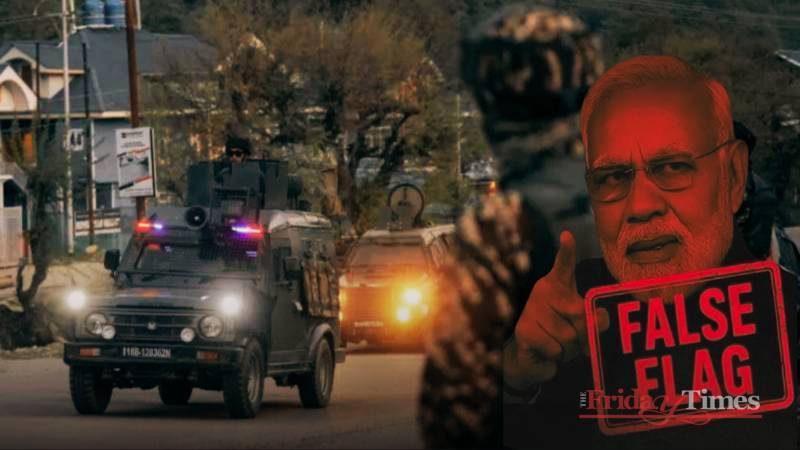
The Hindustan Times reported on 5 May that “India cuts off water flow to Pakistan from dam on river Chenab”. The rest of the Indian media proudly echoed the news, while Godi media anchors celebrated it as a significant victory — an act designed to parch Pakistani farmlands.
The dam in question is Baglihar, built on the Chenab River in violation of the Indus Waters Treaty (IWT). Construction began in the 1990s and it became operational in 2008. When Pakistan raised concerns with the World Bank — the treaty’s guarantor — India defended its position by claiming that the dam was merely a run-of-the-river power project and did not obstruct water flow to Pakistan. Yet, India’s recent manoeuvre lays bare its true intent.
India’s intentions were never clean. Nor, indeed, was its narrative.
Over the past two decades, left-leaning intellectuals in Pakistan have repeatedly praised India for its democracy, its freedom of expression, and for supposedly standing on the right side of history. Having burned much midnight oil to construct and uphold this narrative, they may now find it difficult to criticise India — a country where dissent is criminalised, minority rights are scant, and a well-oiled propaganda machine operates under the banner of Godi media.
It was these very same Pakistani leftist intellectuals who insisted that Pakistan was the aggressor in all four wars with India — 1948, 1965, 1971, and 1999 — and that India was a peace-loving, victimised nation. However, the news cited at the beginning of this piece should be sufficient, for Pakistanis and the wider world, to grasp one fundamental point: how provocations by India often compel Pakistan to consider a first strike.
Let us now consider a hypothetical scenario.
Those familiar with Pakistan’s geography will know that an Indian military build-up along the Rajasthan–Cholistan border, near Pakistani cities such as Bahawalpur, Fort Abbas, and Sadiqabad, would pose a grave threat. This is the narrowest stretch of the country along the north–south axis. If Indian forces were to advance roughly 50 miles into Pakistani territory, they could sever the country’s main artery — the N5 highway — linking Lahore and Karachi, thereby isolating major cities including Multan, D.G. Khan, Sukkur, and Nawabshah.
In such a scenario, the Pakistan Army — in my view, though I do not claim to be an expert on military formations — would likely not wait for an outright invasion. Rather, it would launch a pre-emptive strike. The Indian narrative, in that case, would predictably be: “We were merely conducting routine military exercises when Pakistan attacked.”
A possible missile strike to disable these infrastructures — an action that would provide India with the perfect excuse to cry victim before the world, and for future historians to declare, once again, that Pakistan initiated the war
Similarly, before closing the Baglihar Dam, India first emptied the reservoir, without prior warning, into Pakistan. Of course, once it held the IWT in abeyance, it was under no obligation to consult. The newspapers reported this was done for ‘de-silting’, in order to maximise future water storage. The Hindustan Times quotes: “We have closed the gates of the Baglihar hydel power project. We had done de-silting of the reservoir and it has to be refilled. The process was started on Saturday,” said a second official, who declined to be named. Similar operations have been planned for the Kishanganga Dam on the River Jhelum. The intentions are clear — to punish Pakistan by using these “run-of-the-river” dams, ostensibly built for hydropower generation. In the absence of the IWT, the World Bank cannot intervene.
What options does Pakistan have?
A possible missile strike to disable these infrastructures — an action that would provide India with the perfect excuse to cry victim before the world, and for future historians to declare, once again, that Pakistan initiated the war. India, we would be told, was innocent — the perennial victim. Pakistan started four wars previously, and now, they would claim, it has launched another — against an India that was in mourning over the 26 tourists killed in Pahalgam on 22 April.
This is how narratives are constructed. This is how framing is done — by repeating a lie, day and night.
Sometimes, however, a nation’s own stories betray its deceptions. Emergency, an Indian film available on Netflix, is one such example. The film dramatises Prime Minister Indira Gandhi’s political struggle and the events that led to her declaration of a state of emergency — a move that suspended key constitutional rights and consolidated authoritarian control.
Within this narrative, the military intervention in East Pakistan and the subsequent creation of Bangladesh is portrayed as Indira’s crowning achievement, transforming her into a national hero. As unrest escalates in East Pakistan, she is shown as reluctantly considering military action. Yet, geopolitics plays a crucial role: Pakistan, at the time, was firmly in the Western bloc as a member of SEATO and CENTO. Seeking legitimacy for her plans, Indira Gandhi travels to Washington to secure support from President Nixon, who declines. She then approaches French President Georges Pompidou, who offers a different kind of reassurance — France would remain neutral, but only if Pakistan were to strike first.
Indira Gandhi relayed this to her generals, who then orchestrated a scenario in which Pakistan would be compelled to launch the first strike. Thus, the war began — and the narrative of Indian victimhood was born.
That same script is now being dusted off.
But this time, the geopolitical chessboard has shifted. India is no longer a non-aligned state navigating between superpowers — it is now a strategic partner of the United States, tasked with counterbalancing Chinese influence in the region. Pakistan, by contrast, finds itself defending Chinese interests, deepening its strategic alignment with Beijing.
In other words, the Modi government is attempting to apply an outdated playbook to an entirely altered world order. This contradiction was on full display when India’s Foreign Minister, S. Jaishankar, recently lamented: “We need partners, not preachers.”
No, Mr Jaishankar — what India needs is a new script. Your playbook is quite outdated – but perhaps you are too old to learn new tricks!