

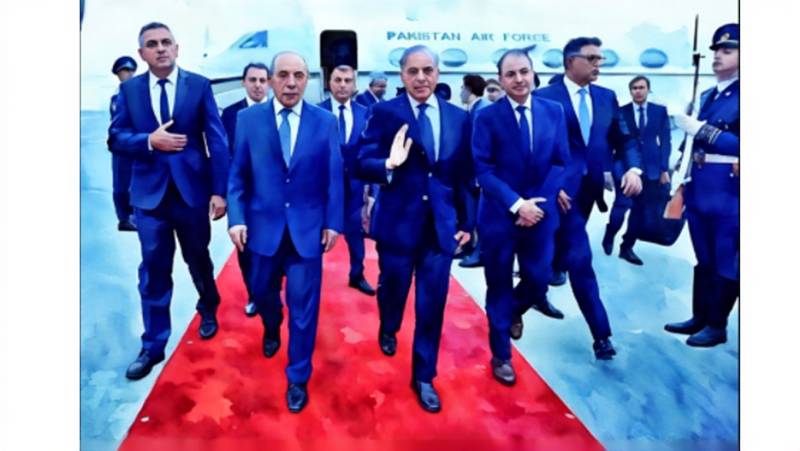
The impression one gets from reading some of the recent commentaries in Pakistani papers is that a golden age has dawned.
Much of this optimism is founded in how the US maintained neutrality between India and Pakistan soon after the four-day aerial encounter in May in which several fighter jets of the Indian Air Force were shot down by the Pakistan Air Force. Soon thereafter, the American president took full credit for brokering a ceasefire between the two warring siblings, saying he had stopped a nuclear war from breaking out in the Subcontinent that could have engulfed millions, and not just in the subcontinent.
In return, the Prime Minister of Pakistan nominated the American President for a Nobel Peace Prize, while his counterpart in India did not. In fact, the latter said that no third party was involved in brokering a ceasefire. Adding insult to injury, he left open the prospect of resuming hostilities with Pakistan at some time in the future, alleging it continued to harbour terrorists.
Pakistan’s army chief, a four-star general, thought this was a triumphant moment and had himself promoted to the rank of Field Marshal, becoming only the second Pakistani officer to hold a five-star rank. Then, out of the blue, he was invited to meet in the Oval Office with the US President in June. After the two-hour meeting, he was called “a great general.”
The US-Pakistan relationship is transactional and cyclical, evoking a sine wave in trigonometry. History reminds us that despite diplomatic openings, alliances often fail to prevent disaster when it strikes
In August, the field marshal attended a meeting of the top US brass at the US Central Command, CENTCOM, in Florida, where he witnessed the change in command and discussed Pakistan’s contribution to counterterrorism efforts. This second visit, in the eyes of some observers, cemented the beginning of a new era in US-Pakistan relations.
In September, Pakistan signed a defence pact with Saudi Arabia, which says that “any aggression against either country shall be considered an aggression against both.” This defence pact further raised Pakistan’s status in the world.
But the ultimate status builder was yet to come. It happened in October when the Pakistani Prime Minister met with the US President at a meeting of several nations to sign the 21-point peace plan put forward by the US. The meeting took place in Sharm el-Sheikh, on the Sinai Peninsula in Egypt. While he was speaking, the US President interrupted his speech to honour Pakistan. Calling him a “man of peace,” he commended him for is role in facilitating the ceasefire agreement. The Prime Minister and the President stood next to each other, smiling and joking more than once in the ultimate photo-op.
Also in October, Pakistan signed an agreement valued at half a billion dollars and involving the sale of rare earths to a US firm.
In December, after much deliberation, the headlines read: IMF approves a $1.2 billion loan to Pakistan. What was not mentioned is that this new loan raises Pakistan’s total indebtedness to the IMF $7.4 billion. What was also not mentioned in the press was that Pakistan’s entire international debt stands at a staggering $135 billion, up from the $3.5 billion that it held in January 1972, right after the secession of East Pakistan.
Does any of this represent the dawn of a golden age? No. While all this deal making with foreign powers has put Pakistan in the headlines, it will be at best a “tight rope walk” between Iran and Saudi Arabia, China and the US, and Israel and the Palestinians. This will be no a walk in the park.
What does history tell us? Pakistan’s ties with Saudi Arabia have always been close and so have its ties with key Arab countries such as Jordan, Egypt and the UAE, and with Turkey. Yet it has encountered one disaster after another, and these friends have done little to either prevent them or to bail out Pakistan when disaster strikes.
The American Pakistani relationship is transactional and has had its ups and downs. Its cyclical nature evokes a sine wave in trigonometry. Thus, when the 1965 war broke out, the US under President Johnson imposed an arms embargo on both combatants, but that only harmed Pakistan because it was heavily armed with US equipment. A year later, when Ayub penned his memoir, Friends not Masters, the reference to the US was very clear.
In 1971, despite Pakistan facilitating a diplomatic opening between the US and China, the US did not nothing to stop the breakup of Pakistan (nor did China), even though a Republican, Nixon, was the US President.
Domestically, the situation is grim, politically, socially and economically.
Politically, Imran Khan’s popularity remains very high, despite his being kept in detention for two years. Public resentment against his detention is simmering beneath the surface. Section 144 was imposed in Islamabad recently to prevent rallies in his support from being carried out. When crowds appeared, water cannons were fired to disperse the crowds, and they did not even spare Imran’s sisters.
The passage of the 27th amendment provides ample evidence that the government fears a mass rebellion. But, as history tells us, that is nothing more than a band aid that could be torn off at any time.
Tensions continue to simmer in Baluchistan and the KPK, for entirely different reasons. Crime is on the rise in Pakistan’s biggest city, Karachi, where the roads are in bad shape and traffic jams have reached a new peak. Power outages continue to affect the quality of life, as does the daily turning off natural gas during certain hours. For all these reasons, highly educated Pakistanis continue to migrate overseas in large numbers to seek better opportunities. In the last three years alone, some 2.9 million college graduates have migrated overseas, representing 10% of the population of college graduates.
On the economic front, the GDP growth rate hovers around 2.5 % while the inflation rate exceeds 7 %. The ratio of external debt to nominal GDP is around 30 %. The country has been experiencing a trade deficit since the late 1980s as imports have grown faster than exports.
Exports of goods and services, which consist mostly of textiles and clothing, continue to be dwarfed by imports. High value-added goods and services, such as manufactured products, have yet to make their presence felt in Pakistan’s exports.
Were it not for the remittances from abroad, the balance of payments would be in the red. The federal budget is in a chronic deficit. Is there a way out of this economic quagmire? Yes, there is but whether it will ever be implemented remains to be seen.
Air Marshal Nur Khan, a legend in his lifetime, told a US diplomat soon after the surrender of East Pakistan to India that Pakistan’s chronic habit of living off debt was akin to a man who lives off opium. This is cited in a book by Ambassador Husain Haqqani. The Air Marshal recommended that Pakistan implement a Chinese-style austerity program but said he was not holding his breath that such a program would see the light of day. He was prescient.
I discussed why it may be premature to think that the golden age has dawned in Pakistan in a recent podcast with Ali Mustafa.