

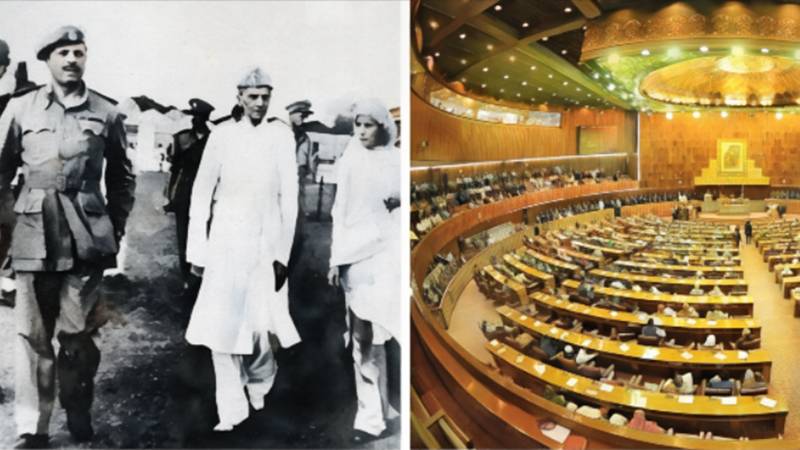
On the global stage, the Islamic Republic of Pakistan is enjoying a moment in the sun. It has befriended countries that are at odds with each other, such as superpowers China and the United States, and regional powers such as Iran and Saudi Arabia, and has signed a mutual defence pact with the latter. It continues to maintain good ties with many others, such as Jordan, Malaysia, Turkey and the United Arab Emirates.
In May, there was a brief aerial clash between India and Pakistan, in which Pakistan apparently came out ahead. This was not the first time that the Pakistan Air Force outsmarted the Indian Air Force, but it gave the country’s security establishment the perfect excuse to put the capstone on the transformation of Jinnah’s Republic into a Praetorian State. This was done in two measured steps.
First, came the promotion of the then COAS to Field Marshal, and getting an invitation to Washington DC, where he had a one-on-one meeting with the president in the White House. He went on to earn an accolade that even he would not have expected: being called “the best field marshal” by the president of the world’s most powerful nation.
Second, the legislative branch of government was mad to pass the 27th Constitutional Amendment which, among other features, gives five-star flag officers in the military not only lifetime tenure but also lifetime immunity from prosecution. Considering who holds a five-star rank in Pakistan, this appears to be a tailor-made provision.
This amendment prevents the current military leadership from facing a situation comparable to that of General Pervez Musharraf, the fourth army chief in the nation’s history to mount a coup and depose an elected civilian government. He had been tried for treason and sentenced to death in absentia.
It also eliminates the position of Joint Chiefs of Staff and states that the army chief will also serve as the Chief of the Defence Staff, yet another elevation. Of course, in Pakistani history the army chief has served as de facto chief of the defence staff. The 27th Amendment enshrined that change in the constitution.
Under the amendment, something even more brazen has been achieved. A Constitutional Court has been created to review constitutional issues, a right that previously resided with the Supreme Court. Why was this done? Perhaps because the Supreme Court was viewed as being too meddlesome in the country’s politics.
In the 16th century, John Harrington had written: 'Treason doth never prosper, what's the reason? For if it prospers, none dare call it Treason'
In Pakistan’s history, when martial law was imposed, the Supreme Court would approve it based on the “Doctrine of Necessity.” Eventually the military ruler would fall from grace and be replaced with a civilian government. Then the Supreme Court would condemn the declaration of martial law and even convict the deposed dictator of treason. Now, the Supreme Court has been demoted.
Essentially, treason has been decriminalised. Way back in the 16th century, the English writer John Harrington had written: “Treason doth never prosper, what's the reason? For if it prospers, none dare call it Treason.” Army chiefs will not be obligated to invoke Hans Kelsen’s Law of Necessity to justify meddling in politics. The army’s primacy in all affairs of the nation will no longer be subject to legal scrutiny.
This doctrine was first invoked in 1954 by Chief Justice Munir. “In a controversial 1954 judgment, Pakistani Chief Justice Muhammad Munir validated the extra-constitutional use of emergency powers by Governor General, Ghulam Mohammad. In his judgment, the Chief Justice cited Bracton's maxim, 'that which is otherwise not lawful is made lawful by necessity,' thereby providing the label that would come to be attached to the judgment and the doctrine that it was establishing.”
The military leadership in Pakistan will no longer need to declare martial law to depose an elected government and seize power through a coup, thereby covering themselves with ignominy in the world’s eyes. The 27th Amendment gives them the legal right to run the country without declaring martial law.
How would MA Jinnah, the founder, have responded to the 27th Amendment? Let us engage in a thought experiment.
Imagine that Quaid-e-Azam miraculously returns to Pakistan in December, the month in which he was born nearly 150 years ago. Would he even recognise the country that he succeeded in creating in 1947 against impossible odds?
First off, he would struggle to even find East Pakistan on a map. Instead, he would see Bangladesh, which seceded from Jinnah’s Pakistan in December 1971, after a bloody civil war, which was followed by a full-scale war with India. Jinnah would discover to his profound regret that the general elections of 1970, widely considered to be the fairest in the nation’s history, were annulled by a military government. The party that won them was not only banned, but its leaders were charged with treason and arrested, unleashing a popular uprising in the east and triggering a civil war which the army was ill equipped to fight.
Second, this would draw him into studying the history of the army in Pakistan’s politics. To his chagrin, he would discover that the model of parliamentary democracy which he had bequeathed to the citizens on 14 August 1947 was annulled on 27 October 1958 by the commander-in-chief of the army.
The “man on horseback” who seized the reins of power charged the elected government with “bribery and corruption, black marketing, and nepotism.” With his Sandhurst accent and clipped moustache, General Ayub used Jinnah’s words to undo his legacy. Perhaps the irony was lost on him.
The Quaid would be shocked to discover that Ayub called himself the saviour of Pakistan who had seized power to rid the country of the vermin that had ruined the country, and that his role was to “save the people from themselves.”
A year later, he promoted himself to Field Marshal. In 1962, he created a new constitution under which a rudimentary form of government was created called Basic Democracy. Presidential rule replaced parliamentary rule.
Third, Jinnah would be astonished to find out that the three army chiefs who followed in Ayub’s footsteps gave their first address to the nation seated underneath his picture, giving themselves a fig leaf of credibility. If they had been sincere, they would have worked hard on creating the republic that he had envisioned, one that he had hoped would be “one of the greatest nations of the world.” Contrary to his vision, he would discover that the army governed the country as if it was the largest political party in the country. He had never said that the army would need to run the state.
He did not think that his fellow citizens were an ill-disciplined, tribal and feuding lot who could only be governed by the army. He did not argue that the politicians were corrupt and that the judges of the Supreme Court were politicised, inept, corrupt and nepotistic. Nor did he assert that the media wanted to undermine Pakistan and that the clerics were fanning the extremists.
Fourth, he would discover that the army kept on fighting wars with India, ostensibly to liberate Kashmir, but the dividing line in Kashmir had not moved much since his death in 1948. Even then, the army kept on growing, from 150,000 troops at independence, to 208,000 during the 1965 war, to 392,000 during the 1971 war, to 587,000 during the Kargil war. It currently stands around 650,000.
Fifth, he would discover that expenditure on conventional forces kept on growing even after the country had acquired and exploded nuclear weapons in 1999. He would search in vain for a nuclear dividend.
And sixth, he would be saddened to learn that poverty, illiteracy and disease kept on inflicting millions of Pakistanis. The population of out-of-school children in Pakistan stood at 25 million, either the highest or the second highest such number in the world. Money that could have been spent on human development was being spent on the military. By contrast, Bangladesh had moved far ahead of Pakistan since its independence in 1971, despite being the poorer of the two wings when Pakistan was a unified whole.
On reviewing these six developments, Jinnah would be disheartened beyond words, convinced that the sun had set on his Republic.
Of course, this transformation was long in coming. Many astute observers, such as Ishtiaq Ahmed, had called it out in 2013, in his book, The Garrison State. The 27th Amendment is the last nail in the coffin of Jinnah’s Republic.