

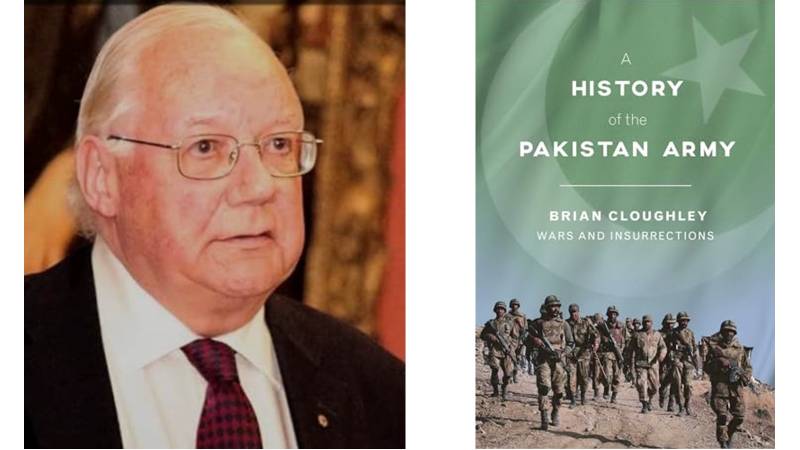
I sent Colonel Cloughley my article on Henry Kissinger recently, but the email bounced back. I began a Google search and my worst fears were realized when I discovered his obituary in the Sydney Morning Herald. It was dated the 6th of July 2024, and captioned: “Khuda Hafiz, Colonel Sahib.”
In 1999-2001, I corresponded numerous times with Colonel Cloughley during the writing of my book, Rethinking the National Security of Pakistan, which was published in 2003. He endorsed it for the publisher, Ashgate: "Scholarly research is well melded with practical observation on what Faruqui so accurately calls the "strategic culture" of Pakistan. The future of the sub-continent depends on human development, not that of weapons and warfare. Faruqui makes his points tellingly and readably." At that time, Cloughley was based in New Zealand. In part because of his endorsement, the book was widely reviewed in the US, the UK, India and Pakistan.
His most cited work, A History of the Pakistan Army, is detailed and objective. It was published in 1999 by the Oxford University Press in Pakistan and went through several editions. The fifth and presumably final edition, 673 pages long, was published in 2016 by Carrel Books in New York.
In 2018, I reviewed it and noted, “Colonel Cloughley is uniquely qualified to write a history of the army. In addition to serving in the British and Australian armies, he spent eight years in Pakistan, first as deputy head of the UN Mission in Kashmir and then as the Australian defence attaché [1988-94].” His involvement with the Pakistan army began in 1980. President-General Zia invited him to visit Pakistan in 1985. Decades later, he also met President-General Musharraf.
The History provides detailed accounts of Pakistan’s major and minor wars with India. Cloughley knew several Pakistani generals personally, and that adds nuance and texture to his analysis.
The downside of being close to the generals is that certain topics are missed, probably by design. For example, why is the army so much larger today than it was during the 1971 war? There is little discussion in the book about the plane crash that took General Zia’s life on 17 August 1988, or of the US mission to kill Osama bin Laden in 2011.
The book is reticent on how much excessive defence spending is costing the economy in terms of human, social, and cultural development, which was the focus of my research.
In 2001, he was kind enough to send me some hand drawn military maps, tightly rolled up in a small package, with a handwritten note
Nevertheless, we hit it off. In October 2009, he had cautioned the US against getting involved in a land war in Afghanistan while searching for Osama. In a piece for VOA News, he was quoted as saying that the United States should learn from the mistakes of the former Soviet Union, and not get sucked into a protracted conflict in Afghanistan. “Don't get involved in Afghanistan itself. If there is an operation to do, and bin Laden can be found and dealt with one way or another, then by all means do it, and do it quickly. And I think that's what's going to happen. But do not get bound up in a land war in Afghanistan.”
When the US pulled off the assassination of Osama, I reached out to him, as I did to several other experts. He was one of the few who responded. I asked: how could Pakistan not know that Osama was living in close proximity to the military academy in Kakul? And how could Pakistan not know that US helicopters had entered Pakistani airspace? He said, if Pakistan had shot them down, it would have jeopardized its relations with the US, a major ally, and much of its advanced weaponry, which was of US origin, would have been rendered dysfunctional.
When asked by Voice of America to comment on how Pakistan's intelligence agency, the ISI, had not noticed something unusual about the compound in which Osama was living for years, he opined that large fortified compounds were not so unusual as to draw scrutiny. The area is full of well-to-do people, including former military officers, who value privacy. "They’ve all got compounds. Small houses are within high-walled compounds. Everyone’s got high walls. There’s nothing unusual about it. And the people who live in places like Abbottabad are naturally withdrawn-type people, they’re retiring people. They don’t want interference. And they don’t interfere with other people.”
His expertise was not confined to Pakistan. Writing in the Asian Military Review, in March 2018, he evaluated the state of the Indian military and concluded that despite several challenges and limitations, “[T]he defence forces of India are professionally competent, commanded by high quality officers, and for the moment moderately well equipped. They would conduct themselves well in conflict.”
He wrote regularly for Jane’s Sentinel and other publications. In 2021, he asked, “Why does Israel have a stockpile of nuclear weapons?” in a piece for Counterpunch and concluded: “Israel’s “abilities” include the capability to strike Iran with nuclear weapons. Given that Bennet and Gantz claim that Israel is threatened by Iran, what happens after the next “incident”? It is far from inconceivable that Israel would employ its nuclear arsenal. After all, for what other reason does it have ninety nuclear weapons?”
Colonel Cloughley not only travelled widely, but he also lived in several countries, including Australia, New Zealand, and France, besides Pakistan and, of course, the United Kingdom.
In 2001, he was kind enough to send me some hand drawn military maps, tightly rolled up in a small package, with a handwritten note: “Dear Ahmad – I hope the enclosed sketches are of use.” The card bore this address: Kirkcaldy, Burnsands, Thornhill, Dumfriesshire, United Kingdom.
Thornhill is a village located in the Dumfries and Galloway region of Scotland. That card will serve as a keepsake, a precious reminder of how much I learned from him and of how much he cared for someone he never met.