

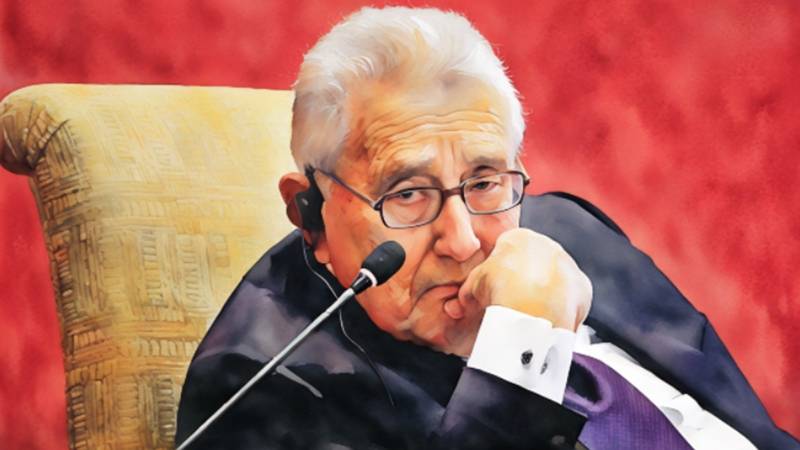
Summers in San Francisco can be uncomfortably cold and foggy, leading one person to say that the coldest winter he ever spent was a summer in San Francisco.
But on 19 July 2001, it was a perfectly clear day in the City. I had taken the day off to listen to a luncheon address by the diplomat par excellence and prolific author, Dr Henry Kissinger.
He had published a new book, Does America Need a Foreign Policy? The title seems quaint now, but it was written at a time when Americans had lost interest in foreign policy. No one knew what would happen in September 2001.
When I arrived at the Fairmont Hotel, situated at the top of Nob Hill, I noticed a hundred protestors holding signs calling him a war criminal.
Probably a thousand people were seated in the grand ballroom. I found a spot on a table with nine women. Then Robert McNamara entered the room, followed by George Shultz, a few other former cabinet members and Kissinger.
They took their seats on the dais. Lunch was served. Then the Chair of the Commonwealth Club of California, which had sponsored the event went to the mike, welcomed Kissinger and requested him to speak.
In his German accent, he began telling us how he had arrived in the US and how kind and hospitable this country had been to him. He talked about his academic career at Harvard University and then turned to a lengthy but somewhat repetitive discussion of his successes in foreign policy. While talking about his days in the White House, he referred to the American President simply as Nixon.
At some point, a guest in the ballroom stood up and unfurled a larger banner on which was written: “Henry Kissinger is a War Criminal.” Everyone’s eyes turned toward him. Suddenly, three bald men in black uniforms appeared out of nowhere, approached the man, lifted him and carried him away, while his legs were swinging.
The Chair asked the audience to be respectful of the speaker and reminded them that next week’s speaker was going to be Christopher Hitchens, who had penned a critical book about Dr Kissinger. She encouraged them to return next week to listen to his talk.
She looked at the honourable speaker and said that nearly a hundred people had asked this question. Kissinger’s face stiffened up, as if he knew what that question was going to be
During the talk, in line with a well-known Club tradition, index cards were passed to all the guests on which they could write their questions for Kissinger. Several people penned their questions. I decided to take a pass. Once he was done with his speech, the cards were collected and passed on to the Chair.
She began putting the questions to Kissinger, one question at a time. Most of them were “home run pitches” to borrow a term from baseball. He answered them effortlessly, and consistently “hit the ball out of the park.” The session had turned insipid. Then something happened which would make it one of the most memorable encounters that I – and probably most people in the room -- had ever witnessed.
The Chair was now holding several dozen cards in her hand, somewhat nervously. She looked at the honourable speaker and said that nearly a hundred people had asked this question. Kissinger’s face stiffened up, as if he knew what that question was going to be.
Just as she was about to ask the question, all the index cards fell on the floor. Then she stooped down to pick them up, awkwardly, one by one. Of course, she had read the question and could have just left the cards on the dais. But maybe she needed to summon the courage to put that most-asked question to Kissinger and to make it clear to him that it was not her question.
She got up, with the cards in her hand, and asked: “Are you a war criminal?”
He lost his cool. The diplomat had decided to part with the etiquettes that were a hallmark of his profession. His anger was aroused, and nothing would dampen it as he proceeded to respond in the most bellicose of voices.
I am a big man, he roared. I am not intimidated by the question. But think about the common man on the streets. He will lose his freedom of speech. This question is a threat to our democratic values. And the people who ask them should be ashamed of asking them.
I was stunned!
I was sure the question did not surprise him. He could have shrugged it off calmly by saying that he had faithfully served the interests of the US and we should let history be the ultimate judge. There was no reason to lose his temper.
The session had ended awkwardly. I walked out, bewildered. Some people lined up to buy his book and get his signature. I was not one of them. I was terribly disappointed.
In fact, I had lost all respect for the man I had come to respect after he used the good offices of General Yahya Khan to fly covertly to Beijing via Islamabad in July 1971, thereby creating an opening between China and the US. There were some who felt he had a role in the hanging of ZA Bhutto, because he had commissioned the building of an atomic bomb. I was not one of them.
It proved difficult for me to ignore the writings of Kissinger. At some point, I picked up a copy of one of his earlier books, Diplomacy.
Late one evening, while flying home from Washington, DC, I began reading it. A flight attendant saw me reading it and politely but firmly said: “You should not be reading it.”
"Why?" I asked.
She said: “He is a war criminal.”
Years later, I visited Santiago, Chile and saw the Museum of Memories, which documents what a military dictator had done there, ostensibly at the behest of the US.