

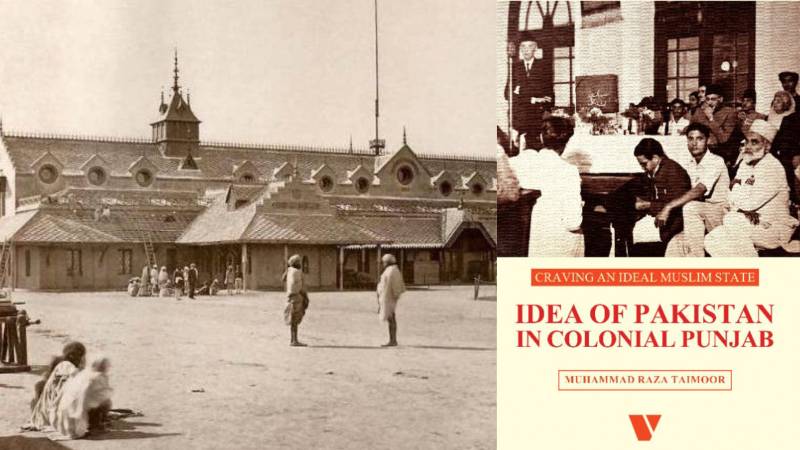
The book titled Carving for an Ideal Muslim State: Debating the Idea of Pakistan in Colonial Punjab is consistently hailed as essential, indispensable, vital, and crucial—marking a profound shift in understanding the nation’s formation by moving decisively beyond the established narrative of partition’s chronology—the “what” and “when.”
Dr Raza Taimoor, a senior Professor of History at Wahdat Science College, Lahore, has established himself as a prolific writer, contributing books and articles on a wide range of topics. His current book, Carving for an Ideal Muslim State: Debating the Idea of Pakistan in Colonial Punjab, stands as a testament to his dedication to in-depth research and his profound intellectual journey. This work, thoughtfully adapted from his PhD dissertation on the idea of Pakistan as a microcosm viewed through the regional lens of Punjab, reflects his scholarly rigour and commitment to enriching the understanding of history—especially the philosophical foundations of Pakistan’s creation.
Structured into five theoretically grounded chapters and employing the concept of the ‘public sphere,’ the book’s main contribution lies in its rigorous exploration of the fundamental processes that culminated in the creation of Pakistan. Instead of merely recounting events, it probes the formative mechanisms, exploring the crucial “how” and “why” that transformed an idea into a nation-state. This shift in focus is fundamental. It acknowledges that understanding the birth of Pakistan requires more than maps redrawn and populations displaced; it demands an excavation of the intellectual currents, cultural negotiations, and discursive battles that provided the ideological fuel and blueprint for the new state. The book argues that the partition itself was the culmination—not the origin story—of a much deeper and more complex intellectual and cultural ferment. By prioritising process over event, the author provides a richer, more nuanced explanation for Pakistan’s specific trajectory, distinct from the broader narrative of Indian independence.
The author draws on Jürgen Habermas’s concept of the public sphere—an autonomous arena, distinct from both state and private interests, where citizens engage in reasoned debate, shape public opinion, and legitimise political decisions through democratic discussion. This sphere fosters open dialogue on common concerns, encourages the exchange of ideas, subjects authority to critical scrutiny, and seeks collective solutions. Taimoor illustrates how institutions such as the Anjuman Himayat-e-Islam, various associations, Islamia College Lahore, tea houses, and social clubs played a pivotal role in influencing discourse and moulding public opinion on the idea of Pakistan.
Central to the book’s thesis is the decisive influence, the profound impact, and the powerful role played by three interconnected forces. The book meticulously charts how ideas about Muslim identity, political rights, religious obligation, and nationhood were fiercely contested in an emerging public sphere. This wasn’t merely elite theorising; it involved speeches, sermons, pamphlets, and debates that reached a growing literate public. The author demonstrates how specific arguments—about representation, sovereignty, Islamic governance, and minority safeguards—gained traction, evolved, and coalesced into a powerful demand for a separate homeland. The nature of this discourse—its tropes, anxieties, and aspirations—fundamentally shaped the character of the envisioned state.
Pakistan’s modern struggles cannot be fully understood without reference to the intellectual and discursive battles that surrounded its birth
This burgeoning public discourse was amplified and disseminated through an explosion of print culture. Newspapers, journals, pamphlets, and books became the critical battlegrounds for ideas. The book showcases how print media not only reported on events but actively shaped public opinion, created imagined communities among geographically dispersed Muslims, standardised languages of debate, and provided platforms for intellectual leadership. The accessibility and reach of print were instrumental in transforming abstract concepts into tangible political goals for a mass audience.
The narrative highlights the pivotal agency of intellectuals, religious scholars (ulema), poets, writers, and political thinkers. Figures like Iqbal, Jinnah (though often analysed through his public pronouncements and the discourse he shaped), Maulana Maududi, Allama Inayatullah Mashriqi, Syed Ataullah Bukhari, and numerous regional voices are examined not just for their individual ideologies, but for how they engaged with and influenced the public sphere. The book illustrates how these leaders articulated visions, mobilised support, countered opposing arguments, and provided the intellectual scaffolding for the Pakistan movement. Their interpretations of Islam, history, and political theory were central to defining the “why” of Pakistan.
The author also highlights the role of media outlets such as Nawa-i-Waqt, Paisa Akhbar, Pakistan Times, along with various weekly and monthly publications, in fostering nationalist sentiment and emphasising the demand for a separate Muslim state. Similarly, Hindu and Sikh communities underscored their distinct religious identities in response. He emphasises that the roots of Khalistan and Hindutva sentiments were sown during this period.
A significant and powerful testament within the book is its compelling argument for the value of regional histories. It underscores that the movement for Pakistan was not monolithic, nor solely driven from elite centres like Aligarh or Delhi. The author powerfully affirms the diverse experiences, grievances, and aspirations found in provinces like Punjab, Bengal, Sindh, and the NWFP (now Khyber Pakhtunkhwa). Local landed elites, regional linguistic identities, provincial economic concerns, and distinct historical narratives interacted complexly with the broader Muslim nationalist discourse. The book reveals how regional dynamics influenced the reception of the Pakistan idea, shaped local leadership’s strategies, and contributed unique strands to the national tapestry. Ignoring these regional variations, the work argues, leads to a flattened and inaccurate understanding of the forces that coalesced to form Pakistan. This focus on regionality adds crucial depth and complexity, moving beyond a homogenised “Muslim” narrative.
One of the book’s most penetrating insights is its exploration of the complex, often unintended consequences or unforeseen outcomes of the ideas fervently debated in the public square. The author exposes the gap between the idealised visions articulated in discourse and the messy realities of political implementation and social transformation.
Debates about the role of Islam in the new state were central, yet often abstract. The book traces the intricate path from these debates to the practical and often contentious attempts at Islamisation, revealing how initial concepts were interpreted, reinterpreted, and instrumentalised in ways their original proponents might not have anticipated or desired. The ambiguity inherent in defining an “Islamic state” became a source of ongoing conflict.
While safeguards for minorities were a recurring theme in pre-partition discourse (often used to argue for separation), the book illustrates how the very process of defining a Muslim homeland based on religious identity created tensions and exclusions that manifested tragically during partition and continued to shape the treatment of religious minorities in Pakistan.
Despite the importance of regional histories in the movement’s success, the book highlights how the imperative of building a unified nation-state post-1947 often led to the suppression of regional linguistic and cultural identities, generating centrifugal forces like Bengali nationalism that culminated in the 1971 war. The centralising tendencies inherent in the “one nation” discourse clashed with the regional realities that helped birth it.
Discourses around Muslim unity and the need for strong leadership to achieve and safeguard Pakistan could, the author suggests, have complex repercussions for the development of robust democratic institutions and a culture of pluralism. Dr Raza Taimoor concludes with a powerful and unifying argument: the formative quest for an Islamic state—as debated, imagined, and contested in the pre-independence and early independence public sphere—still resonates profoundly within Pakistan’s contemporary political landscape. It continues to influence core debates about national identity, the constitution, the role of religion in law and governance, civil–military relations, and foreign policy. The specific formulations and tensions that emerged in those foundational debates—the relationship between Islam and modernity, the definition of Muslim citizenship, the authority of religious scholars versus elected representatives, the balance between unity and diversity—remain unresolved and actively shape political discourse and conflict today.
The author observes that, in the face of mounting hostility from Hindu extremists at the national level—who, bolstered by their numerical dominance, sought to absorb minority communities—Muslims increasingly asserted a distinct identity. Simultaneously, Hindu and Sikh groups in Punjab strengthened their own religious boundaries. He underscores that this era marked the emergence of both Hindutva and Khalistan ideologies.
In short, academic explorations of Punjab’s history—from the high-political focus of Ian Talbot, David Gilmartin, and Qalb-e-Abid to the social dimensions examined by Naumana Kiran and Adnan Tariq—have furthered analysis of the Pakistan Movement. Nevertheless, the pivotal public sphere, fundamental to grasping Pakistan’s justification, constituted a significant gap—one this book masterfully bridges. By shifting the focus from political events to intellectual processes, centring the public sphere and print culture, affirming regional histories, and tracing the complex legacy of ideas, the work stands as a groundbreaking, seminal, and innovative study. It provides an indispensable framework for comprehending Pakistan’s origins and its enduring challenges, demonstrating the lasting impact of its foundational intellectual and cultural ferment.
The book ultimately contends that Pakistan’s modern struggles cannot be fully understood without reference to the intellectual and discursive battles that surrounded its birth. This is the persistent legacy of the public sphere meticulously examined.
Written in clear, simple, and accessible English, this book serves as a valuable reference and textbook for scholars, researchers, and professors.