

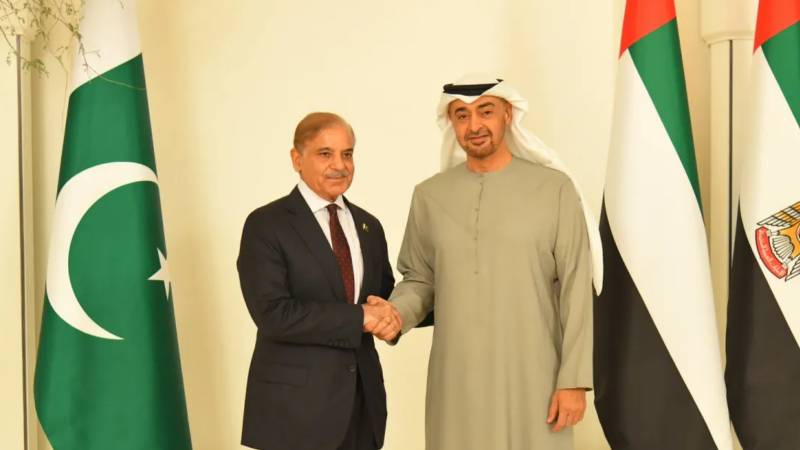
Pakistani leaders prepared a full ceremonial welcome for Mohammed bin Zayed on 26 December last year—JF-17 escort, 21-gun salute at Nur Khan Airbase, reception by Field Marshal Asim Munir, Prime Minister Shehbaz Sharif, and Foreign Minister Ishaq Dar, and a red zone lined with UAE flags and portraits for a formal state reception at the Prime Minister’s House.
The visit did not follow that script. MBZ met the country’s top civilian and military leadership at the airport and departed soon after without attending the planned public engagements.
The visit took place as Saudi Arabia and the UAE were in disagreement over Yemen, particularly the Southern Transitional Council, with tensions extending into the Red Sea, Sudan, and wider regional alignments with Israel. This divergence had begun to shape competing approaches within the Gulf, making the Islamabad discussions more than ceremonial. This same period saw a financial issue come to the fore.
Pakistan did not take sides. It refused to enter intra-Gulf rivalries and did not agree to any strategic or defence positioning against another Gulf state. It maintained its position of balance and offered to mediate between both sides.
A couple of weeks later, Pakistan requested the UAE to roll over approximately $2.5 billion in deposits and reduce the interest rate from about 6.5 per cent to near 3 per cent. The rate was the issue. The UAE facility had become the most expensive among Pakistan’s bilateral arrangements.
Pakistan pursued the matter directly. The request was raised at the leadership level. President Zardari travelled to Bahrain and then to the UAE. Diplomatic and military channels remained active. The objective was clear: extend the deposit at a lower cost.
The UAE did not revise the terms. It retained the higher rate and allowed only two-month rollover periods. As this period is now expiring, Pakistan has begun repaying the deposits this month in phases from its State Bank reserves.
This is a repayment decision, not a rupture. Yet social media has gone berserk.
India is currently jealous of Pakistan’s leadership role in Iran diplomacy. Hence, Indian mainstream coverage quickly framed the repayment as a diplomatic setback rather than a financial decision. Reports and television segments presented it as the UAE “declining further support” and pointed to “strained ties.” On X, the same line was amplified within hours, linking the repayment to political differences and suggesting wider disengagement.
Pakistan’s Foreign Office has now stated clearly that Emirati deposits were placed under bilateral commercial agreements and that their repayment is proceeding under agreed terms, calling any other portrayal misleading
For instance, @KnightsOSINT, a Sweden-based account created recently, reflects patterns highlighted in the EU DisinfoLab exposé of Indian networks operating through European fronts. It pushed the false claim that at a 19 March Riyadh meeting, the UAE backed defeating Iran “by any means necessary,” even invoking nuclear force, and opposed Pakistan’s position. In reality, Foreign Minister Dar, along with his Turkish counterpart, pushed to soften the anti-Iran language as Islamabad was actively engaging Tehran for diplomacy.
At home, two strands stand out. PTI voices attack the government and the Field Marshal, using the repayment to push a political line and projecting it as a diplomatic failure, regardless of the underlying financial terms. Alongside them, a smaller but vocal segment, shaped by ideological sympathy towards Iran, turns its criticism directly on the UAE, treating a routine repayment as withdrawal of support and framing it in openly partisan terms.
Meanwhile, two Indian X handles—@IIRReports and @BabaBanaras—have pushed identical false claims that Saudi Arabia had also asked Pakistan to repay $6.3 billion because Pakistan failed to honour a defence pact and that Saudi officials could not reach Pakistan’s leadership. A Financial Times report added to this by citing “one person familiar with Pakistan military thinking” to claim that Pakistan’s Saudi arrangement had become “a problem” and that deterrence had failed. One unnamed source was used to cast doubt on a strategic relationship.
At the same time, reporting and commentary in US and Israeli media, particularly The Washington Post and The Jerusalem Post, have suggested that Saudi Arabia pushed the United States toward confrontation with Iran, despite Riyadh’s position favouring restraint. These strands move in one direction—question Saudi wartime conduct, dispute Pakistan’s reliability as a mediator, and amplify divisions within the Gulf.
Pakistan’s Foreign Office has now stated clearly that Emirati deposits were placed under bilateral commercial agreements and that their repayment is proceeding under agreed terms, calling any other portrayal misleading.
The country’s ties with the Gulf, particularly Saudi Arabia and the UAE, have been built through repeated moments of crisis, support, and political trust. The UAE deposits originated in the 2018 balance-of-payments crisis. Saudi Arabia and the UAE stepped in together. Crown Prince Mohammed bin Salman provided $3 billion. Upon his request, MBZ extended $2 billion, later added $1 billion. These were rolled over repeatedly across governments. Even when political tensions appeared, the support continued. During the 2022 floods, both countries again assisted.
Estimates place Pakistani wealth held abroad at around $150–200 billion, much of it routed through the UAE
This is not a relationship that shifts because one deposit is repaid. Pakistan’s economic ties with the UAE are structural. Around 1.6–1.8 million Pakistanis work there, and remittances from the UAE—up to $6–7 billion annually—remain among the largest inflows. The Gulf as a whole accounts for well over half of Pakistan’s total remittances. Trade and investment are deeply linked, and the UAE functions as a hub for Pakistani capital largely because Pakistan has not created the conditions to retain it.
Blaming the UAE is misplaced. Capital moves where conditions are stable and predictable, and Dubai offers that. Pakistan has not—policy uncertainty, weak enforcement, and volatility have pushed investors out. Estimates place Pakistani wealth held abroad at around $150–200 billion, much of it routed through the UAE.
The same applies to the conspiracy narrative on seaports: Dubai did not block Gwadar or displace Karachi; Pakistan failed to create the security, continuity, and commercial conditions required for a regional hub, and both Karachi’s decline and Gwadar’s unrealised potential reflect those internal shortcomings.
The regional framing is not accidental. Israel’s strategy has been to pursue selective normalisation while preventing any unified position on Palestine. The Abraham Accords reflect that approach by pulling individual states into separate alignments. Regional disunity suits Israel. It initiated the aggression against Iran, tactfully co-opting President Trump in the process and consequently paving the way for Iranian attacks against the Gulf countries.
Narratives that exaggerate Gulf divisions or question Pakistan’s partnerships serve that outcome. Their amplification through Indian networks and sections of Israeli and Western media follows the same pattern—create doubt, widen rifts, and isolate positions.
This is happening as Pakistan is actively engaged in diplomacy in the Iran war. Islamabad is in contact with Tehran, Washington, Riyadh, Beijing, and other key actors, trying to contain escalation and prevent the conflict from widening. That role depends on balance. Any attempt to portray Pakistan as aligned against one side directly weakens its ability to operate as an intermediary.
Inside the Gulf, the reality is more measured. Saudi Arabia has not treated its differences with the UAE as a rupture. Its position remains that disagreements exist but do not alter the structure of the relationship and will be managed within it. Even under pressure, the emphasis has remained on cohesion and stability.
Pakistan’s policy aligns with that framework. It maintains relations with all GCC states and avoids entering their internal rivalries, while its closest strategic alignment remains with Saudi Arabia and its strongest economic linkage with the UAE.
That approach has continuity. Pakistan worked with Saudi Arabia in shaping Islamic platforms, aligned with Palestine, and repeatedly offered mediation in regional conflicts. The same impulse now guides its role in the current crisis to contain escalation, maintain ties, and prevent wider conflict.
The UAE wants its money back. Pakistan is paying it. What matters is everything beyond that transaction—labour, remittances, investment, security cooperation, and decades of political trust. These ties are being tested in a difficult moment, and they are holding. After all, we are brothers.