

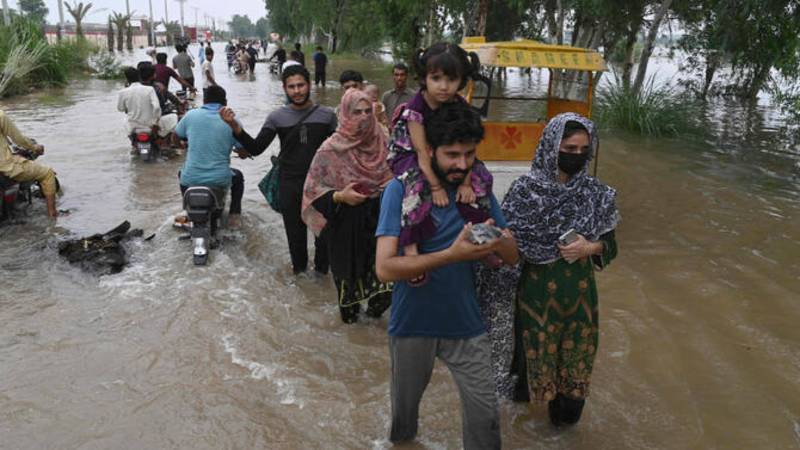
Floods in Pakistan have ceased to be exceptional events; they now represent recurring crises that expose the fragile nexus between society, state, and ecology.
While climate change, deforestation, unregulated urbanisation, and governance failures remain critical drivers, floods do not affect all segments of society equally. Instead, they exacerbate entrenched inequalities, with marginalised populations bearing disproportionate losses while the powerful insulate their assets.
From an anthropological standpoint, floods are not merely natural disasters but deeply social events. Scholars such as Anthony Oliver-Smith and Eric Klinenberg remind us that disasters reveal existing "social fault lines" of inequality more than they reflect nature’s fury.
In Pakistan, floods expose how class, power, and privilege operate during crises. In rural areas, influential landowners and industrialists often mobilise their political connections to divert floodwaters away from their estates, safeguarding cash crops, sugar mills, and agricultural wealth. The recent case of the Ramzan Sugar Mill illustrates this starkly: floodwaters were reportedly redirected towards poor villages to protect elite-owned assets, leaving small farmers and landless households devastated.
For the poor, the consequences are not only immediate but also long-term. Entire communities lose their crops, livestock, and means of subsistence. Families are displaced, children’s education is disrupted, and women shoulder heightened burdens of food insecurity and caregiving under precarious conditions.
Relief distribution reflects the same structural biases. Those with political and social connections are prioritised, while marginalised groups, particularly daily wage labourers, women-headed households, and landless peasants, struggle to access aid.
If floods are to be treated as a “new normal”, then disaster governance must undergo a paradigmatic shift
The socio-economic repercussions are severe. Farmers are trapped in cycles of debt, unable to recover from repeated harvest losses. Informal labour markets collapse, producing long-term unemployment. Displaced families migrate to urban centres, swelling overcrowded slums and deepening urban precarity. These dynamics reproduce a generational cycle of vulnerability, entrenching inequality further with each flood.
Anthropological theories provide important insights into these recurring crises. Ulrich Beck’s notion of the risk society is particularly relevant: risks such as floods are unevenly distributed, with marginalised groups disproportionately exposed while elites externalise their vulnerabilities onto others.
Similarly, Pierre Bourdieu’s concept of capital helps explain why the wealthy navigate disasters differently. Their economic and political capital enables them to protect assets, while their social and symbolic capital allows them to secure favourable relief and rehabilitation measures.
Victor Turner’s idea of the social drama further illuminates how disasters become arenas where power is enacted and contested, as decisions about water diversion, relief, and reconstruction reproduce entrenched hierarchies.
Ultimately, floods in Pakistan demonstrate that the central issue is not the natural hazard itself but the unequal social structures that determine who suffers and who survives with their privileges intact.
If floods are to be treated as a “new normal”, then disaster governance must undergo a paradigmatic shift. Instead of safeguarding elite estates and sugar mills, policies must prioritise ordinary lives and livelihoods.
This requires community-centred planning that involves small farmers, women, and marginalised groups in decision-making rather than privileging elite stakeholders. Transparent water management, including independent monitoring of canal diversions and flood defences, is essential to prevent manipulation for elite benefit.
Equitable relief distribution based on need rather than connections must be institutionalised. Long-term measures such as crop insurance, debt relief, and rural safety nets are also crucial to break cycles of vulnerability.
Importantly, anthropologists and social scientists should be embedded in disaster policy teams to illuminate how culture, power, and inequality shape outcomes. This ensures that technical solutions do not ignore social realities.
True resilience lies not in saving the assets of the powerful but in dismantling structural inequalities. Only then will disasters cease to reproduce hierarchies and instead cultivate the conditions for collective survival, justice, and renewal.