


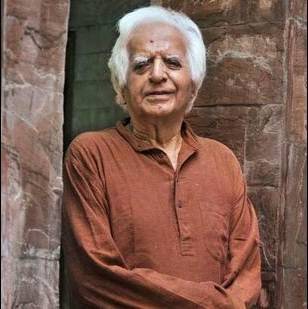
Joginder Paul was born on 5 September 1925, a hundred years ago today in Sialkot. He went to India at the time of partition in 1947. In 1948, he undertook residence in Kenya. He lived there for 14 years, and then, after premature consensual retirement as Education Officer from the Ministry of Education there, he returned to India. Thereafter, he was appointed as Professor and Head of the English Department in SB College in Aurangabad, in the Deccan. After a year he was made Principal of the same college but after a year he resigned in 1978 to move with his family to Delhi. He died on 23 April 2016.
In addition to short-stories the novels Ik Boond Lahu Ki (1963), Naadeed (1983 the novellas Bayanaat (1975), Aamad-o-Raft (1975), Khvaab Rau (1990); volumes of critical essays Raabta (1998) and Be-Istilaah (1999) have been published.
Joginder Paul, in a traditional manner, especially by remaining captive for some time within the dome of the popular stories of his time, wrote short-stories and gradually revealed the viewpoint that events are not important, but instead the impressions of the short-story writers upon them are important. As a representative short-story writer of Dr Wazir Agha’s journal Auraaq, he tried to separate himself from writings carrying political and social consciousness. In his work, there is the experience of Indians emigrating for economic reasons, and also the consciousness and feeling of different cultures existing in the same connection. It is a creative experience which could be had by a sympathetic and humanist person roaming India freely—an experience of meeting people of varied languages, ideas, and habits with reference to human nature, and of wandering in search of a point of affinity through the diversity of his land and civilisation.
This experience was available to Joginder Paul, but one feels that somewhere or other there is a deficiency of fervour in that his name could not be included among the short-story writers of the first rank, although he has been a popular short-story writer in every era.
Death is like an apparition in Joginder Paul’s work, somewhere a post-mortem of corpses is being conducted, somewhere some dead body has been lost or someone living is being numbered among the dead. That is why except a few short-stories, we again find this state of repetition or here and there a tone creating irony has been adopted in order to control this fear.
“The dead too must definitely settle somewhere or other like us. Wait don’t speak who knows we too are dead. I have read somewhere that every person is actually already dead before their death. It is unknown since when – I am having a blurred memory I too had died in great distress and then I had been sent here in the morgue. I have been rotting here since the last fifteen years.” (Murda Khana, p 24)
“If I don’t have a five rupee note in my pocket then I can’t even buy pills for my children.” (Chor Sipahi, p 53)
“I don’t remember how much time has passed since I died. All my memories very much begin after death.” (Koi Nijaat, p 55)
Death is like an apparition in Joginder Paul’s work, somewhere a post-mortem of corpses is being conducted, somewhere some dead body has been lost or someone living is being numbered among the dead
“The sound of their crying cannot be heard. I too begin to cry sitting there at the head of my corpse and have been struck dumb while crying.” (Ibid p 63)
“In the light of the full moon Daadi’s corpse was very much encircled by myriad Daadis.” (Daadiyan, p 83)
But when he writes a short-story like Be-Gaur (Graveless) joining this apparition of his with his social consciousness, then one does not feel repetition rather an expansion is automatically created in his creative world.
“The Americans need a few corpses, this is what the Indian contractor tells them while supplying living people: ‘Sahib, the dead indeed do not have a feeling of being dead but look at them closely everyone has a full sense that they are dead. All of them will indeed die one of these days. Many will indeed die upon the ship on the way.’” (p 139)
Joginder Paul’s comparatively later short-stories have been written within a global perspective and mostly one finds the impression of travelogues and diaries in them. but there is no doubt that there are very few Urdu short-story writers who had been writing ceaselessly with a fresh pen for the last fifty years when death summoned him.
See these extracts from two short-stories of his last collection Pachchees (Twenty-Five): “Ladies and Gentlemen! I had indeed arrived from America at the request of my special representative with the intention of announcing to double my investment immediately but the reliable manner in which our co-chairman Mr Lala has mentioned a few obstacles in his report, in view of that in my opinion the time has not yet come for so much expansion of capital, therefore I have decided that until the natural act of liberalisation of this country’s economy is not fulfilled officially, I should put off expansion of investment.” (Market Economy, p 151).
“Very much nearby beneath a tree a middle-aged African was busy reading a newspaper. I came near him, he began to look towards me with bitter inquiring eyes. I said in a very friendly tone, ‘The land of the lake beneath our feet shivers. What a great miracle it is?’ He replied in an extremely dry manner. ‘But the real miracle as I understand is that why only the land of the lake shivers beneath your feet, why not the land of the whole of Africa?’” (Mojaza, p 219)
Note: All the translations from the Urdu are by the author