

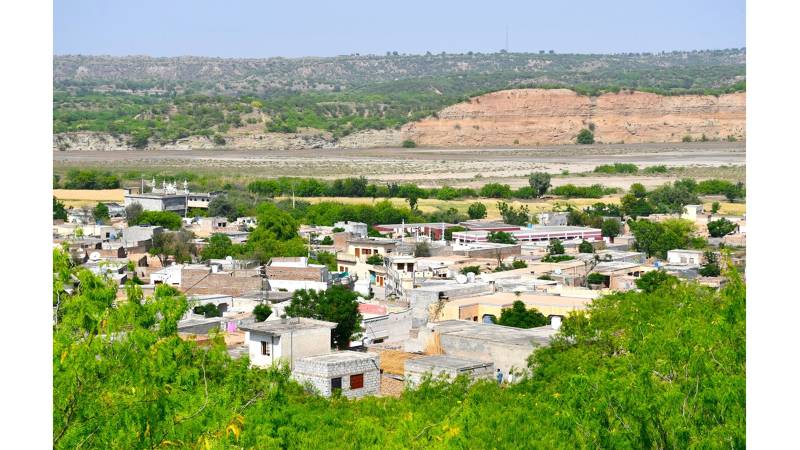
Mirjan is a historic village in Chakwal’s Talagang tehsil, noted for its religious scholars, masons and historic mosques. It is located about 21 km northeast of Talagang town. I visited Mirjan with my friend, Tariq Mehmood Malik, to see two historic mosques in the village. Before visiting the village, one can enjoy a panoramic view of the village from a nearby hill, from which the road leads down into the village. Standing on a hillside, one can also see the Gambhir nullah, which is a tributary of the Soan River. Mirjan village is situated on the left bank of the Gambhir nullah. Along these waterways, one can spot the remains of ancient settlements.
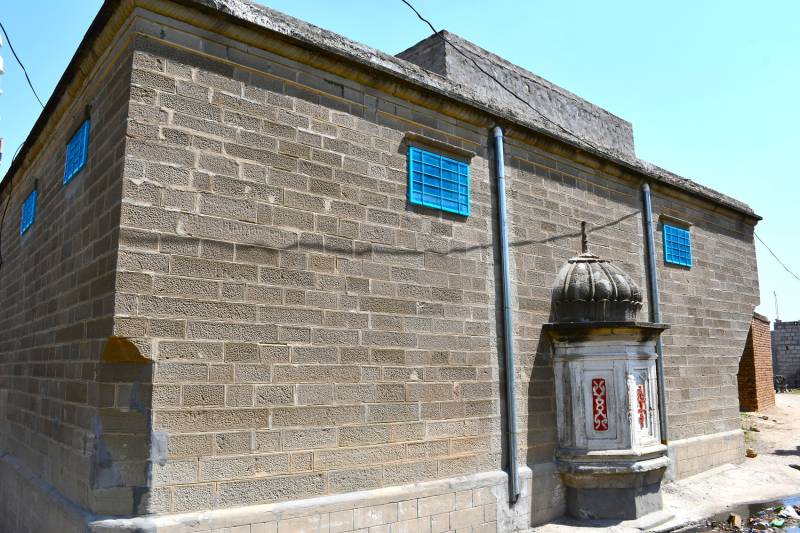
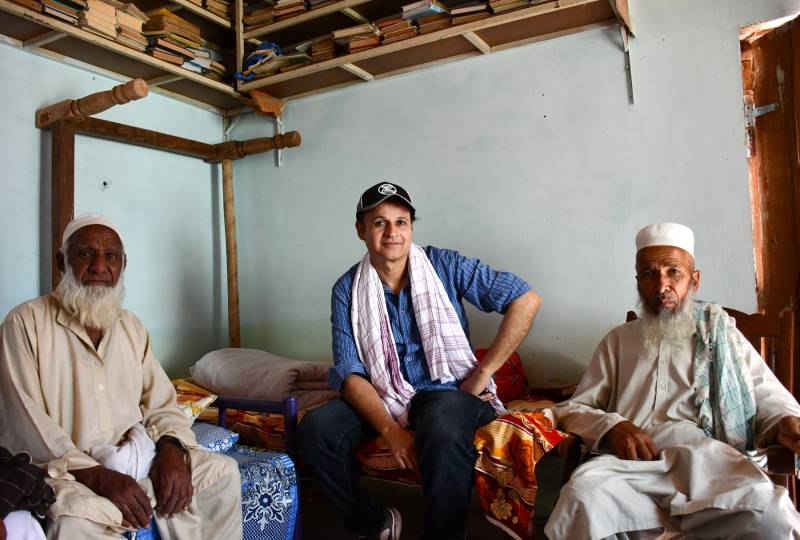
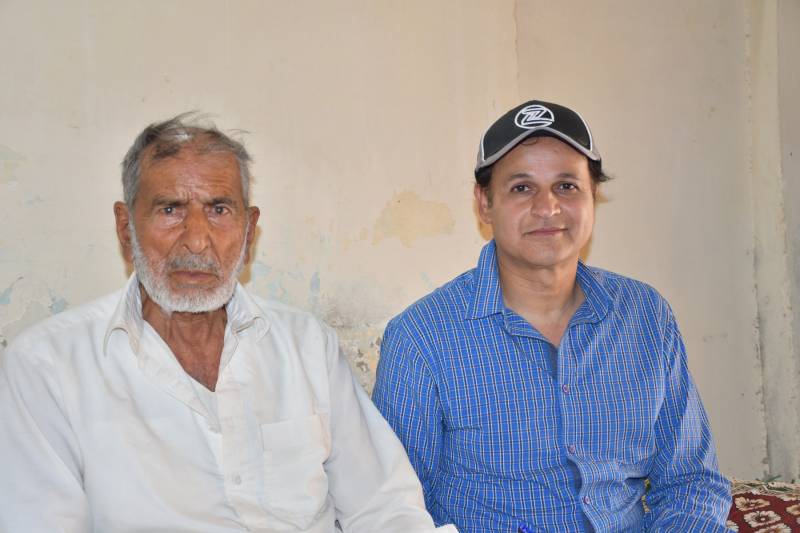
There are five mosques in the village, of which two are historic. The earliest mosque of Mirjan is the Jamia mosque, which was built when the village was founded in the second quarter of the eighteenth century. According to Maulana Abdul Waheed Rabbani, Pesh Imam of Jamia Masjid Mirjan village, Maulana Khan Muhammad started religious education in the mosque in the third quarter of the nineteenth century. I interviewed Maulana Abdul Waheed Rabbani, Hafiz Muhammad Masood, Ghulam Isqhaue, and others in Mirjan village, who shared their knowledge about the history of the village, its religious scholars, masons, and mosques.
Maulana Khan Muhammad was a famous religious scholar of Mirjan village. Akhtar Rahi (1998:169) states in Tazkira-e-Ulama-e-Punjab, Vol 1, that Maulana Khan Muhammad received early religious education in Chakki Shah Jee and Makhad. Both were thriving Chishtiyya centres.
This journey into Chakwal is not just about visiting two historic mosques with their intricately carved woodwork and stone masonry. It is about unearthing a forgotten legacy of knowledge
I have written articles on both Chakki Shah Jee and Makhad, respectively. Akhar Rahi (1998) writes that he later went to Hyderabad Deccan, where he studied under the supervision of Maulana Muhammad Zaman (d. 1292 AH/1875 AD). Maulana Khan Muhammad spent nine years in Hyderabad Deccan. From Hyderabad Deccan, he went to perform Hajj. Akhtar Rahi (1998) states that Maulana Khan Muhammad spent most of his time in Taif, where Nawab Faizullah Khan, the Raes of Datavali, was staying.
He stayed there until the death of Nawab Faizullah Khan. After the death of Nawab Faizullah Khan, he returned to his village, Mirjan, where he started religious education in the village mosque. After some time, he received an invitation from the sons of the late Nawab Faizullah from Datavali near Aligarh. Maulana Khan Muhammad, due to his relations with the late Nawab Faizullah Khan, accepted the invitation and went to Datavali. The sons of Nawab Faizullah Khan were residing in Aligarh, where Maulana Khan Muhammad Mirjani also stayed. He met and benefited from the knowledge of two eminent religious scholars, Maulana Lutafullah ( 1334 AH/1916 AD) and Maulana Ismail Muhaddis. After returning from Aligarh, Maulana Khan Muhammad spent most of his time imparting religious education to people in his village.
He died in 1909, leaving behind two daughters and an illustrious son, Maulana Qazi Ghulam Mustafa, who was also a famous religious scholar of Mirjan village. According to Akhtar Rahi (1998: 170), an eminent religious scholar, Abdul Baqir Karsalvi, offered funeral prayers of Maulana Khan Muhammad. I have written an article, "Chisthti Saints of Chawali," on Qazi Abdul Baqi and his mentor, published in The Friday Times-Naya Daur on March 13, 2024. Qazi Abdul Baqi Karsalvi was a student and disciple of Qazi Ghulam Nabi Chishti. One knows from Fauz al-Maqal Fi Khulfa-e-Pir Sial, Vol . 1, by Haji Muhammad Murid Ahmad Chishti (1997:621), that Qazi Abdul Baqi Karsalvi was initiated into the Chishtiyya Silsila by Khwaja Shamsuddin Sialvi (d. 1883). Akhtar Rahi (1998:80), the author of Takira-e-Ulama-e-Punjab Vol . 1, writes that Qazi Abdul Baqi Karsalvi was the son of eminent scholar Qazi Ahmaduddin Karsalvi, who was a student of Shah Abdul Aziz Muhaddis Dehlavi (d 1824).
Qazi Ghulam Nabi was a deputy of Khwaja Shamsuddin Sialvi, alias Pir Sial (d 1883). Qazi Ghulam Murtaza was a scholar and saint who belonged to the Mughal Kassar tribe. He received early religious education from his father and later went to Delhi for further education. He studied under the supervision of eminent Islamic scholar Sadruddin Khan Azurda Dehlavi (d 1868). After completing his education, he returned to his native village, Chwali. Later, upon the request of his student, Qazi Abdul Baqi Karsalvi, he began teaching at a madrassa in Karsal village, Chakwal.
Maulana Khan Muhammad Mirjani was buried in the old graveyard of Mirjan village. His son Qazi Ghulam Mustafa continued his legacy in Mirjan village. He was also a famous religious scholar. Qazi Ghulam Mustafa received religious education in famous seminaries and from eminent scholars. Akhtar Rahi (1998:526) writes in Tazkira Ulama-e-Punjab Vol II, he studied under the supervision of Maulana Abdul Rehman (d.1942)of Attock’s Jangala and Maulana Ghulam Nabi Karsalvi. He went to study at Madrasa Nomania in Lahore and Madrasa Lutfia in Aligarh. In 1938, he was admitted to Darul Uloom Deoband and studied under the supervision of Maulana Husain Ahmed Madani. After completing his studies at Darul Uloom Deoband, he returned to his native village, Mirjan, and continued to teach in the Jamia mosque Mirjan. He also taught in Madrasa Muhammadia in Qila Didar Singh and Dar-ul-Uloom Taleem-ul-Quran.
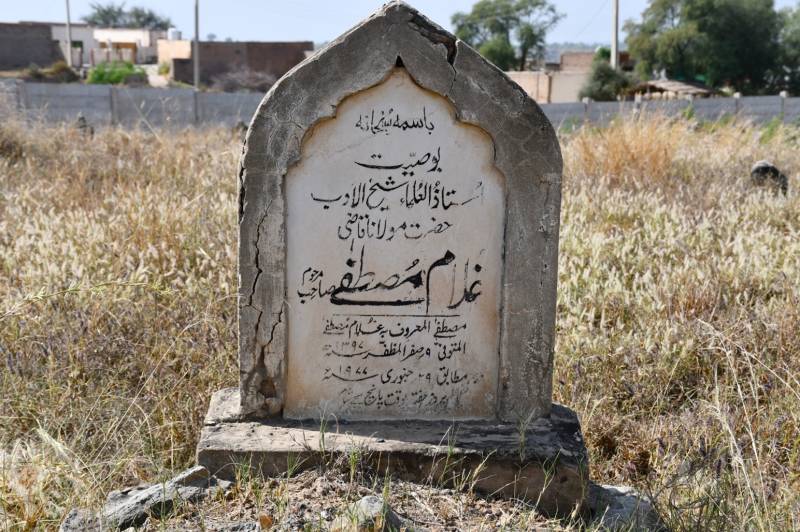
Qazi Ghulam Mustafa also performed hajj; he was a learned scholar and author of two books. He died in 1977, leaving behind two sons, Hafiz Abdul Rasheed and Hafiz Abdul Rahim. He was buried in Maria Wala Qabristan in Mirjan village. Both his sons were also learned scholars who continued the legacy of their father and grandfather.
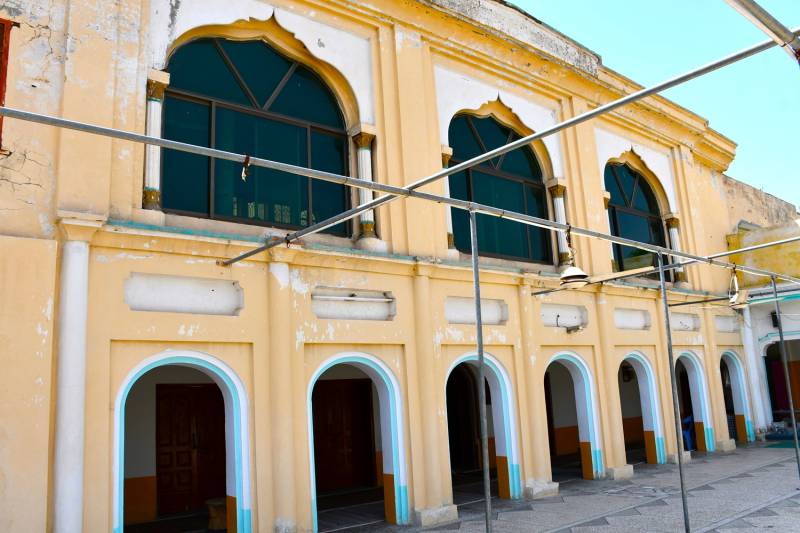
In 1984, Jamia Mosque Mirjan was rebuilt under the supervision of Hafiz Abdul Rasheed and Hafiz Abdul Rahim. The villagers gave the funds for the mosque's construction. Maulana Abdul Rehman managed the finances for the mosque's construction. The old mosque was made of stone, featuring intricately carved wooden doors and ceilings that showcased the skill of the masons of Mirjan.
The second-oldest mosque in Mirjan village is also located in Mirjan. This mosque is known as Farooqia Masjid. It is also known as Khokhran Wali Masjid, as it is located in Khokhran Mohallah of the village. To learn about the history of the Farooqia mosque, I met Noor Abdullah, the son of Noor Khan, who is the most knowledgeable person in the village. He is 95 years old. He has retired from the Pakistan army as a Havaldar.
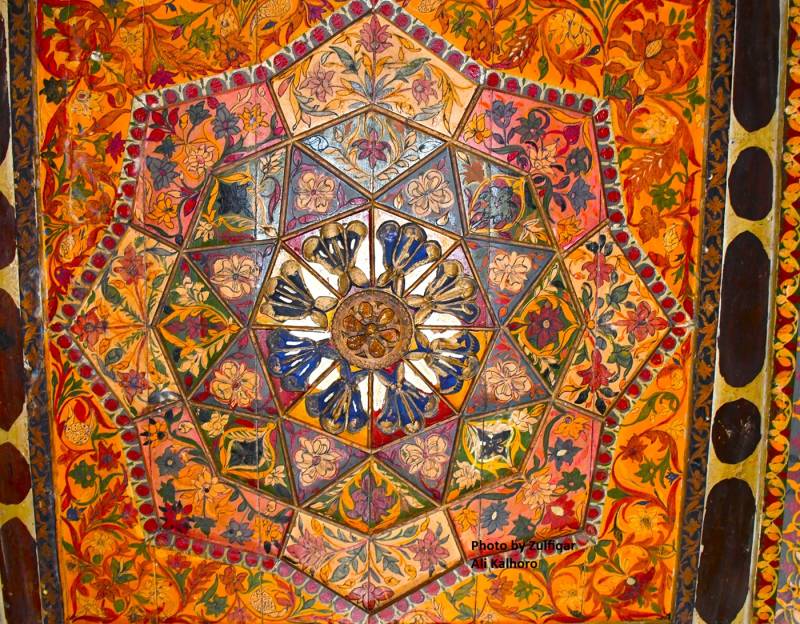
During an interview with Havaldar Noor Abdullah, I learned that the Khokhran wali mosque was constructed around 1942. He was twelve years old when the mosque was built. The stone for mosque construction was sourced from Pera Jangla village, located approximately 5 km north of Mirjan village. Stone was transported by camel and brought to the village, where they were dressed and used in the mosque. According to Havaldar Noor Abdullah, two eminent masons of Mirjan village, Mistri Hayat Muhammad and Mistri Fazal Illahi, constructed the mosque. It took 4 years to complete the mosque. The mosque was also noted for its wood doors and ceiling. It has undergone renovation. In front of the Farooqia mosque is a beautiful old house of Captain Muhammad Malik, which is noted for its wooden doors and ceilings. Lacquer ceilings were used in most of the old houses in Mirjan village. Now, much has been lost. Only the home of Captain Muhammad Malik retains the old, beautiful lacquer ceilings. Such work can also be seen in many other villages in Talagang.