

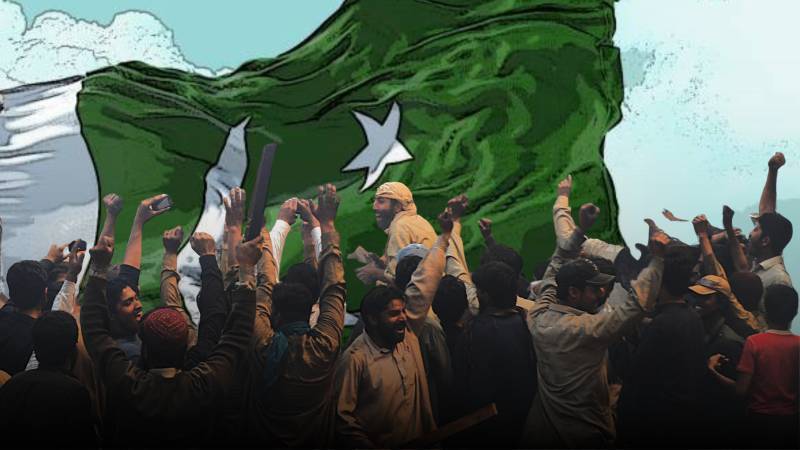
The reality of Pakistanis differs from the State of Pakistan.
Men are willing to bend over to enable genocide and other mad men, far and near.
I do not recognise this Pakistan, which wants to aid and abet men drunk on murder and mayhem. Wonder why? Unbridled power, unaccountable, never checked, would embolden anyone — so why not? Penny for anyone’s thoughts, or buckets full of… do they see themselves in the reflection? The stench of death can never be disguised by oil, smoke and mirrors, or whatever rubs the goat.
Pakistanis, on the other hand, me included, remain numb, perhaps paralysed, definitely exhausted and perpetually aghast — in silent rage. Blinded by the inaction and unable to read the non-silence all around, what is clear, perhaps crystal clear for once, is that ‘we’ are not in sync with Pakistan.
How does it work when people, or people, or citizens, or a bunch of individuals, are not with the country, or the nation, or the state? What is this called? Chaos or nonsense. That is where we are. Pakistan vs Pakistanis. The big P vs the little p. Or is it the other way around?
A prime minister and everyone above remain more concerned about Turkey, Israel, America, China, even Azerbaijan, and their relationships with these nations, than those living in Pakistan. When was the last time the flag bearers engaged with their people? Do they know what concerns the average Pakistani in Mastung, Mastuj, and Badin? Does it matter how many kids are not in school, or the lack of nutrition of millions of Pakistanis?
Selling arms to Sudan seems to fill them with glee; selling off blocks of water offshore is a celebration; underground, above ground, and things that kill seem to be what gets their goat. For whom is all this peddling and lobbying for?
The European philosophers theorised how nation-states are formed; Johann Fichte suggested a shared heritage or language bound a people into a nation, John Locke’s idea of a popular mandate of the people created legitimacy that glued people towards a shared present and future destiny; while Charles Tilly argued conquest over lands and consolidating power through fiscal extraction from residents through a centralised bureaucracy could bind a people into a nation; however tenuously. What binds us?
Since 1947, and some might argue even before, the people of Pakistan have not participated in the conversations and decisions of Pakistan; this is how it has been for most Pakistanis
Looking at Pakistan or Pakistanis through these lenses, we have some of these ingredients, but not most.
Pakistanis aren’t European, nor do they share the historic trajectories of Europeans per se, who arrived at the idea of a nation-state, but does that mean it is an alien idea for Pakistanis?
Is there an innate human predilection irrespective of culture and history? As the philosophers of the concept of the nation-state suggest, there are many paths to this artificial formation of a common identity or allegiance. Are South Asians or Central Asians unable to develop a democratic culture within a nation-state structure?
I tend to veer in the direction that there are innate predilections of being human and their expectations from their community and managers of affairs. I believe South Asians are no different to any other human beings on earth, irrespective of culture, history or modernity.
But many in Pakistan do not believe this to be the case.
Pakistan, which is unrecognisable to Pakistanis, believes Pakistanis do not have a right to their destiny. Pakistan will decide for them.
Since 1947, and some might argue even before, the people of Pakistan have not participated in the conversations and decisions of Pakistan; this is how it has been for most Pakistanis.
Someone else decides for them. Someone else tells them who they are and what they hold dear. Therefore, for many of us, we do not recognise our country. We do not share its image, its voice, its positions, its beliefs. The difference is diversity, but denying the rift that exists between the state and its people can no longer be ignored.
As the walls, blockades, barriers increase, the many different versions of exclusion we call normal in Pakistan, this is not normal by any definition.
When we are told the state is going to fight a war, abroad or internally, without our consent, and on the wrong side of our ally, I realise I am no longer part of this… whatever you may call it.
Today, I am in a very uncomfortable place. What is Pakistan without Pakistanis? Perhaps that is why Pakistan is not recognisable or describable by Pakistanis.
What is Pakistan?
Borders, lands, languages, food?
The mountains, rivers, deserts, plains, and forests are what make me, or us? The absence screams quite loudly NO. People, a land without people. A Pakistan without Pakistanis.
Sometimes you will hear or see the spectacle of folks dancing in bright clothes or playing beautiful music, but what do they think, believe, want, desire, need? That is unheard.
History has shown how people are in one nation one day and another a century later; new identities, new labels. Borders shift. The people remain, but the names and identities change. Or perhaps the other way around.
It takes a second to change everything, or two, or three or four.
Are Pakistanis at that point? Or is Pakistan aware of its fragility?
This Pakistani, Nilofer Afridi Qazi, does not permit Pakistan to collude with murderers, genocidal projects; no more killing human beings, whether inside Pakistan or outside of Pakistan. No more killing Pakistanis due to neglect, violence or hate. No more wars in my name. This binary I am comfortable with. Either you are with us or without us.
Pakistan must acknowledge the ‘i’ in Pakistani and begin to worry about the absence of the ‘i’; it must listen to the “i” before it is too late.
I do not give consent unasked, I know, but I am screaming it out loud anyway.