

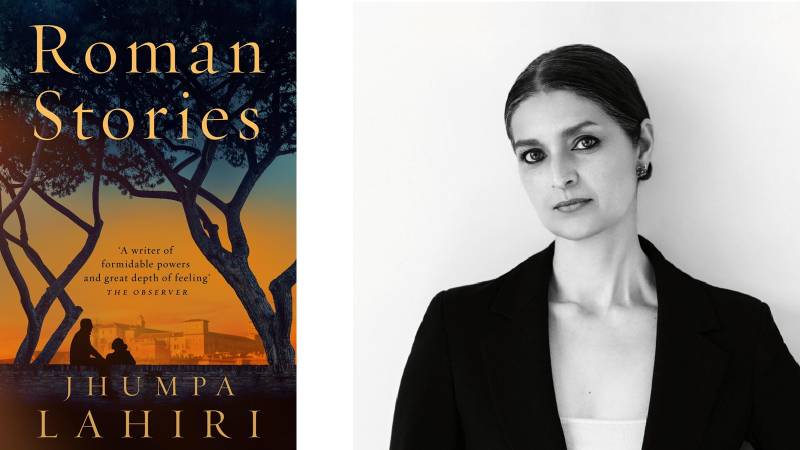
Pulitzer Prize-winning author Jhumpa Lahiri is celebrated for her depiction of immigrant and Indian-American life, yet her tender stories also capture universal themes of longing, loneliness and barriers of communication. She was born in London in 1967 and raised in Rhode Island by Bengali immigrant parents. Jhumpa Lahiri’s upbringing shaped much of her literary voice. She often writes on the tussle between cultures, belonging, and the search for identity. The key works she has written are Interpreter of Maladies (1999), The Namesake (2003), Unaccustomed Earth (2008), The Lowland (2013), In Other Words (2016), Whereabouts (2018), Roman Stories (2023), Translating Myself and Others (2022), The Clothing of Books (2016) and Hell-Heaven.
Roman Stories is a short story collection of nine stories by Jhumpa Lahiri about the lives of people in Rome, particularly immigrants and outsiders who have come and settled there. Lahiri has now lived in Rome for many years. The book has been translated by Jhumpa Lahiri and Todd Portnowitz from Italian to English. The stories explore themes of identity, belonging, and “otherness” in the city, examining the human condition through both the beauty of Rome and the struggles of its inhabitants. The collection is a tribute to the Italian writer Alberto Moravia, focusing on marginalised characters living in Rome and the multifaceted confrontations between newcomers and long-time residents. Though the stories are not connected by plot or recurring characters they do share a sense of place, tone and fixation with belonging, displacement and identity.
The stories in Lahiri’s book emphasise on a variety of characters, including expats, migrants, and refugees, who wrestle with their sense of dislocation and the trial of finding a home in Rome. Many stories revolve around characters in the middle of their lives, reflecting on their past and their place in a new culture, as shown in the example of a woman reflecting on her life during her mother-in-law's funeral. The city itself is a central element, portrayed as both alluring and indifferent, with the stories showcasing its historical richness as well as its subtle and overt intolerance. There are political and social undercurrents, touching on issues like xenophobia and the struggles faced by those living on the margins.
The stories offer a diverse collection of life photographs, from a couple dealing with loss to an outsider family being displaced. Lahiri’s prose is elegant, spare and quietly observant. Perhaps influenced by Italian literary minimalism there are clean lines, restraint and understatement in her writing which is focused on the everyday. Apartments, public transport, conversations, weather are all filled with emotional tension. Reflecting Lahiri’s own life, language perhaps becomes a metaphor for belonging and estrangement.
Some of the stories that stand out among the nine are: “The Boundary,” “Well-lit House,” and “P’s Parties.”
The city itself is a central element, portrayed as both alluring and indifferent, with the stories showcasing its historical richness as well as its subtle and overt intolerance
In “The Boundary,” a caretaker’s daughter observes the lives of a young couple and their daughters (a vacationing family), thus dimming the lines between observer and outsider. The observer explains how the father takes the girls out while the mother stays back relaxes and makes notes and other such tiny details which are of interest to her.
As for “Well-lit House,” a widow feels invisible in her own apartment complex.
“P’s Parties” is simply brilliant. It is an excellent view of social hierarchy and belonging in Rome’s expatriate circles. P throws parties every year is which all sorts of individuals are invited and thrown together to mingle and for what ensues you must pick up a copy of the book.
The book is Lahiri’s evolution as a writer who has moved beyond her English-language debut (Interpreter of Maladies) into a multilingual and transcontinental literary scenario. Lahiri is as always, a naturally gifted and uber-talented writer who pens down short stories with emotional accuracy on universal themes of dislocation. She continues to explore language as identity in Roman Stories.
I admire the intimacy and subtlety of her writing. I had many fun evenings reading the stories lazily and learning new Italian words and terms as some of the words were still in Italian in the book. And best of all, reading the book felt as if one was roaming the streets of Rome itself, it was an almost magical transportation to Italy back to when one had vacationed there, as I could relate to some of the elements in the stories.
It was not just a short course in belonging and identity, the book was a vivid and imaginative read for anyone with any interest in culture, art, history, love, cities, longing, laughter, food, public transport and all the things that we as humans often take for granted. The immigrant tussle for belonging in Roman Stories taught me not to take belonging for granted, it’s not everywhere that one belongs, even in this globalised world. Sadly, these days there is a lot of “otherisation.”
Roman Stories is a beautifully written novel that I would recommend wholeheartedly to all those who love to read. We must all learn from Lahiri’s wisdom.