

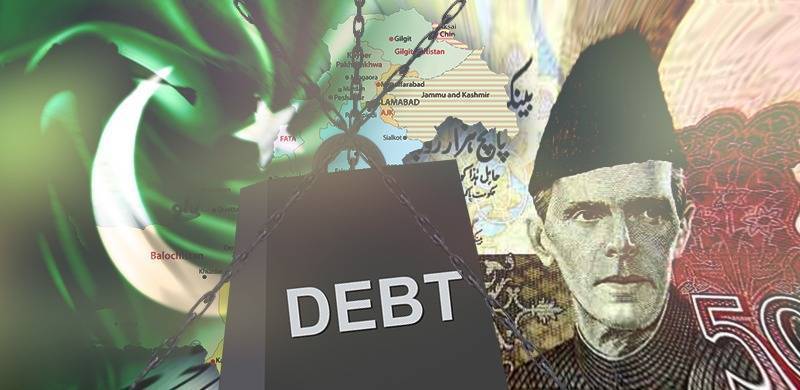
On the desk of every senior finance official in Pakistan lies the same document: a spreadsheet charting debt repayments inching higher and revenues falling further behind. Somewhere in that grim grid of numbers, a figure jumps off the page: $23 billion. That is the amount Pakistan must repay in external debt this fiscal year—nearly half of the entire federal budget committed solely to servicing past loans.
That number is not just a statistic. It is a signal flare, screaming into the void of policymaking inertia and economic mismanagement. This is not the first time Pakistan has flirted with default. It will not be the last—unless someone, somewhere, dares to break the cycle of strategic denial that underpins our national economic story.
Pakistan borrowed a record $26.7 billion last year, with only 13 percent of that amount allocated to development projects. The rest? Used to repay existing liabilities and plug the ever-depleting foreign exchange reserves—a revolving door of crisis disguised as planning. Debt, once a means to an end, has now become the end itself.
There is a delusion in Islamabad’s corridors of power that loans are lifelines. In truth, they are shackles. Every dollar borrowed is a dollar leveraged against national sovereignty. The Ministry of Finance has admitted that at least $12 billion of this year’s obligations are dependent on “friendly country” rollovers—namely China, Saudi Arabia, and the UAE. These are not guaranteed. They are diplomatic IOUs, contingent on shifting global winds and regional alignments.
A single refusal to rollover, and the house of cards collapses.
Global agencies have begun ringing alarm bells. Fitch Ratings has flagged Pakistan’s excessive dependence on short-term deposits and rollovers as a key structural risk. But here at home, we are stuck in a ritual: delay reforms, seek bailouts, increase levies, and pretend the crisis is external. It is not. The real crisis is internal—and moral.
Less than 2 percent of Pakistanis file tax returns. Of those who do, most pay trivial amounts. The elite—real estate moguls, industrial cartels, landed aristocrats—enjoy tax holidays, amnesty schemes, and state protection. Meanwhile, the lower and middle classes face the full force of indirect taxation, subsidy withdrawals, and inflation that bites deeper each month.
It is no coincidence that inequality is rising while fiscal capacity is shrinking. This debt crisis is not an accident. It is the outcome of a deliberate political economy: one that protects privilege and punishes vulnerability.
The $23 billion repayment due this year is not just a number; it is a mirror reflecting a state that has borrowed too much, reformed too little, and pretended for too long
The government’s budgetary response—at least on paper—aims for fiscal consolidation. Reducing the deficit from 5.9 percent to 3.9 percent of GDP is an admirable goal. But at what cost? Growth remains sluggish. Inflation hovers in double digits. Hospitals are underfunded, schools are overcrowded, and development is at a standstill. Austerity without a growth vision is not prudence. It is paralysis.
Pakistan is now borrowing not to build capacity, but to maintain an illusion—the illusion of solvency. This is the core tragedy. Unlike nations that borrow to invest in productivity, exports, and innovation, Pakistan borrows to delay difficult choices. CPEC, once touted as a game changer, is mired in opacity and debt dependency. It has attracted neither the reform nor the foreign capital that was promised.
As the rupee continues to depreciate—losing over 35 percent of its value in two years—wages have stagnated. The purchasing power of ordinary citizens is in free fall. Over 64 percent of Pakistan’s population is under the age of 30. They are growing up in an economy that offers shrinking prospects and swelling debt.
This disconnect between the state’s priorities and the people’s needs lies at the heart of Pakistan’s fiscal failure. Public trust erodes when citizens see borrowed funds enriching a few and burdening the many. If we spend more on interest than we do on health and education combined, we are not managing a state—we are servicing a loan.
So, what must be done?
First, we need honesty from politicians, bureaucrats, and business leaders. There is no more room for vanity projects, unchecked military expenditures, or sweetheart deals for the elite. Every rupee must be tracked, and every foreign loan must pass the test of national interest—not personal or political gain.
Second, tax reform can no longer be postponed. The tax-to-GDP ratio must exceed 13 percent within two years. This is achievable if property taxation is enforced, exemptions are rolled back, and digital integration is pursued with genuine political will.
Third, transparency. Pakistan needs a comprehensive debt audit. The public deserves to know the full extent of our obligations—not just IMF and Paris Club loans, but bilateral and commercial loans from opaque entities. Parliament must be empowered to scrutinise, debate, and challenge debt terms.
Fourth, we must prioritise exports and productivity. That means embracing the digital economy, modernising agriculture, and building capacity for low-cost manufacturing. Without a substantial export engine, our import-driven debt trap will continue tightening.
Finally, our elites, military and civilian must lead by example. Asset declarations, tax compliance, and symbolic sacrifice are more than optics. They are necessary signals to a public that has been asked to sacrifice for decades while watching opulence flourish in cantonments and gated societies.
We are no longer at the edge of a cliff. We are off it—sliding downward with speed. But we can still grasp the ledge if we act decisively.
The $23 billion repayment due this year is not just a number; it is a mirror reflecting a state that has borrowed too much, reformed too little, and pretended for too long. If this crisis is allowed to pass like the others before it—with band-aids, bailouts, and broken promises—then we will have only ourselves to blame.
Pakistan’s economic survival now demands more than clever accounting or diplomatic favours. It requires courage—the political courage to change course, to prioritise people over perks, and to finally treat debt not as destiny, but as a warning.
Will we listen this time?