

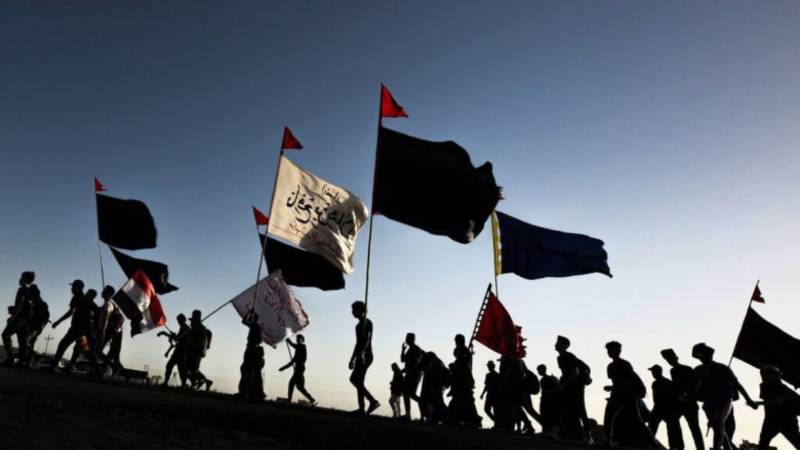
Arbaeen, the fortieth day after the martyrdom of Imam Hussain (peace be upon him), is not merely a religious ritual. It is the symbolic expression of humanity’s historic struggle, the echo of the ancient conflict between light and darkness, truth and tyranny. This solemn anniversary interrogates each generation: Which camp do you belong to? Are you with Hussain’s caravan, or aligned with Yazid’s army?
The genesis of Arbaeen is intertwined with the arrival of Jabir ibn Abdullah al‑Ansari, a companion of the Prophet Muhammad. Forty days after Karbala, he arrived there, placed his head upon the graves of the martyrs, and wept, a gesture that seeded the tradition of visitation. Later, the Ahl al‑Bayt, freed from the captivity of Damascus, traversed Karbala on their route back to Medina. There, Hazrat Bibi Zainab and Imam Zain‑ul‑Abideen mourned at the graves, and thus Arbaeen ceased to be mere ritual; it became a global day of visitation for the oppressed, evolving steadily into a movement.
The Imams of Ahl‑al‑Bayt, particularly Imam Jaʿfar al‑Sadiq, viewed Arbaeen not solely as an expression of personal devotion but as an instrument for awakening collective conscience. The Ziyarat-E-Arbaeen not only honours the martyr’s grandeur but reiterates the purpose for which Hussain sacrificed everything: to establish justice, to resist oppression, and to uphold the truth of the prophetic path.
Wherever tyrannical rule has prevailed, Arbaeen has invariably been seen as a threat. During Saddam Hussein’s Baʻthist regime in Iraq, every aspect of the pilgrimage processions, visitations and mourning gatherings was suppressed. Pilgrims were imprisoned, tortured, or even assassinated. Karbala and Najaf were militarised. Yet impoverished Iraqi pilgrims, undeterred, embarked on secret nocturnal journeys, barefoot and carrying children, determined to reach Arbaeen. In their footsteps lay testimony that the love for Hussain cannot be extinguished by bullets or cages.
Arbaeen is the triumph of conscience over cruelty, the unity of strangers in faith beyond faith, the pilgrimage of humanity towards justice
Today, Arbaeen stands as an international grassroots movement. Every year, millions walk eighty kilometres from Najaf to Karbala, some even beginning from Basra. This is not merely a geographical pilgrimage but a spiritual and ideological migration. Participants include Shia, Sunni, Christian, Sabian, Jewish, Hindu and even the atheist. All unite under Hussain’s banner. His message transcends sect; it addresses humanity, not factions.
In Pakistan, too, love for Hussain is manifest. Hundreds of thousands prepare for months to make the overland pilgrimage to Iraq. They sell their possessions, take loans, secure visas and travel via Iran because air travel is unaffordable. Yet recently, the Pakistani government imposed restrictions on this land route during Arbaeen, citing security, diplomatic inability, and limited resources. These restrictions have not only curtailed the pilgrims’ religious freedom but crushed the hopes of thousands who prepared in good faith. Protests have erupted across Balochistan, Sindh and Punjab. Tearful pilgrims are demanding only one liberty: the freedom to love Hussain—must this, too, be regulated?
Regrettably, a number of elements in Pakistani society still view Arbaeen with sectarian suspicion. Yet Imam Hussain did not rise for one sect; he rose for the entire ummah—rather, humanity by and large. His martyrdom is not confined to a single community; it is a timeless clarion call for all who dare to defy injustice and uphold dignity.
If the Pakistani state and society were to embrace Arbaeen as a symbol of unity rather than division, it could become not only a bridge between schools of thought but also a foundation for religious tolerance and social peace.
Further afield, modern forms of oppression continue to emerge. Imam Hussain’s message must echo louder than ever. The children in Gaza, the women in Yemen, prisoners in Kashmir, and the deceased in Afghanistan all trace their moral lineage back to Karbala—a willingness to refuse submission in the face of tyranny.
Arbaeen is not merely remembrance of martyrs; it is a warning to the Pharaohs of our age. To treat it as a hollow tradition would betray Hussain’s sacrifice. But to link it with awareness, affection, justice, and freedom means Arbaeen will remain an earthquake beneath the seat of oppression for centuries to come.
Let us recall the eternal Qur’anic injunction: “O you who believe! Stand firmly for justice, as witnesses to God, even if it be against yourselves, your parents, or your kin…” (Qur’an 4:135) This was the injunction Hussain embodied; this is the instruction every pilgrim reciting the Ziyarat of Arbaeen reaffirms.
The Karbala paradigm provides a model for ethics, resistance, and identity throughout time. Scholars compare Hussain’s martyrdom to Christ’s sacrifice for justice, and note that pilgrims on this path undergo spiritual transformation as they endure hardship and unity in communal pain. Arbaeen, moreover, ranks among the world’s largest annual gatherings, with over twenty‑two million participants in 2023 alone, drawn from across the globe in service and devotion.
Thus, Arbaeen is the triumph of conscience over cruelty, the unity of strangers in faith beyond faith, the pilgrimage of humanity towards justice. It remains an open-ended journey that continues to call: Are you with Hussain, or with Yazid?