

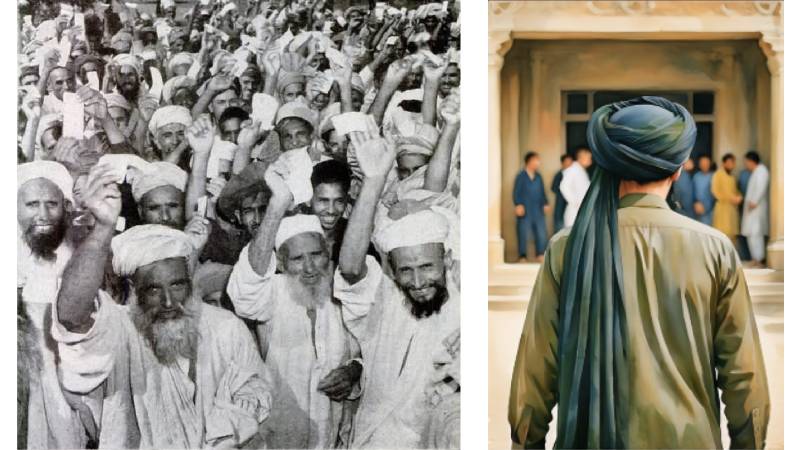
The sun of July 1947 burned like fate itself—merciless, absolute, final. The earth beneath our feet cracked with heat, but something far older and deeper stirred in the hearts of the Frontier. This was not just another summer. This was Qismat – a destiny etched in the calloused hands and sunburnt brows of a people who had resisted empire after empire and now stood at the doorstep of a new dawn.
My uncle used to speak of that day with eyes that glistened – not from nostalgia, but from reverence. The village had emptied. Men walked barefoot, some leaning on canes, others on nothing but pride. Their white shalwars were not just clothing — they were uniforms of resolve. One carried a prayer bead, another a dusty copy of the Qur’an. They weren’t soldiers. They weren’t landowners. They were cobblers, farmers, herdsmen. And yet, they marched like they had been summoned by the trumpet of the Last Day. This was no ordinary moment. No province in British India was asked what it wanted.
Except one. Ours.
Punjab was sliced by foreign hands. Bengal was amputated on paper. But NWFP? We were given a ballot. A Rai Shumari. And for the first time in a thousand years, no emperor, no viceroy, no khan ruled over us – only our conscience.
We may have been forgotten by the capital, but we never forgot the capital we invested in Pakistan, with our tears, our dreams and our faith
The Raj called it a referendum. We called it a wada – a solemn promise. We didn’t ask what Pakistan would give us. Would there be schools? Hospitals? Roads? Who knew? And frankly, who cared?
All we knew was: we were done bowing. To Delhi. To Kabul. To London.
We would now bow only to the Almighty, and to the flag born of faith.
Congress had their champions here: Bacha Khan, noble and sincere, yet tethered to a fading dream of unity. His brother Dr Khan Sahib called for boycott. They warned us: this ‘Pakistan’ is just an idea. But to us, that idea was everything.
A man asked an old villager that day, “Do you even understand what Jinnah is saying?” He smiled through his cracked lips and replied, “No, but I believe him. Whatever he says, it’s for our honour. Allahu Akbar!”
And that was it. The verdict. Not just of the ballot box, but of history. We voted. 289,244 souls.
99.02% said Yes. Yes to Pakistan. Yes to faith. Yes to freedom.
It wasn’t just a vote. It was a cry that cracked the heavens.
“Pakistan Zindabad!”
Not chanted, but roared from the throats of the barefoot, the unseen, the unheard.
Yes, the dawn was bloodied. Yes, promises frayed. The very people who had bled for this idea were later questioned, doubted, and at times sidelined. But no one—not one—can erase what was carved into the soil of Peshawar that day.
We may have been forgotten by the capital, but we never forgot the capital we invested in Pakistan, with our tears, our dreams and our faith.
Because we remember the march.
Because we remember the shout.
And in that shout lived Khushal Khan Khattak’s dream – not of rule, but of izzat. Not of conquest, but of watan. A homeland not perfect, but ours. Warts and all. A Pakistan born not in drawing rooms, but in the dust and devotion of men.
These were men who walked without sandals, but with unshakable belief.
Pakistan Paindabad. And this time, we said it with our souls.