

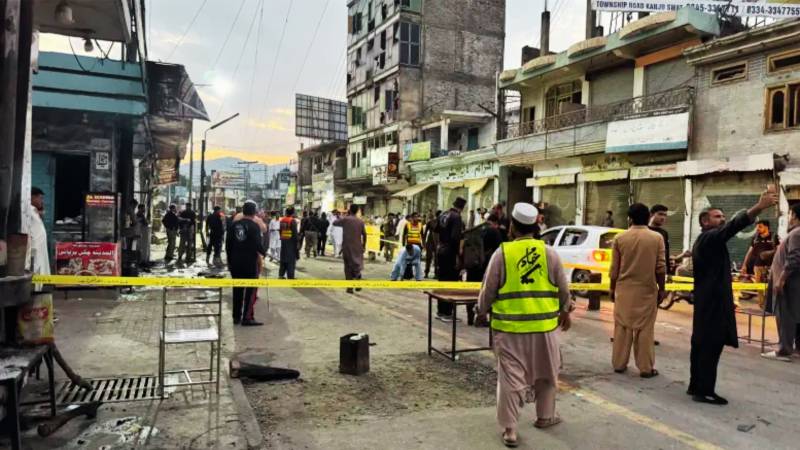
On Sunday evening, a suicide bomber blew himself up outside Kabal Police Station in Swat, killing 10 people — including 7 police constables — and wounding 12 others, including 8 police personnel and 4 civilians. In the days that followed, grieving families, political leaders, and protesters took to the streets of Kabal, all asking the same question: when will the cycle of violence and terrorism end? The attack came at the close of Pakistan’s deadliest month of 2026.
In Swat Valley at 6:15 PM on Sunday's, as a Pashtun Tahaffuz Movement rally was wrapping up in Kabal Chowk, a suicide attacker tried to enter the Kabal police compound. Stopped at the main gate, he detonated himself.
IG Khyber Pakhtunkhwa Zulfiqar Hameed said the attacker had been trying to get inside the compound that houses Kabal Police Station, the police lines, and a facilitation center. “Our brave police personnel stopped him without regard for their own lives. Because of their timely action, a much larger tragedy was averted,” he said.
Hameed told The Friday Times that a Joint Investigation Team would be formed to probe the attack. He told The Friday Times, “The suicide bomber has been identified. We also have intelligence about other potential attackers in the province. We had prior concerns, which is why security was tight.”
An FIR was registered at the CTD police station under the 7-ATA terrorism clauses on the complaint of the SHO Kabal. The FIR named Tehreek Taliban Pakistan commander Muzaffar and other militants as suspected perpetrators.
The Human Cost
Behind the casualty figures are families whose lives have been torn apart.
He came home for a wedding
Dr. Maaz Khan, 33, was not part of the peace rally. He was the only son among 4 sisters, and had flown in from Romania just days earlier for his sister’s wedding on August 3.
Dr. Maaz’s uncle, Sardar Ali, told The Friday Times that he had gone to the market near the kabal police station to buy things for guests who had come from his sister’s in-laws. “He came home after a long time and met his father after five years. His father works on a ship,” Ali said. “He fulfilled that dream, and now he’s gone forever.”
Ali further told TFT that Dr. Maaz was in his final year of Doctor of Veterinary Medicine, in Romania. At home, wedding cards were still on the table. “We were supposed to be enjoying the marriage function,” the family said. “Instead, we are sitting at a janaza now.”
Today we became orphans
Assistant Sub-Inspector Hashim Khan, 42, was among the 7 police officers martyred. He left behind 5 young children. His brother Yaqoob, speaking with tears in his eyes, told TFT. “He was the eldest of us. Today we became orphans.” He described searching for Hashim after the blast — first at Kabal Police Station, then at Saidu Sharif Hospital, where the body was finally found.
Hashim’s son, 18-year-old Muhammad Hassan Khan told The Friday Times that we stood beside his father’s coffin during the funeral, which was given full state honors with a guard of salute. Senior police officers, civil officials, army officers, and a provincial minister attended. “My father sacrificed his life for the country and for peace,” the 18-year-old said. “I will also join the police and protect Swat and Pakistan.”
He then appealed directly: “Please stop this. He was the head of household. We are 2 brothers and 3 sisters. The terrorists have destroyed our home. Just let us live.”
Protests and Political Fallout
The bombing sparked immediate protests. Members of civil society and lawyers took to the streets of Khwazakhela, Swat, chanting slogans against terrorism and demanding lasting peace.
Visiting Swat to offer condolences to the families of those killed in the attack, Khyber Pakhtunkhwa Chief Minister Sohail Afridi strongly condemned the incident and vowed to restore peace in the province.
Afridi told The Friday Times that terrorism was unacceptable under any circumstances and pledged that the provincial government would ensure peace "at any cost." He blamed the resurgence of militancy in Malakand Division on what he described as the federal government's "flawed policies," alleging that those responsible for securing the country's borders had failed to perform their duties effectively.
Referring to the federal government's declaration of 2026 as the "Year of Peace," Afridi questioned why militants were "being given free rein." He warned that after Swat, other districts such as Buner could also face similar threats if decisive action was not taken.
The chief minister also criticized the federal government, calling it a "Form-47 government" without a public mandate, and accused institutions "whose job is not politics" of interfering in political affairs. He reiterated his commitment to restoring lasting peace across Khyber Pakhtunkhwa.
Governor Khyber Pakhtunkhwa Faisal Karim Kundi on Tuesday told The Friday Times that police and security forces were engaged in a war against terrorism and called on the chief minister to convene an in-camera session to discuss the security situation.
He said the police had yet to be equipped with modern weapons and stressed that the federal and provincial governments must work on the same page to combat terrorism. He added that all political parties were united against terrorism. The governor alleged that terrorists were receiving support from across the border and said the Afghan government had failed to act despite repeated warnings. "What kind of Islam is this, where there is terrorism in mosques, colleges, and other places?" he asked, adding that there would be no talks with terrorists.
Federal Minister for Kashmir and Gilgit-Baltistan Engineer Amir Muqam, after visiting the injured at Saidu Sharif Hospital, directed the hospital administration to ensure the provision of all possible medical facilities.
Muqam told The Friday Times that the entire nation must unite against terrorism, describing the fight against militancy as a shared national struggle.
He vowed that the government would defeat the designs of terrorists at all costs and would not allow miscreant elements to challenge the writ of the state. Muqam said the current situation demanded unity rather than political criticism, adding that he himself had been a victim of terrorism. Condemning the Kabal blast as a cowardly act, he conveyed Prime Minister Shehbaz Sharif's condolences to the families of the martyrs and expressed solidarity with the injured.
The Bigger Picture: July 2026
According to the Pakistan Institute for Conflict and Security Studies, July was the bloodiest month of 2026.
According to its report, 205 people were killed and 218 injured in terrorist incidents nationwide. The dead included 112 security personnel, 74 civilians, and 19 members of peace committees — the highest monthly death toll for security forces since January 2023, and the highest for peace committee members in 10 years.
Security forces responded with the largest counter-terror month in a decade, killing 401 militants. But militants also escalated: at least 8 suicide attacks were recorded, 5 of them vehicle-borne — the highest in 10 years. Kidnappings doubled from 33 in June to 66 in July.
For Swat, a district that paid a heavy price during the 2009 insurgency, the Kabal gate bombing is a painful reminder that the threat has returned. As one grieving son put it: “We just want to live in peace.”