

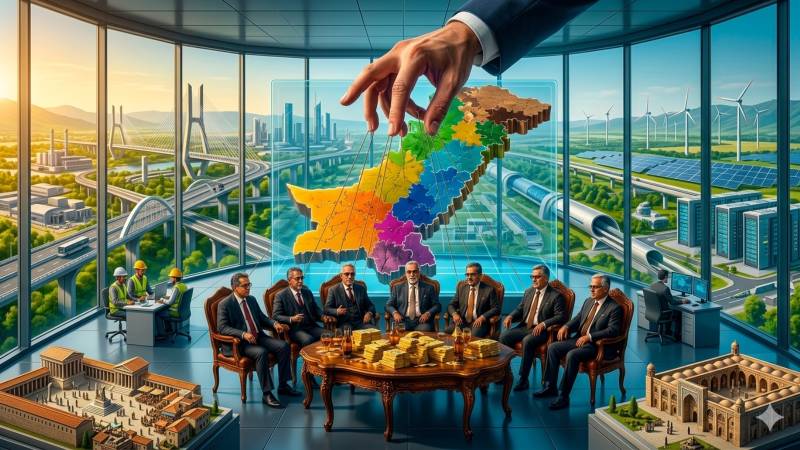
The establishment wants to redraw the map. Pakistan's crisis was never about the map.
Mohsin Naqvi has given an old idea a new sales pitch. Speaking at the Pakistan Economic Summit in Islamabad on July 30, the interior minister said Pakistan's governance system has collapsed. He said it cannot be fixed without new provinces. Ordinary people need jobs and basic services, he said, and the current system cannot deliver either. His warning was blunt: without drastic change, he said, we will be having this same conversation ten years from now.
Within days, others jumped in. Abdul Aleem Khan, a federal minister and head of the IPP, called for splitting each of Pakistan's four provinces into three. MQM-P leaders Farooq Sattar and Khalid Maqbool Siddiqui backed the idea. Former prime minister Shahid Khaqan Abbasi supported it too, though with caution. Mustafa Kamal, who has pushed for years for a separate Karachi or Sindh province, called it vindication. Even the army's spokesman, DG ISPR, weighed in. He noted that Pakistan's population has grown many times over since 1972 while the number of provinces has stayed the same, and said the current setup deserves a fresh look. He was careful to add that any such decision is for elected leaders to make, not the army.
The noise around this debate should not be confused with substance. Pakistan's crisis is not about geography. It is about how power works. The country keeps concentrating wealth and privilege in the hands of a few networks. The result is weak growth, weak institutions, weak schools, and weak governance. New provinces would mean new capitals, new assemblies, new chief ministers, new bureaucracies. None of that makes the state more capable.
In fact, without real reform, it could simply give the same elites more turf to fight over. Some critics are already saying this out loud. More provinces mean more government departments, more official homes, more senior posts, and more protocol and security for officials. Somebody has to pay for all of that. It will likely be the taxpayer.
The timing matters too. Pakistan's biggest threat today is not military. It is economic. A country that cannot educate its children, collect enough tax, grow its exports, or attract real investment will eventually find its security at risk too, no matter how many missiles or divisions it has. Economic weakness has become a national security problem.
But instead of fixing the real causes of decline, Pakistan's rulers keep reaching for shortcuts. Over the decades the fix has been a military government, a technocratic government, a national government, a government of experts, constitutional tinkering, local government reform, presidential rule, parliamentary rule, accountability drives, court activism, privatization, nationalization, administrative restructuring. Now it is new provinces.
The labels change. The results don't. The reason is simple. Pakistan's problem is not policy. It is power. Take state-led development. The common story is that Pakistan's nationalization drive failed because governments are simply bad at running the economy. The real history is more complicated. State-led finance helped build some of the world's most successful economies. South Korea and Taiwan leaned heavily on state banks, industrial policy, and directed credit. Their governments picked winners, backed them, and disciplined private business. State involvement was not an accident of their success. It was the engine of it.
Pakistan tried some of this too. Early results were promising. Bank branches spread, deposits grew, credit reached sectors that had been ignored. It fell apart not because state involvement was doomed from the start, but because the system was captured by patronage and political interference. Elite groups turned the machinery of development into a machine for handing out favors. That pattern has repeated across every sector and every government since.
Pakistan's history since independence can be read as one elite group after another taking turns at the top, while the underlying system of privilege stays intact. Landlords gave way to industrialists in some periods. Military and bureaucratic alliances ran things in others. New business families rose. Old political dynasties adapted. The names changed. The system did not. This is what the new provinces debate misses.
Who will actually run these new provinces? Naqvi himself has offered no real answer, only a process. His pitch is that political parties should lock themselves in a room, for a day or a month or a year, and hash it out. That is a plan for a meeting, not a plan for power. It says nothing about who will control land, budgets, contracts, and government jobs in the new units. It could easily be the same networks that control them today. If the same people keep controlling land, credit, contracts, and regulation, then adding more provinces just adds more places for them to extract rent. Turning four poorly governed provinces into ten poorly governed provinces is not reform. It is bloat.
Real reform means taking on people powerful enough to stop it. Pakistan's problems have been ignored for generations: too few people pay tax, the elite get exemptions, schools fail, local government is weak, land and wealth sit with a small class, the bureaucracy has no incentive to perform, and the country leans on foreign money instead of raising its own.
The countries that succeeded did not stop at building new institutions. They changed who held power. South Korea and Taiwan carried out land reforms that broke the old landlord class. They poured money into education. They gave their bureaucracies real independence and clear targets. They tied business profits to export success, not political connections. Pakistan never went through that kind of change. Instead, outside money filled the gap. Foreign aid, strategic value to bigger powers, remittances, debt, and repeated bailouts took the pressure off the ruling class to build a real tax system. The result: crisis after crisis gets managed, never solved.
This also exposes a weakness in Naqvi's own framing. He talks like a manager pointing out a broken system, and on that point he is not wrong. But managers can improve how things run. They cannot change who holds power. Pakistan has seen plenty of capable technocrats enter government, only to find that good ideas mean nothing against entrenched interests. Experts can write the plan. They cannot force it through when it threatens people who benefit from the status quo.
Naqvi is not really speaking as a technocrat, though. He speaks for an establishment that is clearly unhappy with how PML-N and PPP have run the country, but has no real strategy for fixing Pakistan's many crises beyond leaning harder on dissent. Breaking up Punjab and Sindh looks less like decentralization and more like a way to break the grip both parties hold over their home turf. Splinter their provinces, and you splinter their power base too.
That points to a deeper bind the establishment is in. It cannot hold a genuinely free election, because it fears Imran Khan would win it. It also cannot simply impose direct military rule the way it did in 1999, because the country, the region, and the world have all changed since then, and that kind of takeover may no longer be possible to pull off. New provinces offer a way to reshape the political map without doing either. It is a workaround, not a strategy.
New provinces would mean new capitals, new assemblies, new chief ministers, new bureaucracies. None of that makes the state more capable. The reason is simple. Pakistan’s problem is not policy. It is power.
History offers one more uncomfortable lesson. Countries usually don't develop because they became democratic first. More often, democracy followed development, not the other way around. Britain industrialized long before most people could vote. The United States became an economic power while denying political rights to large parts of its population. Much of Europe's wealth came from colonies and slavery. The East Asian economies most often held up as success stories grew fastest under authoritarian rule, not democracy.
That does not mean dictatorship is the answer. If it were, the world would be full of prosperous dictatorships. Egypt, Myanmar, and many African states prove otherwise. Their failures show that authoritarian rule guarantees nothing. The real lesson is that development needs a state strong enough to discipline its own elites and stick to long-term goals. Whether that state is a democracy or not is often beside the point.
Pakistan's problem is that it has failed at both. This brings us to an uncomfortable truth. Pakistan's likely future is not a choice between good democracy and good authoritarian rule. It is a choice between different flavors of kakistocracy — government by the least capable and most self-serving people, a word the economist Paul Krugman helped popularize. This is not limited to one type of government. People have used the word for elected leaders as often as for dictators. Donald Trump's America, Narendra Modi's India, Bolsonaro's Brazil, army-run Myanmar, and authoritarian Egypt have all faced the same question: does voting or does central control do a better job of keeping bad leaders out?
The evidence says neither does, reliably. Bad democracies produce bad leaders. Bad dictatorships produce bad leaders. The one advantage democracies keep is a way to correct course peacefully, even if imperfectly. Pakistan's own record makes the point. After nearly eight decades, repeated stretches of military rule have not left Pakistan with stronger institutions, a bigger economy, or a more capable state than India has built through its messy, often dysfunctional democracy. India's democracy has plenty of flaws. Pakistan's military interludes have not done better.
That is not an uplifting conclusion. There is no grand new solution here, no silver bullet, no clever new map. But wishful thinking will not fix this. Islamabad is once again reaching for a map instead of a mirror. Pakistan needs a full reset of how its economy and politics work. It needs institutions that discipline elites instead of serving them. It needs a state that rewards work over connections. It needs a competent bureaucracy, real fiscal reform, and a serious push on education — a strategy that survives changes in government instead of resetting every few years. That kind of change needs something Pakistan does not currently have: a group of leaders willing to give up short-term privilege for long-term national gain. It would take real courage, real competence, and leaders willing to take on the very interests that have run the country for generations.
That is the tragedy. That is the real story here. It is not just that Islamabad can't act on the diagnosis. It is not clear the establishment has one. Three and a half years in the corridors of power, by Naqvi's own count, and the response to Pakistan's crisis is still a map. Not a tax reform. Not a plan for the schools or the patronage machine that hollows out every institution it touches. Just new lines on paper. An establishment that understood the problem would be talking about who captures the state, not how many provinces it should be divided into. Until that changes, Mohsin Naqvi's new provinces will do little more than rearrange furniture in a house whose foundation is still cracking.