

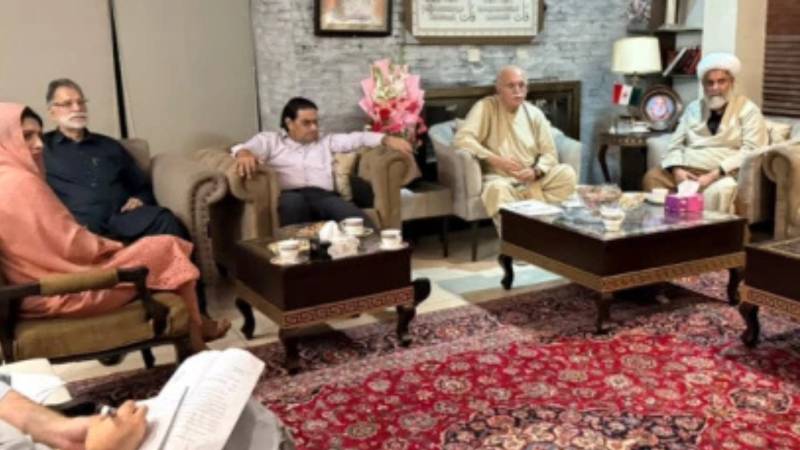
A few days ago in Islamabad, a meeting was organised by the six-party Tehreek Tahafuz Aayeen-e-Pakistan (or the Movement to Protect the Constitution of Pakistan) at Islamabad’s Legend Hotel. Leaders from the Pakistan Tehreek-e-Insaf (PTI), Sunni Ittehad Council (SIC), Awam Pakistan, Majlis Wahdat-e-Muslimeen (MWM), the Pashtunkhwa Milli Awami Party (PkMAP), and others attended. It was called the "National Conference on Constitutional Supremacy".
Sadly, I did not attend this—not because I didn’t want to, but because I was unaware of the meeting. However, I did manage to read the press release by Mustafa Nawaz Khokhar, which said everything that needed to be said.
Does this give me hope for a revival of democratic action by politicians—or by those who aspire to be politicians? Not really. Why?
To begin with, when I read the list of "political parties" that attended and call themselves the TTAP alliance, my heart sank. Perhaps TTAP reads too closely to TTP. The members, individually and politically, have already displayed their mentality and support for extremely undemocratic positions over decades. They do not represent hope, nor are they capable of upholding norms that represent democratic ideals. Regressives aside, what is this alliance asking for? Rule of law? Freedoms for the general public? These are democratic ideas, they do not believe in themselves. This hubris and hypocrisy remain the hallmark of Pakistani politics: the status quo, with faces changing occasionally.
That said, Mustafa Nawaz Khokhar is an exception—along with a handful of other individuals in this motley crew who are calling themselves the Opposition.
The English-language press reported that “civil society” was also involved in these two-day discussions. I am very curious: who were their representatives? It would be enlightening to hear their voices and perspectives. Perhaps they meant the PTM and BYC, who remain incarcerated, persecuted, blacked out, and maligned social movements in Khyber Pakhtunkhwa, the former FATA, and Balochistan?
Those in service to this coterie have no interest in the welfare of the 250 million Pakistanis, who are growing dangerously angry, young and poor
Some feedback suggests that the “political parties” present focused on their self-interested agendas rather than on what is required for Pakistanis to have a better present and future. For example, the PTI—with all its contradictory positions—remains primarily interested in releasing Imran Khan. This is a reasonable demand, given the state of our judicial system. But what about the thousands of missing persons from Balochistan, KP, and Sindh? A political party focused solely on the welfare of one individual is not a party for a nation—it is a party seeking power through a popular person.
Imran Khan has no doubt become a lightning rod for many who simply want change, and who have set aside his flaws—for now—just to break the lockjam of Pakistani chaos.
Is Imran Khan the real Opposition? I don’t think so. The millions in PTI who support him, on the other hand, perhaps are. Understanding this distinction may be the beginning of a genuine journey towards democratic evolution in Pakistan.
I recall when the Awam Party was being established and Imagine Pakistan dialogues were being organised across the provincial capitals. These were led by Shahid Khaqan Abbasi, former Prime Minister from the PML-N—an able and progressive individual. I once asked him: when was the Awam Party going to the people? Conferences and discussions in boardrooms, hotels, press clubs and TV studios do not translate to engagement with 250 million citizens. These are the people who require inclusion. They remain effectively disenfranchised, unheard, unseen, and disconnected from Pakistani politics—old or new, hybrid or whatever came before. I never quite got a straight answer.
Not to be pessimistic or disparaging, in the current claustrophobic and increasingly dangerous environment, any opposition voice is welcome and necessary. But it is also important to distinguish between merely breaking the cycle of the same and a genuine opposition.
One cannot paint every individual with the same brush, but Pakistan has seen over 55 years of fake democratic political parties created by the permanent power structures. These offer personal enrichment and state largesse to a few. Those in service to this coterie have no interest in the welfare of the 250 million Pakistanis, who are growing dangerously angry, young and poor.
To break the cycle, or even move the goalposts slightly, we need to see more faces, voices, and leadership from the unheard. Political movements are born from the people, not conference rooms. Mansoor Pashteen and Mahrang Baloch are such faces and voices. How many more are there—fighting similar struggles in Sindh, Gilgit-Baltistan, and southern Punjab—who remain unseen and unheard at the centre? They do exist, and they are there for the people locally.
These citizens—these leaders of the people—represent the majority of Pakistanis (under 35), and are children of the perpetual conflict and pain too many have lived through for generations. These genuine opposition voices are the children of war who reject war, conflict, and violence. They remain unheard and unseen. When we see an opposition with these faces and voices, we will then have hope that Pakistan is finally moving towards change.
These unheard, unseen voices do not need to convince the centre—they are the demos, and they are democratic Pakistan. They are what the country needs at the helm to offer the vast majority an opportunity to unchain themselves from the weaponised, regressive social-political norms.
I imagine a Pakistan unchained and free to celebrate all of its selves, safely. Until then, the Opposition Conference on the Constitution will need to prove its intentions in action and deed.