

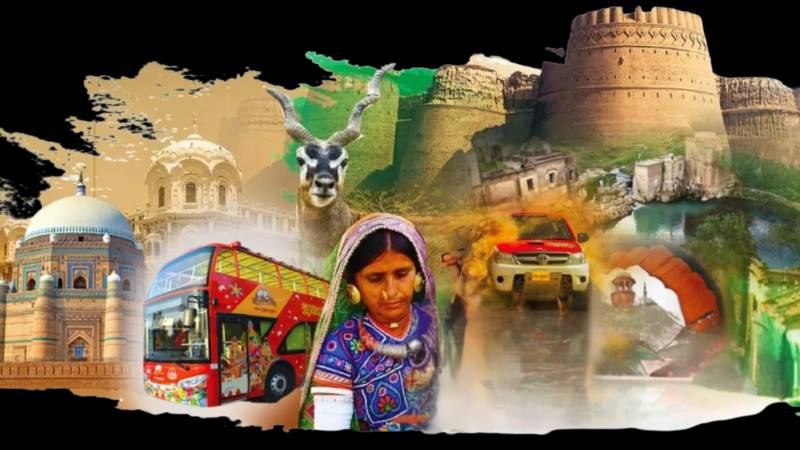
When Punjab announced its Tourism Policy in 2019, it labelled it more than just another government initiative. It was a promise to rethink how the province presents its identity to global travellers. Hometown to centuries of history, sacred landscapes, and rich culture, Punjab has long kept the raw ingredients for a prosperous tourism economy. What it was missing was a comprehensive and inclusive strategy to connect these ingredients. That’s where the Youth Affairs, Sports, Archaeology and Tourism (YASAT) Department of Punjab intervened and crafted a policy intended to transform Punjab’s heritage into a sustainable source of dignity and well-being.
The new policy had a direct but strong goal: tourism should become a stimulus for economic development and a source of inclusive growth. The plan incorporated three main reforms, i.e. financial, administrative and institutional, based on a thorough study of the province’s tourism industry through SWOT (strengths, weaknesses, opportunities and threats) analysis. For the first time, Punjab’s government set out to lessen its own role in service distribution, calling private investors to guide where bureaucracy once fixated. This step aimed to form a tourism environment governed by innovation, partnership and opportunity.
The policy didn’t just define grand goals; instead, it proposed a practical roadmap. Institutions like the Tourism Development Corporation of Punjab (TDCP) and the Department of Tourist Services (DTS) were to be strengthened to guide reforms. The plan aimed for more cooperation between federal and provincial agencies, improved regulation and a stronger partnership with the private sector. In fact, Punjab desired to transform its approach to handling tourism from being directly involved in governing it to creating an atmosphere that permits tourism to develop on its own.
Over the next few years, the policy started to take shape. In 2021, the provincial government announced an outsourcing policy for government rest houses and guest houses, calling private actors to run them under Public-Private Partnership (PPP) models. TDCP contracted with departments like Forests and Irrigation to identify capable tourist sites and open them up for private development.
Simply making policy is not enough; it should be reviewed continuously, and improvements must be added to gain maximum output, according to the needs of each location
Across Punjab, new spots were introduced, facilities were improved, and safety measures were introduced. Tourism Squads were deployed, CCTV cameras installed, and information boards placed at important sites. The Institute of Tourism and Hotel Management (ITHM) boosted its training programmes, formulating a skilled team to meet increasing visitor requirements.
But like many other public policies, progress was not inclusive. Political instability remains a continuous phenomenon in Pakistan’s governance, which means frequent changes in departments, each bringing its own priorities. While privatisation upgraded the maintenance of some sites and facilities, real evidence of enhanced revenue remains missing. More critically, the policy lacked a midterm review mechanism, which made it difficult for decision-makers to determine what worked, what did not, and what improvements should be introduced.
One of the most encouraging features of the 2019 policy was its eco-tourism component, which focused on aligning tourism development with environmental sustainability. Some noticeable changes were seen, like public toilets and trash bins being placed at different tourist locations and cleanliness approaches introduced at famous spots. Yet these steps hardly meet the true needs required for Punjab’s tourism’s actual growth. As climate change intensifies, the province’s tourism potential faces serious threats.
Floods in 2010, 2022 and again in 2025 damaged large parts of Pakistan, and Punjab was not excluded. Heritage sites such as the Badshahi Mosque in Lahore and the Kartarpur Sahib shrine near Narowal experienced damage and temporary shutdowns. The floods didn’t just damage monuments; they also ruined tourism roads, destroyed infrastructure and eliminated years of efforts and investments. Despite these alarming conditions, the 2019 policy possessed no clear strategy for emergency management or climate resilience. In a country that is highly vulnerable to climate change, this negligence could prove costly.
Simply making policy is not enough; it should be reviewed continuously, and improvements must be added to gain maximum output, according to the needs of each location. Therefore, Punjab tourism officials need to communicate with climate scientists, urban planners and engineers to build climate-resilient infrastructure. New hotels and tourist services should be inspected for structural strength and environmental safety, supervised by independent evaluation teams. Training services for tourism staff should now include disaster response skills, ensuring tourist safety during natural catastrophes.
Funding is also an important factor, and by expanding public-private partnerships, the financial load on the government alone can be reduced.
Punjab’s Tourism Policy was a great start. It was an acknowledgement that the province’s cultural and natural heritage could be both sustained and flourish. Yet, as floods and changing politics continue to test its foundation, the actual success of this policy will depend on how quickly Punjab’s tourism department adapts to the climate risks posed by floods to tourism infrastructure. If the government can combine its heritage dignity with climate change planning and institutional stability, the province has a greater chance not only to remain a destination but to become a model for resilient and sustainable tourism in South Asia.