

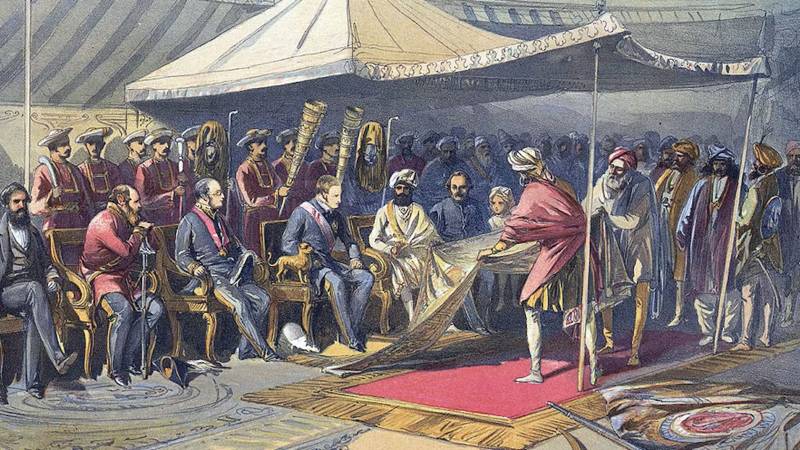
The British Raj ended in August 1947 but the nearly 2 billion inhabitants of the South Asian Subcontinent continue to suffer from its overhang. The most visible manifestation is linguistic apartheid, which is the use of English words, sentences and paragraphs when natives converse in a local language.
I studied English in Catholic schools in Pakistan. Most students did not speak English at home but in class they were required to speak in English.
Most people in Pakistan studied in Urdu-medium schools, but we kept our distance from them. Unknowingly, we were participating in linguistic apartheid.
In college, I found myself in classrooms from Urdu-medium schools for the first time. When I entered Karachi University, I discovered they were in the majority. Some were smart and got excellent marks. When the university hired me as a lecturer, I taught in English, knowing that my vocabulary was probably going over the head of several of my students. That is what that culture had taught me.
It all changed when I came to the US, as I encountered students from around the world. The language of instruction was English. Students would speak to each other in English when discussing the subjects they were studying.
But there was a major difference. Students from non-English speaking countries, such as the Arabs, the Chinese, the French, the Japanese, the Latin Americans and the Persians, spoke in their native language to each other. I did not detect any injection of English in their conversation.
That opened my eyes. English was just a means of communication, not a status symbol. However, whenever I travelled back to Pakistan during the summer and winter breaks, linguistic apartheid was omnipresent.
Even in the early 1980s, I saw the words “Meat Market” written in Urdu letters on a store in Karachi, even though “Gosht-ka-Bazaar” existed in Urdu.
The diplomas of my bachelor’s and master’s degrees from the University of Karachi in 1973 are written in two columns. In the Urdu column, the word “university” is written in Urdu letters, but later in the same diploma the Urdu word for university, “jamia,” is written. MA is written in Urdu letters as MA and BA is written in Urdu letters as BA.
In Malaysia, despite a history of British colonialism, knowing English and being considered learned are not enmeshed with one another as they are in South Asia
Yet, many English words are correctly translated, confirming that there is no deficiency of words in the Urdu lexicon. For example, the English word “faculty” is translated as “kuliya” in the Urdu script. “Arts” is translated as “fanoon,” “whereas” as “harga,” “subject” as “mazmoon,” “economics” as “muashiat,” “degree” as “sanad,” “first” as “awwal,” “class” as “darja,” “master of arts” as “mahir fanoon,” and “honours” as “imtiazi.”
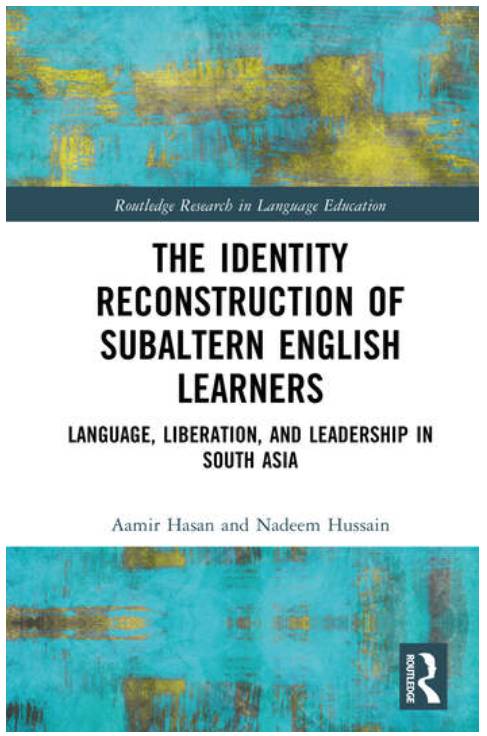
The anglicisation of Urdu has only gotten worse with the passage of time. Linguistic apartheid has gained so much traction that it is now the subject of a new book, Identity Reconstruction of Subaltern English Learners: Language, Liberation and Leadership in South Asia. The authors are Aamir Hasan and Nadeem Hussain.
Initially, the title threw me off. In my mind, and I suspect in the minds of many other readers, the word “subaltern” means an army officer below the rank of captain. Well, in postcolonial academia, it means the non-elite segments of society.
The book largely confirms my impression that the people of the entire South Asian Subcontinent, not just the people of Pakistan, suffer from a deep-rooted inferiority complex which prevents them from conversing in their native language.
But that is not true of all British colonies. Malaysia is cited as an example.
Here is a quote:
“Malaysia, a country that has achieved high levels of literacy through the mother tongue i.e., the Malay language. This is true of many other countries in Southeast and East Asia as well. In Malaysia, knowing English and being considered learned are not necessarily enmeshed with one another the way they invariably have become in South Asia.”
This is also what I found when I visited Malaysia a couple of times. With each other, they talk in Malay. With me, they would talk in English.
On one of my trips to Singapore, the immigration officer cleared my entry and asked, “Ahmad, do you speak Malay?” When I said, “no,” she said welcome in English. The people there were proud of their native tongue.
Similarly, linguistic Anglophilia does not exist in Cambodia, Vietnam, China, Japan, Latin America or in Europe.
The book contains several detailed case studies of people who live in South Asia and who fall into the non-elite or subaltern category. A common thread runs through the case studies. They all believe speaking in English is essential to their sense of self-esteem. If they don’t speak English, they are a “nobody” in society. They won’t be hired. If hired, they won’t be promoted.
Some regard it as a necessary condition for survival. Others regard it as a necessary and sufficient condition for attainment of status in society. Knowing English seems to be more important than knowing the subject.
Here is a quote:
“So, you know obviously in a country like Pakistan if you cannot speak English and you just praise Urdu, so people will say you are praising Urdu because you cannot speak English, you know, they just start just finding your mistakes. But when you know the English language, and then you are just praising and advocating for the Urdu language, then it just creates some impact, and it gives some power to your words.”
Here's another one, expressing similar sentiments:
“I went to a government school, a public sector school in Pakistan where education is being taught in Urdu which is a national language of Pakistan. But the irony is that when you finish your school, and if you plan to go to for the professional education like medical school (or) engineering universities, there the curriculum is in English. So, there is this double standard where the system is not promoting students coming from public sector or underprivileged background to pursue higher education or professional education, and that significantly reduces their self-confidence and self-esteem.”
Rudyard Kipling, who wrote “The White Man’s Burden,” must be smiling in his grave. So also, Thomas Macauly, who believed that the people of British India would not be ready for self-rule for another 600 years.
Only 100,000 Englishmen ruled over 400 million Indians. The only way they could rule over a population that was 4,000 times larger was by creating “brown sahibs.”
Sadly, the brown sahibs did not depart with the British. They and their successors dominate the Subcontinent today which is suffused with Anglophilia.
The literature yields several linguistic hypotheses which are verified and modified empirically with studies in the book. I was relieved to read this quote:
“Language is just a tool, not a measure of intelligence or worth. English is just one language among thousands. Knowing it may offer certain advantages in global communication or job markets, but it does not make someone superior. A person who speaks Tamil, Urdu, Bengali, Sinhala, Nepali, or any other native language fluently, with pride and clarity, is no less intelligent or valuable. South Asia is rich in languages, traditions, and wisdom. When people take pride in their culture, history, and mother tongue, it strengthens identity and self-respect. This pride fuels confidence far more deeply than any foreign language ever could. Farmers, artists, freedom fighters, spiritual leaders, and community builders across South Asia have made lasting impact without ever needing to speak English. Their self-esteem came from their purpose, not their vocabulary. English can open doors, but your self-esteem comes from knowing who you are, not what language you speak. Respect for yourself, your language, and your culture is far more powerful than fluency in English. You are valuable, with or without English.”
Hindi-medium and Urdu-medium students are mentioned in the book but Bengali-medium students are not. A key reference is made to Haque in the text, but Haque is not listed in the Bibliography. At times, the text is repetitive. The last chapter begins to sound like a hagiography of the English language.
Despite these limitations, the book is a must-read for experts and non-experts alike.