

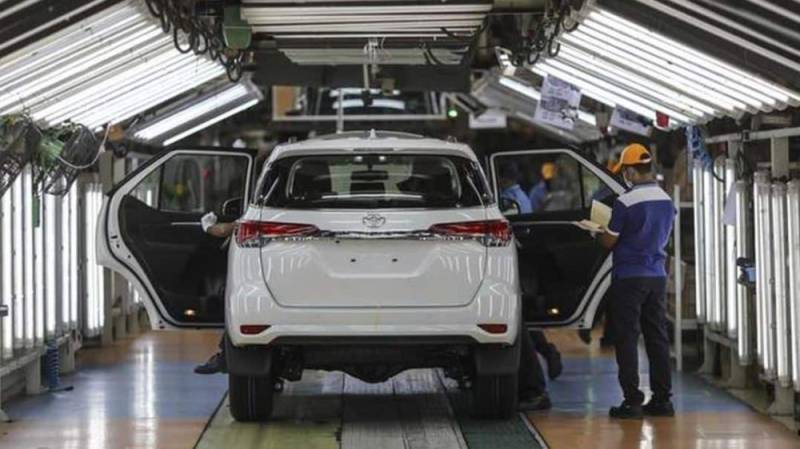
Pakistan introduced its Auto Industry Development and Export Policy for the years 2021 to 2026 with the hope of reshaping the country’s automotive sector. Under this policy, auto manufacturers were assigned progressive export targets, starting from zero percent in 2021 and gradually moving to ten percent of their import value by 2026. The government offered several incentives to help achieve this, such as reduced customs duties on exports, a dedicated financing facility, and allowance for duty-free import of vintage cars solely for the purpose of re-export.
While the policy sounds ambitious on paper, the realities on the ground suggest that its implementation and effectiveness face significant hurdles. Pakistan’s automobile sector is heavily dependent on imported components, suffers from high production costs, and is not yet technically prepared to penetrate foreign markets. These issues make the success of the policy questionable.
At the center of Pakistan’s auto industry are three major Japanese manufacturers: Toyota, Honda, and Suzuki. Collectively known as the “Big Three,” these companies dominate the local market, producing about sixty percent of the cars in the country, as per figures from the Pakistan Automotive Manufacturers Association. Despite their strong presence in the domestic market, Pakistan’s position in the global auto trade remains marginal. In the fiscal year 2023, Pakistan imported vehicles worth over 345 billion rupees, while its total vehicle exports were only about 21 billion rupees. Specifically, Pakistan brought in auto-related goods worth over 74 billion rupees from China, about 62 billion rupees from Japan, and over 50 billion rupees from Thailand. In contrast, the country’s exports to neighboring Afghanistan stood at just over 7 billion rupees and to the United Arab Emirates at over 4 billion rupees.
Another important indicator is that only about six percent of Pakistanis own cars, according to data from the Pakistan Social and Living Standards Measurement Survey of 2019-2020. The entire auto industry in Pakistan generates an annual turnover of approximately 30 billion rupees and accounts for just 2.8 percent of the country’s Gross Domestic Product, as per Pakistan Institute of Development Economics.
The hope of transforming Pakistan into a car-exporting country within five years without addressing the structural issues in the industry seems unrealistic
Even so, there have been some recent efforts by companies to explore exports. In April, Honda became the first to export a batch of forty locally assembled cars to Japan. Last year, Pak Suzuki Motor Company started sending auto parts to Bangladesh and Afghanistan. Toyota Indus Motors also engaged in exports, mainly of semi-processed raw materials to Egypt and other Toyota-affiliated companies. These developments, reported in the local media, indicate a willingness among manufacturers to test foreign markets.
Moreover, a number of serious challenges stand in the way of realising the export goals outlined in the policy. The international automotive market is extremely competitive, and it is not easy for Pakistani manufacturers to break through with appealing pricing models. The situation is further complicated by currency fluctuations, high transportation and logistics costs, import duties in target markets, and the financial burden of meeting international compliance standards. All these factors make Pakistani products less competitive globally.
The execution of the export policy has also been slow. One of the reasons is that local manufacturers have limited capacity and low levels of localisation in their production processes. Instead of building a supply chain ecosystem that would support exports, most companies remain focused on catering to the domestic market. Without supply chain reforms, expansion in production scale, and strong government support, these firms are unlikely to meet the targets set under the export policy. For example, meeting the target of exporting ten percent of the value of imported vehicles by 2026 seems quite far-fetched under current conditions.
Another questionable area is the decision to export to developed countries such as Japan. On paper, the idea of exporting locally assembled vehicles to Japan sounds like a success story. However, the reality is more complex. A large number of auto parts used in Pakistani vehicles are themselves imported from Japan. Sending the final assembled cars back to Japan may not result in substantial financial gains, especially when one considers the strict safety and environmental standards imposed by countries like Japan. The high cost of local production adds to the difficulty of competing in such advanced markets. These exports might serve a symbolic purpose or fulfill contractual obligations within multinational corporations, but they are unlikely to transform Pakistan into a serious global player in auto exports.
Furthermore, the policy framework itself lacks critical features that are necessary for export success. Unlike other countries that support their auto industries with export incentives or tax rebates, Pakistan offers no such benefits to its manufacturers. There is also no mechanism in place to recover the duties paid on raw materials that are later used in exported vehicles. This oversight increases the financial burden on companies trying to enter foreign markets. High operational costs in Pakistan, driven by some of the most expensive utility rates in the region and inadequate infrastructure, make exporting even more difficult. In addition, Pakistan’s relatively small domestic market limits the potential for economies of scale, which are crucial for reducing costs and competing globally.
While the export-focused direction of the policy is a step in the right direction, its design appears to overlook many ground realities. It assumes a level of readiness and competitiveness that the domestic auto industry simply does not have at the moment. The hope of transforming Pakistan into a car-exporting country within five years without addressing the structural issues in the industry seems unrealistic. It would be more effective for future policies, such as the next Auto Industry Development and Export Policy to be drafted after 2026, to adopt a more pragmatic approach. This would mean accounting for the limitations of the local industry, offering practical support measures, and setting realistic targets that can be achieved with steady and consistent efforts.
In summary, the goals set out in the current export policy are admirable but difficult to achieve in the current environment. Without deeper reforms, meaningful incentives, and coordinated efforts from both the government and industry stakeholders, Pakistan's auto exports will likely remain a small fraction of its overall trade. The lessons from this phase should guide the next steps, and any future strategy must be grounded in the economic and industrial realities of the country rather than ambition alone.