

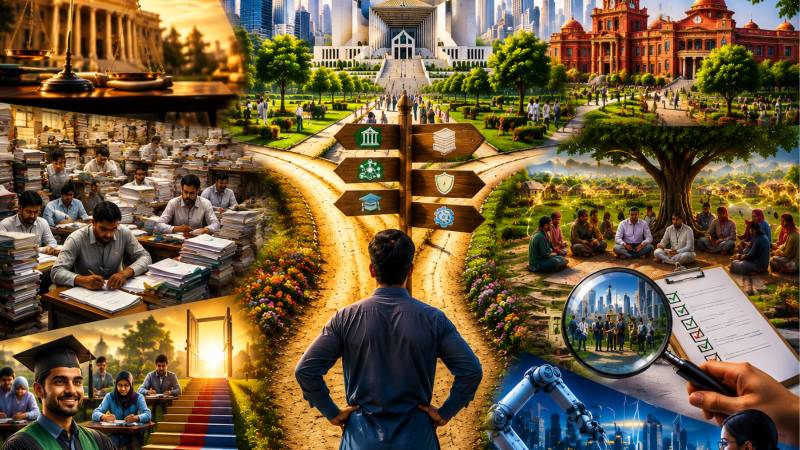
For seventy-eight years, Pakistan has changed almost everything about who governs it. It has elected feudal families, embraced populist leaders, lived under military rule and experimented with technocratic governments. Yet despite these changes, the same problems remain. Circular debt keeps rising, public services continue to decline, governments struggle to implement long-term policies and the bureaucracy fails to deliver. Pakistan's crisis has never really been about who governs. It has been about the constitutional system through which anyone governs.
The problem begins with the way the state is organised. Pakistan operates through three political layers, i.e the federal government, provincial governments and local governments. On paper this appears balanced. In reality it creates confusion. Max Weber argued that good administration requires clear authority and a simple chain of command. Pakistan's system often does the opposite. When a road remains broken or a school lacks teachers, citizens cannot easily tell whether responsibility lies with the local council, the province or the federal government. Every extra layer increases the distance between citizens and decision-makers, making accountability weaker and encouraging officials to pass responsibility to someone else.
This is also why the popular demand for creating new provinces misses the real issue. Whether it is southern Punjab, Hazara or another region, a new province does not remove a single layer of government. It simply creates another assembly, another chief minister, another cabinet and another bureaucracy. Public choice theory suggests that government institutions naturally expand because every new office creates fresh opportunities for patronage and political influence. Instead of solving Pakistan's governance crisis, new provinces would simply make the system larger, more expensive and even harder to manage.
When voters cannot critically evaluate information, elections become vulnerable to populism, misinformation, personality cults and sectarian appeals.
Pakistan should think more boldly. Instead of creating new political institutions, it should reduce them. Provincial governments and assemblies should all be abolished. The country should adopt a simple two-tier constitutional structure consisting only of a national government and constitutionally protected local governments. Political authority would exist only at the national and local levels. Everything in between would become administration rather than politics.
Under this system, Pakistan would be divided into single-member constituencies, each electing one representative to a single National Assembly. This would become the country's only legislature. Since provinces would no longer exist as constitutional political units, the Senate would lose the purpose for which it was created and should be abolished. This approach is not unprecedented. New Zealand abolished its provincial governments in 1876 and later removed its upper parliamentary chamber, yet it continues to govern effectively through one national parliament supported by strong local councils.
If governing a country is among society's most important responsibilities, then those who make its laws should possess the knowledge required for the task. Candidates for the National Assembly should therefore hold at least an MPhil degree from a recognised university. Nobody would trust an unqualified surgeon simply because patients voted for him. Governing a nation is even more complex than performing surgery, yet political leadership often requires no specialised preparation. Professional qualifications are expected in medicine, engineering and law. It is reasonable to expect similar standards from lawmakers.
The office of Prime Minister should require even higher qualifications. Every candidate should hold a doctorate in a governance-related discipline such as political science, economics, constitutional law, public administration, public policy or international relations. Economist Douglass North argued that institutions produce better outcomes when they are built around capable rules and competent leadership rather than personal charisma. Pakistan has spent decades choosing leaders largely because of popularity, family influence or political connections. A constitutional system that values expertise would stand a better chance of producing informed and effective leadership.
The same principle should apply across the cabinet. Finance should be led by economists, health by medical or public health professionals, education by education specialists and agriculture by agricultural scientists. Christopher Hood argued that governments perform better when they operate as professional organisations rather than patronage networks. Ministers chosen because they understand their fields would be more likely to make evidence-based decisions instead of politically convenient ones.
Real power over everyday public services should also move closer to citizens. Local governments should become primarily responsible for education, sanitation, municipal services, infrastructure and community development. They should enjoy constitutional protection and guaranteed financial resources instead of depending on provincial governments. The principle of subsidiarity holds that decisions should be taken as close as possible to the people affected by them. Denmark demonstrates this approach by relying on strong municipalities to deliver most public services while national authority remains with a single parliament. Accountability improves when citizens know exactly who is responsible for local problems.
Instead of creating new political institutions, it should reduce them. Provincial governments and assemblies should all be abolished. The country should adopt a simple two-tier constitutional structure consisting only of a national government and constitutionally protected local governments.
The same argument for competence can also be extended to voting. Only citizens holding at least a bachelor's degree should be eligible to vote in national elections. Democracy works best when voters can compare policies, question political promises and distinguish evidence from slogans. Political philosopher Jason Brennan argues that democracy should place greater importance on political competence than on numbers alone. When voters cannot critically evaluate information, elections become vulnerable to populism, misinformation, personality cults and sectarian appeals. Pakistan has repeatedly experienced these problems. Educational qualifications would improve the quality of democratic decision-making rather than weaken it.
These proposals would naturally face criticism. Many would argue that educational qualifications for voting or contesting elections violate political equality and weaken democratic legitimacy. Others would fear that abolishing provincial governments would centralise power in Islamabad. These concerns deserve serious consideration. However, every democracy already limits political participation through age requirements, citizenship rules and other constitutional qualifications. Adding competence to that list follows the same principle. At the same time, constitutionally protected local governments with guaranteed authority could provide stronger local representation than provincial governments that often answer more to party leadership than to local communities.
More than two centuries ago, James Madison argued that constitutions should never rely on the virtue of those who hold power. They should instead be designed so that institutions themselves encourage responsible government. Pakistan has spent seventy-eight years changing rulers while leaving the constitutional structure largely untouched. The results are visible in every sector of the state. Better politicians alone cannot fix a system that repeatedly produces the same failures. Lasting progress requires better institutions. The real question facing Pakistan is therefore not who should govern next. It is whether the country is finally prepared to build a completely different constitutional order.