

“The secret of happiness is freedom, and the secret of freedom is courage”—Thucydides
“Mr President, Pakistanis seem to live in a constant state of foreboding and terror of the intelligence agencies. These intelligence agencies have never told the truth, as it is not in their culture to do so, nor are they telling the truth to you about the state of the hearts and minds of the nation. Are these hearts beating for Pakistan or from the fear of getting lashed in public or thrown in dirty cells with convicts on the mere suspicion of being dissenters? These agencies have carefully crafted the fall of every government. What is to stop them from doing the same to your government?
Sir, the road from the airport to the Aiwan-e-Sadr does not reflect the soul of Pakistan, which, in fact, lurks in the dark and pitted backstreets of Pakistan. But these agencies would not suggest that you take a peek there and see the real state of the wretched Pakistani nation. The press, Mr President, is stifled, and people are petrified to speak their distressed minds.
I have worn this uniform with incredible pride and never hesitated to put my life on the line for the defence of my country. Tragically, I do not feel the same sense of pride as I did a decade ago, when people almost kissed our hands when they saw us in uniform in a public place. Today, the tables have turned. People have visible contempt for us and our uniform. Since, in some small way, I share the responsibility for this metamorphosis, I do not feel proud wearing this uniform any more.”
The echo of these defiant words, uttered way back in 1979, still resonates despite a lapse of 47 years. It takes the courage of a hundred lions to stand before the most powerful person of his time, look him in the eye, and then call “a spade a spade”. The annals of military history are often written in the ink of official citations. Yet, the true soul of a warrior is found in the moments when the uniform is cast aside in favour of a higher conscience.
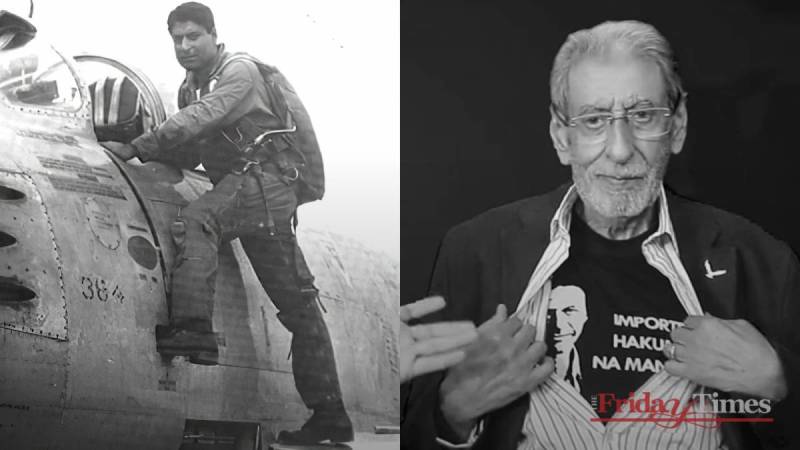
Air Commodore Sayed Sajad Haider (1932–2025), known to the world as ‘Nosey Haider’, was a man whose persona was defined not just by the Mach 1 speeds of his F-86 Sabre, but by an unyielding moral compass that remained steady even in the turbulent skies of the political upheaval of the 1970s.
While a room full of senior officers remained silent, Haider stood up
To understand Haider, one must first look at the morning of 6 September 1965. As Squadron Leader of No. 19 Squadron, he did not just fly a mission; he orchestrated a masterpiece of aerial warfare. Leading eight Sabres in a low-level, high-risk strike against India’s Pathankot Airbase, he caught the enemy off guard, destroying 13 aircraft on the ground—including nine then-advanced MiG-21s.
This was the “Saviour of Lahore” in his element: precise, calm, and daring. Before take-off, he famously arranged for towels drenched in eau de cologne for his pilots, jokingly remarking that if they were to meet the angels that day, they should at least “smell good”. This blend of grim resolve and flamboyant wit became his trademark, earning him the Sitara-e-Jurat (a military award) and a place in the Pakistan Air Force Museum as a living legend.
Haider’s personality was truly forged in the crucibles of peace, where the battles were fought with words rather than missiles. In November 1979, while serving as the Director of Joint Warfare, he attended a top-secret meeting at General Headquarters (GHQ). General Zia-ul-Haq, the military dictator, had just outlined his plan to renege on promised elections and extend military rule.
While a room full of senior officers remained silent, Haider stood up. He confronted the dictator to his face, criticising the manipulation of truth by intelligence agencies and the military’s conduct towards civilians. This act of dissent was unprecedented. Recognising that he could no longer serve a regime he viewed as unjust, he opted for voluntary retirement in May 1980. He walked away from a promising career with only a few thousand rupees in his bank account and a vintage Toyota, choosing dignity over the perks of power.
In retirement, Haider refused to fade into the quiet comfort of a veteran’s life. He became an “iconoclastic” voice through his memoir, Flight of the Falcon, where he dismantled the “myths” of the 1965 and 1971 wars. He was a man who “straight-shot” the truth, often calling out the failures of high command that he felt had betrayed the blood of martyred soldiers.
His final years saw him as a staunch supporter of now-detained Imran Khan, often seen at political rallies even in his 90s. He believed the power to change Pakistan lay with the youth, whom he urged to demand their “haqiqi azadi” (true freedom). Whether holding a placard in Islamabad or engaging in a dogfight over Pathankot, Sajad Haider’s life was a testament to the idea that a warrior’s greatest weapon is his integrity.
He left this world on 3 January 2025, leaving behind a legacy that commandingly soars as high as the Sabres he once piloted—a testament not merely to extraordinary military prowess, but to that rare, unshakable courage required to stand solitary in defence of the truth. While the modern world grapples with a deficit of such principled giants, it is heartening to see today’s digital landscape where a new vanguard of the valiant exists: those with the steely resolve to confront injustice and the unflinching nerve to confront unfiltered truth.