

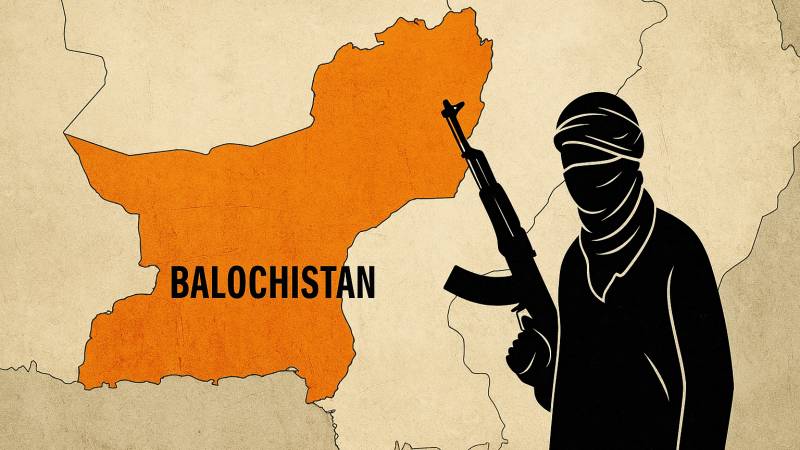
The hijacking of the Jaffar Express train by the Baloch Liberation Army (BLA) last month has sparked a renewed backlash against the Baloch people across Pakistan. Recently, key members of the Baloch Yakjehti Committee (BYC), including Dr. Mahrang Baloch, were arrested during a crackdown on their Quetta sit-in, where they demanded an end to alleged enforced disappearances.
Following a Karachi protest, BYC leader Sammi Deen Baloch and four others were detained for 30 days under the Maintenance of Public Order (MPO) law but were released on Eid day. Meanwhile, Akhtar Mengal of the Balochistan National Party (BNP-M) continues his long march from Wadh to Quetta, demanding the release of BYC leaders and missing persons. The state of Pakistan wants to become a 'Hard State' To Ensure Stability.
The insurgency and armed movements in Balochistan have a long history, marked by a never-ending cycle of violence and repression. Successive governments, whether democratic or military dictatorships have failed to address the underlying issues, with only brief periods of relative calm.
The failure of the Pakistani government to address the grievances of the Baloch people has multiple dimensions. It encompasses the denial of civil rights, social justice, and a rightful share of the province's rich natural resources. The current development projects, particularly those linked to the China-Pakistan Economic Corridor (CPEC), have exacerbated tensions. The CPEC is dominated by the Pakistan Army, which has faced resistance since the killing of Nawab Akbar Bugti, the chief of the Bugti tribe, on August 26, 2006.
This incident sparked a sharp rise in insurgency, with armed Baloch groups allegedly launching attacks on laborers working on development projects, including CPEC, as well as Chinese nationals, buses carrying passengers, and pilgrims traveling to Iran. These attacks have drawn widespread condemnation within Pakistan and internationally.
The situation highlights the need for the Pakistani government to address the long-standing issues faced by the Baloch people, including their demands for greater autonomy, control over natural resources, and an end to human rights abuses. Rafiullah Kakar, a public policy practitioner and PhD scholar at Oxford University, has a deep understanding of the issues faced by the people of Balochistan. He explains, "Apart from oil and gas resources, all mineral resources were under the control of provincial governments, even before the adoption of the 18th amendment. This amendment allowed for a 50% partnership with the provinces.
The Saindak Copper Gold Project, located near Saindak town in Chagai District, was handed over to the Chinese in 2002 by the federal government. The revenue-sharing agreement allocates 50% to China, 48% to the federal government, and a mere 2% to the Government of Balochistan. However, as part of the 'Aghaz Hqooq e Balochistan' package, it was decided that the federal Share would be given to the Government of Balochistan”.
He further explains “After the expiry of the agreement in 2012, the federal government retained control of the share by exerting pressure on the provincial authorities”. In 2017 and 2022, two more extensions were managed through hybrid governments in Balochistan. Similarly, the Sui gas situation remains a contentious issue between the Baloch and federal governments. Despite Balochistan producing 90% of Pakistan's natural gas, the province's consumption share is merely 4%, as noted by Rafiullah Kakar.
The analyst believes that this marginalisation has sparked a revolt among the Baloch leadership, with young, educated youth taking the reins of the movement to secure their rights, even if it means resorting to armed struggle
Rafiullah Kakar highlights the disparity in the allocation of resources under the Benazir Income Support Programme (BISP), a globally recognised anti-poverty initiative. Despite Balochistan being one of the poorest provinces in Pakistan, it has received only 3-4% of the programme's benefits over the last 16 years, which is less than its share of the country's total population.
The people of Balochistan face severe discrimination in various sectors, including food security, health, and education, in addition to being denied their due share in natural resources and benefits from programs like BISP.
A recent nutrition survey has revealed alarming statistics: 49.6% of children in Balochistan suffer from malnutrition. Almost half of the children across all 36 districts experience severe food insecurity.
In education, Balochistan trails behind the rest of Pakistan, the province has the lowest literacy rate, at 54.5% (Pakistan Economic Survey 2024), gross enrollment rates for girls in matric are a mere 21%, Eight out of 10 girls in Balochistan are not enrolled at matric levels.
According to mainstream media reports data related to health reveal a dreadful situation, with a staggering doctor-to-patient ratio of 1 for 1,000 and a nurse-to-patient ratio of 1for 50 patients.
As per the Pakistan Bureau of Statistics, “the literacy rate in Balochistan is 42% the lowest among all provinces, as per the 2023 census. Additionally, only 38.6% of the population is part of the labor force, indicating widespread unemployment”. This situation forces the Baloch youth to indulge in smuggling and to be recruited by armed groups.
Balochistan's political landscape has undergone a significant shift, with hybrid leadership replacing genuinely elected representatives in parliament and the provincial assembly. This has led to widespread alienation from mainstream politics among the Baloch people, who feel their nationalist leaders, such as Dr. Abdul Malik Baloch, Akhtar Mengal, Lashkari Raisani, and Nawab Aslam Raisani, have been pushed aside to impose hybrid leadership by the military establishment.
The analyst believes that this marginalisation has sparked a revolt among the Baloch leadership, with young, educated youth taking the reins of the movement to secure their rights, even if it means resorting to armed struggle. This shift in leadership and tactics marks a significant escalation in the Baloch insurgency, which has its roots in the province's historical grievances, including economic neglect and limited political representation.
Following the hijacking of the Peshawar-bound train 'Jaffar Express', the Baloch Yakjehti Committee (BYC) launched protests in Lahore, Karachi, and Quetta against continued enforced disappearance. However, these protests failed to garner significant support from local urban populations, particularly in Lahore. Eyewitnesses reported that only a handful of people joined protesting Baloch students in Lahore, despite Karachi having a substantial Baloch population.
Dr. Ayesha believes, “At least young political leadership headed by Dr. Maharang Baloch wants to talk, but no one is ready to talk to them”. It's an irony that they have pitched people like Anawar Kakar and the province is being led by Sarfraz Bugti who are demeaning nationalist political leadership who can be used to defuse the situation. “they are imposed by agencies who have no link with the soil or Baloch community they have no potential to change the mood in Balochistan”. Ayesha says.
Senator Jan Muhammad Buledi of BNP comments, 'The current ruling elements in Balochistan are the beneficiaries of the situation, and they want the ongoing insurgency to be crushed by force, whereas nationalist political circles disagree and demand a political dialogue and the recovery of missing persons, which can also create an environment for dialogue”.
Former President of the Pakistan Federal Union of Journalists (PFUJ), Shahzada Zulfiqar, who hails from Balochistan, rejects the notion that the current ruling elite - who frequently switch between political parties like PMLN, PPP, and BAP - or any military option can succeed, given that the province has been facing such operations for the last 25 years."
While no country in the world permits secession, experts argue that the only viable solution to resolving the insurgency is through diplomatic engagement, addressing the separatists' legitimate concerns, and bringing them to the negotiating table. Moreover, they emphasise that insurgency requires a distinct approach, differing from counter-terrorism strategies employed against heinous crimes.