

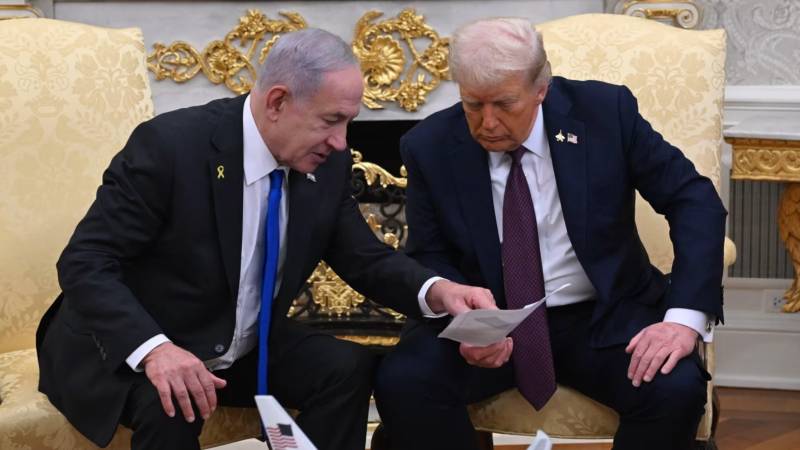
Two days ago, President Trump presented a 20-point peace deal to end the “war” in Gaza, which was immediately accepted and endorsed by Israel, a collection of Arab states, and lauded by our very own Islamic Republic of Pakistan. Discourse on Pakistan’s validation of the deal is at an all-time high, with most Pakistanis expressing vehement opposition to it, while a select few accuse the majority of being unreasonable and speaking over Palestinians. Pakistan’s endorsement of this deal represents a departure from its principled commitment to the Palestinian cause – and the arguments of those who favour signing the deal are based on a flawed understanding of both the deal’s specifics and the context of the genocide in Gaza.
First, let’s have a quick review of why this endorsement is a violation of Pakistan’s principled commitments to the Palestinian cause. Pakistan has had a very clear ideological position on Palestine: it supports a two-state solution, with an independent, sovereign Palestinian state, based on pre-1967 borders, with Al-Quds Al-Sharif as its capital. It has consistently held to this stance in all major diplomatic forums over the decades, e.g. the United Nations and the Organisation of Islamic Cooperation, and it is additionally one of the few elements of politics in Pakistan behind which there is meaningful domestic consensus.
Many people, Pakistanis included, have argued for the preferability of a one-state solution for ideological reasons and because they believe the two-state solution is inherently unviable. Because of this, proponents of the deal contend that any criticism of it stems from a misunderstanding of Pakistan’s expressed diplomatic stance. However, it is their own claim that is based on a misunderstanding. Trump’s deal does not remotely resemble the two-state solution that Pakistan has advocated for.
Trump’s deal does not grant the Palestinians a state in any form – it just vaguely gestures at the notion that there might be a ‘pathway to Palestinian self-determination and statehood’ at some point in the indeterminate future (it is also worth noting that Israeli PM Netanyahu has outright rejected any demand for a Palestinian state and correctly claims that the deal does not include any such provision). The plan also includes no mention of a return to 1967 borders and contains no implications that anything will be done about illegal Israeli settlements in the West Bank. It should also be noted that it de facto cedes Jerusalem to Israel, as the plan makes no mention of any change in the ownership of the city. Additionally, it completely undermines Pakistan’s commitment to a sovereign Palestinian state, as the plan is conditional on Palestinian disarmament, with security being contractually handed over to a group of foreign armies. This is not in any form the two-state solution that Pakistan has historically endorsed, and any argument which suggests that it is is deeply misleading.
By endorsing Trump’s deal, we undermine our own stances and betray the people of Kashmir and Palestine alike
Furthermore, it should be self-evident that support for this deal actively undermines Pakistan’s own position on Kashmir. Pakistan has long linked Kashmir and Palestine in its diplomatic rhetoric, positing both to be examples of struggles against occupation and annexation by foreign powers. We have consistently argued that international law must take precedence in guiding these conflicts to make the claim that settlement-building should not be able to alter the status of disputed territories. This is the same argument that allows us to make the claim that Indian control in Jammu and Kashmir, particularly post-2019, when India revoked Kashmir’s special status, formally annexing it and aggressively increasing the rate of illegal settlements. By endorsing Trump’s deal, we undermine our own stances and betray the people of Kashmir and Palestine alike.
The second major problem with the deal, apart from issues of principle, is that it contains no meaningful measures for enforceability. Those who continually argue that any criticism of the deal means advocacy for the deaths of Palestinians would do well to note the following points.
First: the deal calls for the complete demilitarisation of Hamas, the only major military force that represents and fights for Palestinians at present. This means that Palestinians will no longer have any leverage or influence once the deal is passed, leaving their fates entirely up to their new security guarantors.
Second, it relies heavily on Israeli goodwill and cooperation. It is worth noting that Israel has already violated several previous ceasefires, and there is no reason to assume that it will not do so again. The international peacekeeping force is not intended to keep Israel in check: rather, it is expected to cooperate with the IDF to help secure Gaza’s borders.
Pakistan’s motivations are geared toward making its endorsement acceptable to Israel and the West, not to the Palestinians
Third, it is worth noting the repeated duplicity of both the US and Israel when it comes to negotiations over the past year. These states have used the false flag of ‘negotiations’ to lull their opponents into a sense of false security, before ruthlessly assassinating and/or cheating them. This happened when Israel bombed the Hamas leadership during negotiations in Qatar earlier this year, when they struck and killed Iranian scientists during Iran’s nuclear negotiations with the US, and the refusal to follow up on the terms of the release of Israeli-American soldier Edan Alexander by Hamas by allowing aid to re-enter Gaza. The question must be asked – is there no burden of proof on the proponents of the deal to demonstrate that this is not just the latest tactical manoeuvre?
A common defence of the endorsement is that it aligns with the desires of the Palestinian people, and that outsiders should not speak over them. This argument, however, collapses under three key flaws.
First, it ought to be noted that there is no reliable polling in Palestine at present. Gaza is a war zone, and the West Bank is an occupied Israeli territory. Anyone who can claim that they and they alone represent Palestinian sentiment is blustering and has no proof for their assertion. This is particularly pressing when we consider that Palestinians will have many good reasons for rejecting this deal, as already highlighted above.
Second, this argument makes very little sense as Pakistan has endorsed the deal before Hamas has confirmed or denied their participation in it. If the purpose is not to speak over the Palestinian people, where does Pakistan derive its right to endorse deals on their behalf before they have made their own positions clear?
Third, if Pakistan wants to merely maintain its respect for the wishes of the Palestinian people, and that is the purpose for endorsing this deal, why does PM Shahbaz Sharif’s language on the deal refer to it as ending the ‘war’ in Gaza when Pakistan’s long-standing stance has been to refer to it as a genocide? It appears Pakistan’s motivations are geared toward making its endorsement acceptable to Israel and the West, not to the Palestinians.
It should be abundantly clear at this point that all arguments in favour of supporting the deal have put the cart before the horse and are built on shoddy, circumspect reasoning. There are so many further problems with the deal which have not been discussed for worries of length – the powers given to Tony Blair, whose actions slaughtered a million in the Iraq War; the unilateral blame and responsibility for disarmament laid on Hamas, rather than the Zionist settler state; the dismissal of UN-led conflict resolution in favour of the ominous ‘Board of Peace’ headed personally by Trump the list goes on and on.
Thankfully, Pakistanis at large seem to have reacted vehemently against their political leadership’s positive reaction to the deal and betrayal of Palestine. This has immediately prompted some weak retractions by both the Pakistani and Arab states, who have now come to claim that edits were made to the plan without their approval, and have pivoted to arguing for a vague two-state solution again. However, the edits that have been identified have little to do with key problems such as the disarmament of Hamas, and the latest Pak-Arab statement makes no mention of settlements, Jerusalem, or the 1967 borders. This retraction is weak and seems largely to have been driven by popular sentiment.
The major public backlash and subsequent vague retractions from the government suggest that Pakistan’s present position is politically unsustainable. For the sake of its diplomatic credibility and moral consistency, Pakistan must fully withdraw its support for this plan and return to its principled advocacy for a just and viable solution for the Palestinian people.