

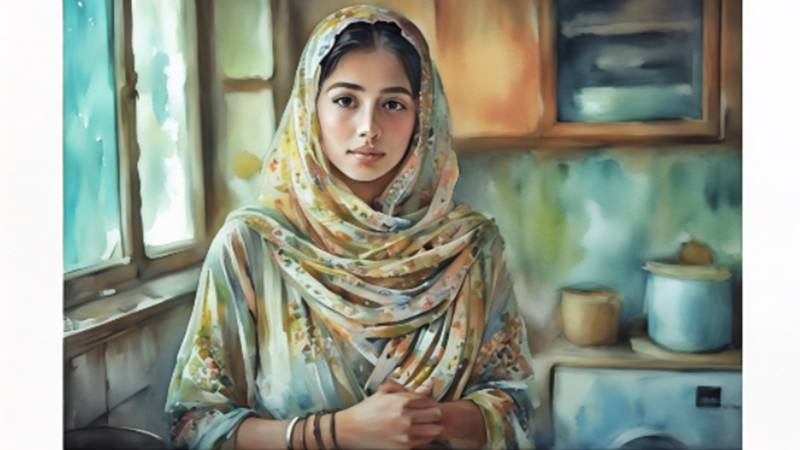
“When I rise before dawn, the house is already waiting for me,” says a woman from a village in rural Sindh. “By the time I rest, the sun has set twice over my work.”
Millions of Pakistani women live this routine daily—rising before sunrise to cook, clean, fetch water, care for children and the elderly, and keep the fragile machinery of life running. Yet none of this work is recognised as “labour.” It is unpaid, uncounted, and invisible in national accounts.
International time-use data show that for every one hour a Pakistani man devotes to domestic and caregiving work, a Pakistani woman spends nearly eleven hours. When valued in economic terms, women’s unpaid domestic labour could equal 22 to 25 percent of Pakistan’s GDP—nearly a quarter of the national economy—yet it remains absent from official statistics. This invisibility is not just an oversight; it reveals how women’s time and energy continue to subsidise both families and the state.
In 2015, the United Nations’ Sustainable Development Goal 5.4 urged governments to “recognise and value unpaid care and domestic work through public services, infrastructure, and social protection policies.” It was the first global acknowledgment that economies rely on care work—mostly done by women—to reproduce the workforce and sustain society.
Women’s unpaid domestic labour could equal 22 to 25 percent of Pakistan’s GDP - nearly a quarter of the national economy - yet it remains absent from official statistics
Economist Marilyn Waring made the same argument decades earlier in her landmark book If Women Counted. She observed that national income systems were designed to ignore women’s unpaid labour: “If women counted,” she wrote, “the whole economic structure would collapse under the weight of its hypocrisy.”
Italian feminist Silvia Federici, who helped launch the 1970s “Wages for Housework” campaign, went further. She insisted that domestic labour is not an act of love but an economic foundation that keeps capitalism functioning. “No one works as hard as women do for nothing,” she said in a 1976 New York Times interview. “If we stopped, the economy would be paralyzed.”
Federici and her colleagues Mariarosa Dalla Costa and Selma James reframed domesticity as political economy. They argued that housework sustains the workforce by feeding, nurturing, and emotionally stabilising those who go out to earn wages. Yet the women who perform this labour remain unwaged, unacknowledged, and socially conditioned to believe it is their natural role. “Not only has housework been imposed on women,” Federici later wrote, “it has been transformed into a natural attribute of our female physique and personality. It is being assumed that housework is not work.”
This naturalisation is also evident in Pakistan, where social norms continue to assign domestic responsibility as a woman’s duty rather than shared labour. As a result, even when women take up paid employment, they shoulder what sociologist Arlie Hochschild famously called “the second shift”—coming home after work to cook, clean, and care while men “help” occasionally.
Educated and urban women may face the double burden more acutely, juggling professions and family, while rural women face the physical extremes of unpaid work—walking long distances for water, tending livestock, and caring for multiple generations. A UN Women study found that Pakistani women spend about five hours daily on unpaid domestic and care work, compared to less than one hour by men. In villages across Sindh and Balochistan, women’s workdays can stretch to fourteen hours.
Despite this, Pakistan has not conducted a comprehensive Time-Use Survey since 2007, leaving policymakers blind to the scale of women’s invisible contribution. When labour remains unmeasured, it remains unprotected. This omission also undermines women’s access to social security, pensions, and policy recognition.
There have been attempts, however, to address women’s economic marginalisation. The Benazir Income Support Program (BISP), launched in 2008, provides cash transfers to millions of low-income women. It is among the largest social safety nets in South Asia and recognises women as central to household welfare. Yet as researchers like Haris Gazdar and Ali Cheema have noted, BISP tries to alleviate poverty—it does not value or compensate unpaid care work. It offers income relief without restructuring the system that keeps women’s labour invisible.
The real challenge is structural. Pakistan’s economy, like many others in the Global South, treats unpaid care as an infinite, cost-free resource. Public investment in care infrastructure—childcare centres, eldercare services, clean energy, and water access—remains minimal. The absence of such infrastructure means that women’s time fills the gaps left by the state.
Globally, there is growing recognition that care is not charity but an economic sector. The International Labor Organisation’s 2024 Resolution on decent work in the care economy links investment in care services to job creation, productivity, and gender equality. UN Women and the ILO promote the “3Rs” framework—Recognise, Reduce, and Redistribute unpaid care work—expanded by feminist movements to “5Rs,” adding Representation and Remuneration. These principles guide countries like Mexico, which now includes unpaid domestic work in its national GDP through Satellite Accounts, showing it contributes more than 26 percent of national value.
Pakistan’s own Care Economy Roadmap, developed with 'UN Women', is a promising start. It envisions a shift from short-term welfare to long-term investment—creating public childcare, measuring unpaid labour, and designing social protection systems that reflect women’s real workload. The province of Sindh has already demonstrated legislative initiative through the Sindh Domestic Violence Act (2013) and Maternity Benefits Act (2018). The next step must be public spending in care infrastructure—the only way to reduce the 1:11 time gap that burdens Pakistani women.
Yet progress also depends on cultural change. Across classes, women’s work at home is still romanticised as devotion rather than labour. As one Sindhi villager put it, “If I stop, the house stops.” Recognition, as Federici warned, is not enough if it leaves the division of labour untouched.
Unpaid domestic work is not a private duty—it is the hidden infrastructure of the national economy. To make it visible is to make it just. For Pakistan, valuing care work is not merely a feminist demand but an economic necessity. When women’s labour is acknowledged, counted, and supported, the entire economy gains resilience. Until then, millions will continue to subsidise the system that refuses to see them.