

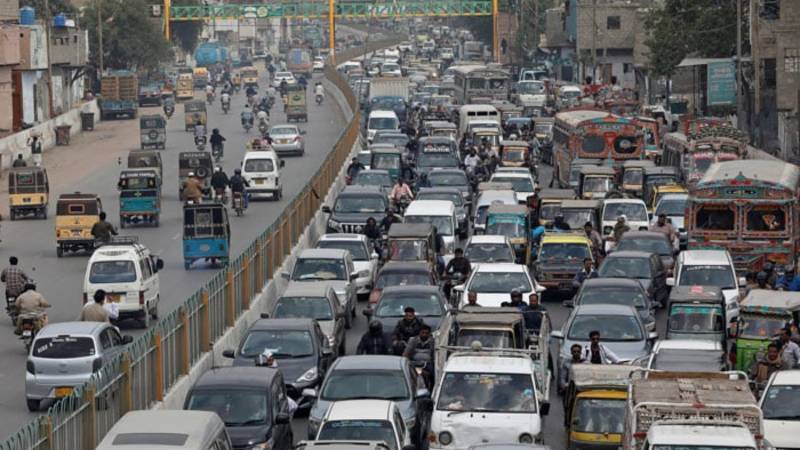
Despite generating over Rs 1,500 million in toll revenue, the National Highway Authority’s (NHA) busiest road in Karachi still lacks a digital toll collection system, leaving a key route of the metropolitan city without technology-driven solutions.
According to documents available with The Friday Times, the NHA has generated Rs 1,500 million in three years from just one federalised road in Karachi — the Lyari Expressway — while it has spent Rs 282 million on this road for maintenance.
The NHA data reveals that the authority earned Rs 1,529.5 million in the past three years through toll tax collection via a manual cash lane system. The year-wise breakdown of expenditures shows that more than Rs 140 million was spent on routine maintenance last year, which includes highway safety, toll plazas, weigh stations, and special maintenance. In addition, the authority incurred over Rs 186 million in 2022 and over Rs 285 million in 2023 under similar maintenance-related expenses.
Inaugurated a few years ago after a delay of over 15 years — with an escalated construction cost of around Rs 7 billion — the 38-kilometre-long road is built along the Lyari River in Karachi. The road is currently facing several issues, among them the traffic congestion at toll plazas due to the outdated manual toll collection system.
This is the busiest road in the port city. It carries immense importance in reducing the ever-growing traffic volume inside Karachi. Traffic coming from the port and the Super Highway (now M9) uses the expressway to reach their destinations without entering the city.
Not only this, the construction of the expressway has also contributed to reducing flood damage to areas along the river and added to the environmental protection of the entire zone.
A large number of commuters benefit from this road; however, they face constant inconvenience as they are forced to queue at the toll plaza to pay taxes via the manual cash system.
A couple of months ago, Federal Minister for Communications Aleem Khan announced that a plan is under review to convert the entire toll collection system across the national road network to an e-Toll system. To implement this idea, the NHA has also approached the National Database and Registration Authority (NADRA).
The purpose of this move is to effectively handle the ever-increasing traffic volumes and to ease the movement of vehicles on highways and motorways across the country. Under the proposed system, electronic readers installed at toll plazas will capture vehicle details from an RFID chip placed on the windscreen. This will eliminate time-consuming manual procedures and make toll collection in the country error-free. The system is also expected to ensure reliable financial reconciliation, real-time data collection, smoother traffic flow, and above all, a cost-effective solution.
An official at the NHA headquarters, speaking on condition of anonymity, stated that the country already possesses successful digital toll collection infrastructure on some motorways. “The automated toll collection is not only feasible but operationally superior,” he said, adding that international best practices further support digital transformation.
“It also reduces collection costs, minimises revenue leakage, and provides real-time financial monitoring capabilities that manual systems cannot match,” he further explained.
The NHA generates revenue through various streams. Toll collection from motorways and highways remains among its major sources of income.
As per official documents, the authority achieved a revenue target of Rs 102,956 million for the last fiscal year 2024–25. Annual revenue has significantly increased over the past five years. However, the department continues to face a financial discrepancy amounting to millions, with a substantial gap between earnings and expenditures.
Documents further reveal that the authority’s toll revenue has nearly doubled from Rs 32,394 million in 2018–19 to Rs 102,956 million in 2024–25. Over five years, the NHA has raised substantial amounts from various sources, including Rs 178,894 million from toll income, Rs 37,291 million from police fines, and Rs 6,197 million from weigh station fees. Moreover, it has collected Rs 23,734 million through various types of NOCs and rental charges. The authority also earned Rs 61,589 million from bank profit and auctions during the same period.