

For the longest time, she had zero aitebar (faith) in humanity. It was not something random; it was entirely what life had taught her again and again that trusting others could prove costly. So, she hardened her stance and learned to survive solely by relying only on herself and, hence, lived by the belief that no one would come and that she must do this (thing called life) all on her own.
But the Universe, in its divine tenderness, doesn’t leave these beliefs unchecked forever. It waits for the right moment, and when you’re ready, it sends you a lesson, wrapped entirely in love. This is a story about that moment, a moment in the Dolmen Clifton car park on a hot summer’s day, a moment that cracked her open and restored her aitebar in humanity – as narrated to me by a close friend, Aisha.
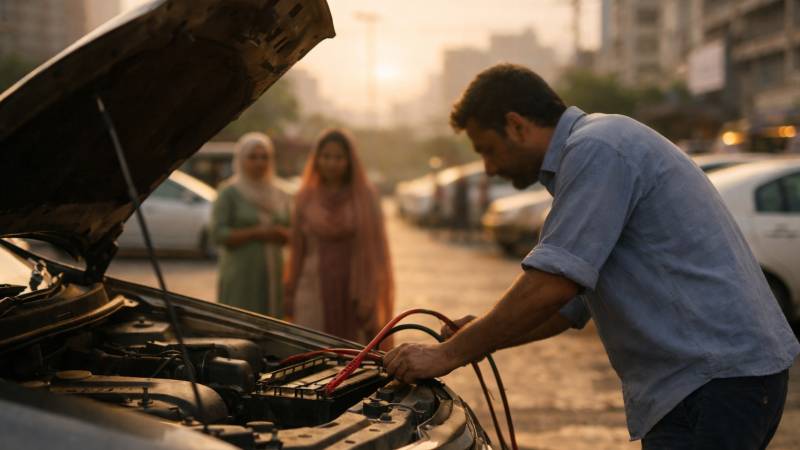
Aisha and her mother had just finished some last-minute shopping before their upcoming trip to the US. They were excited to visit their extended family and were out to fulfil requests from Khaadi and Generation. But as they loaded the car, they discovered it wouldn’t start and tried again and again. Nothing. Aisha’s mother was tired, and her own patience was wearing thin.
Looking around for help, she saw a man nearby. Aisha told me that while approaching this man, she was humming something:
Milo to sahi
Raasta koi mil hi jaaye ga
Chalo to sahi, chalo to sahi
This man initially seemed annoyed that he was even just asked. He said he didn’t have jumper cables and hesitated when Aisha told him that she had her own. Noticing that his body language was closed, Aisha caught herself judging his demeanour.
See? No one helps anymore, her old belief whispered.
But then another voice – quieter, wiser – interrupted: He’s allowed his boundaries. Don’t take it personally. So Aisha thanked him and walked away, looking for another solution.
Aisha chose to trust choosing faith over fear. And even though they didn’t end up finding the right fuse, they negotiated with a mechanic who would later arrive to help start the car
Minutes later, to everyone’s surprise, the same man walked over with a portable jump starter in hand. “Bonnet kholo (open the bonnet),” he said simply. Aisha noticed a limp in his step, and immediately something about him softened in her heart. He had his own struggles – and yet he chose to show up.
He tried everything he could, but the battery didn’t seem to be the issue. “Maazrat chaahta hoon. Battery issue nahi hai. Lekin mere pass yehi hai (My apologies. It isn’t a battery issue. But this is all I have),” he said. And even though the car didn’t start, Aisha felt so moved by his effort.
As he turned to leave, he pointed to a beat-up car that was parked nearby and whose driver was sitting inside. “Ask him,” he said. “I’m sure he can help you.” It seemed random. How would he know?
But the moment felt orchestrated – as if the Universe was speaking through him.
Aisha approached the car and saw that the seats were worn and belongings were scattered everywhere. Yet before she could finish explaining, he simply said: “Of course.” Without hesitation.
He brought a heavy car battery from his own car and swapped it with Aisha’s. He went back and forth, troubleshooting with care. Aisha mentioned offering to help, but he replied, “It’s okay.”
He didn’t ask for anything. He didn’t rush. And with every action, Aisha said that she felt her heart healing – slowly and tenderly. They found a fuse to test, and on the way, Aisha thanked him again. He smiled and said, “This is how it should be. Either we help each other, or nothing at all. Doesn’t matter who you are or where you’re from. We’re all one.”
How could he have known that those were the exact words that Aisha’s soul needed to hear?
This man – seemingly Pathan – showed up for Aisha in more ways than most people usually would. And this wasn’t just any city. Karachi can often be very glaringly divided in terms of ethnicity, and approaching someone for something (or anything) can be taken to be dubious.
In every sense, though, he proved that through action, goodness can transcend narratives. He later told Aisha, “When my car once broke down, no one helped me. So now, when I see someone stuck, I can’t say no.”
It had been a long day, and Aisha needed a quick solution. This man offered to drive to Block 2 to find the parts that were required. Logic would have said: do not enter a stranger’s car. And this fear is understandable — after all, this is Karachi. But something inside whispered: This is different. You can trust this one.
Kya huwa agar zindagi zara ulajh si gayi?
Socho to zara
Jangalon mein bhi raastey to hain
Humein bhi koyi mil hi jaaye ga
Aisha chose to trust choosing faith over fear. And even though they didn’t end up finding the right fuse, they negotiated with a mechanic who would later arrive to help start the car.
The car eventually started, and Aisha and her mother got home soon after. But this entire escapade gave Aisha something greater: her faith in humanity restored.
Before they parted ways, Aisha’s mother asked him what his name was. He smiled and said Abdul Al-Wahhab. And just like that, they knew that this was no random encounter. This was sacred. You see, the name Al-Wahhab means The Provider. And this man embodied that light. He gave when he had little. He went above and beyond for a stranger. He healed Aisha—without ever knowing what he did.
The Universe had sent a literal message of Aitebar. And now, every time we remember this story, we remember kindness and grace. You see, not every good person you see will have “that” cape on hand. They may not have perfect cars or polished words. But they show up, and that’s what matters.
Because the truth is, we are all walking each other home – if only we choose to listen:
Suno to sahi, suno to sahi
Aitebar bhi aahi jaaye ga, aahi jaaye ga