

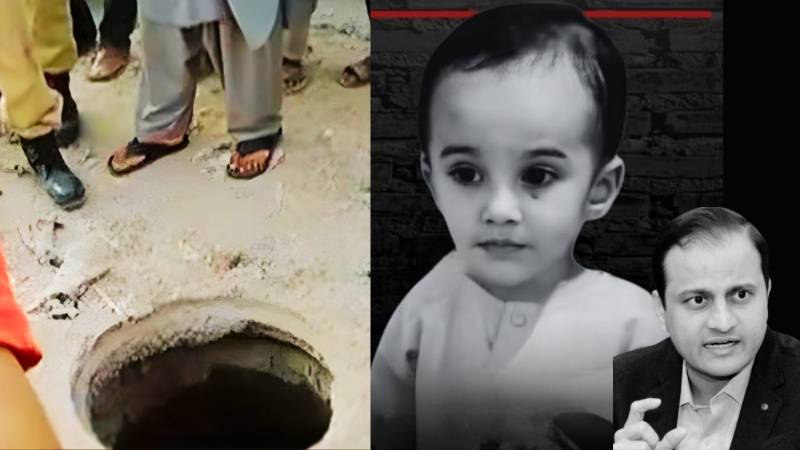
Karachi once again woke up to tragedy this week when a three-year-old boy, Ibrahim, slipped into an open manhole near Nipa in Gulshan-e-Iqbal and disappeared into the underground sewerage system. The boy had arrived with his parents for routine shopping; they stepped out of a store, the child ran a few steps ahead, and within seconds vanished into a gaping hole right beside their parked motorcycle. There was no lid, no barrier, no sign, nothing to warn a family that death was lying in wait just inches away on a busy public road. His grandfather later said in grief that Ibrahim was the parents’ only son.
As the rescue operation entered its twelfth hour, the situation at the scene revealed more than a tragic accident; it exposed the collapse of civic governance in Karachi. Rescue officials admitted openly that they had no proper machinery to assist them. They lacked excavation equipment, concrete breakers, depth-sensing tools, or any advanced search system. Most shockingly, no officials from the Water and Sewerage Corporation or the Karachi Metropolitan Corporation arrived for hours. Even the machinery that was initially present gradually disappeared, leaving rescue workers stranded without resources.
And so, Karachi’s residents did what they have done far too often: they took matters into their own hands. Locals pooled money, arranged heavy machinery themselves, and continued digging through the night while comforting a devastated family. The sight of citizens renting excavators and manually digging through the sludge of a metropolitan sewer system while the government stayed absent was a humiliating reminder of how deeply broken Karachi’s civic structure has become.
The public’s anger eventually boiled over. Roads around Nipa Chowrangi were blocked, tyres set ablaze, and stones hurled at passing vehicles. The roads leading to Hassan Square, Karachi University and Gulshan Chowrangi came to a standstill. Media teams covering the incident were attacked; a crew from Dunya News was held hostage by enraged citizens who shouted, “If the administration won’t come, what use is the media?” It was not unjustified aggression; it was the reaction of a city abandoned by those paid to protect it.
After fifteen hours of desperate efforts, the body of Ibrahim was finally recovered from the sewer. The rescue confirmed the worst fears of every resident: Karachi’s underground system is a tunnel of death, narrow, toxic, oxygen-deprived, and suffocating. The truth is brutal, and the family seems painfully aware of it.
This tragedy, however, is not an isolated case. According to rescue officials, twenty-four people have died this year in Karachi after falling into open manholes and drains. Nineteen of the dead were adults. Five were children. Twenty-four families have buried their loved ones simply because a manhole cover was missing. Where else in the world do people die just by walking on the street? Where else do children disappear into a sewer outside a shopping complex? Where else do residents themselves rent machinery and work through the night while government departments fail to appear?
Karachi’s citizens deserve a city where walking on the road is not a life-threatening act. They deserve a government that arrives before the media cameras. They deserve institutions that function, systems that protect, and leaders who take responsibility instead of issuing statements
The tragedy grows even more complex when one considers the reasons behind uncovered manholes. It is not always municipal negligence, though that is certainly part of it. Another grim reality is that manhole covers are often stolen. Many times, municipal teams install new lids, only for them to be removed within hours by drug addicts or scrap-metal thieves who sell the iron for a few hundred rupees. In a city battling poverty, addiction and lawlessness, even basic public infrastructure is at constant risk of being ripped apart and sold for survival. This cycle of theft, lack of policing, and incompetent oversight turns Karachi’s streets into traps—literal death pits waiting for the next victim.
Government response this time has been familiar but ineffective. A spokesperson for the Sindh government announced the launch of an inquiry into why the manhole was left uncovered. Karachi’s Deputy Mayor stated that all rescue agencies had been put on alert. Yet residents on the ground reported no such presence for hours. The gap between official statements and on-ground reality has become a painful joke, tragic but predictable.
Karachi is a city of 20 million, Pakistan’s financial backbone, a powerhouse of industry, trade and labour, but it is also a place where basic urban safety has collapsed to medieval levels. Its problems are far larger than a missing manhole cover. The city suffers from dysfunctional sewerage, broken pipelines, collapsing footpaths, unplanned expansions, chronic negligence and absolute failure of accountability. The return of extortion bhutta-khori has only added to the city’s sense of insecurity and lawlessness, as shopkeepers and small businesses once again fear the knock on their doors.
It is important to ask: why is Karachi unmanageable? Is it only population pressure? Is it political conflicts between the ruling party and metropolitan authorities? Or has the city simply been abandoned due to decades of administrative incompetence? When one looks at cities far larger than Tokyo, Seoul, Shanghai, New York, São Paulo, one sees massive populations but functional governance, strict inspections, fines for civic negligence, technological monitoring of infrastructure and responsive emergency systems.
Across many cities in Europe, North America, Japan, South Korea and Australia, uncovered manholes are considered an emergency-level threat. If a manhole cover goes missing, smart sensors notify city authorities within minutes. Municipal teams arrive immediately and seal the area. If, by some extraordinary accident, a child ever fell into a sewer, the nation would erupt in outrage. Officials would resign. Investigations would be transparent. Emergency response teams would work with advanced sonar, thermal imaging and mapping systems. And the tragedy would trigger a national conversation on safety.
Karachi, by contrast, has normalised these deaths. The annual tally of twenty-four this year is quoted casually in rescue reports, as if discussing the number of potholes repaired or trees trimmed. The acceptance of this horror shows how deeply the public has been conditioned to expect nothing from their institutions.
The tragedy of Ibrahim has shaken Karachi, but it must be seen as a turning point, not another forgotten headline. The city cannot afford to wait for the next child to fall, the next protest to erupt, the next inquiry to gather dust. Karachi needs a complete overhaul of its civic system, beginning with accountability within KMC, the Water and Sewerage Corporation, and district administrations. Regular inspections of manhole covers, mapping and monitoring of sewerage lines, strict punishment for theft of civic equipment and faster emergency response units are essential.
Equally important is the need to address the socio-economic roots of the problem: drug addiction, unemployment and poverty that push people to steal infrastructure. Without tackling these issues, manhole covers will continue to disappear, no matter how many times the municipal teams replace them.
Karachi’s citizens deserve a city where walking on the road is not a life-threatening act. They deserve a government that arrives before the media cameras. They deserve institutions that function, systems that protect, and leaders who take responsibility instead of issuing statements.
As the search for Ibrahim concluded, the question haunting the city is simple and devastating: how long will Karachi bury its children because of uncovered manholes? How many more deaths before someone finally takes responsibility?