

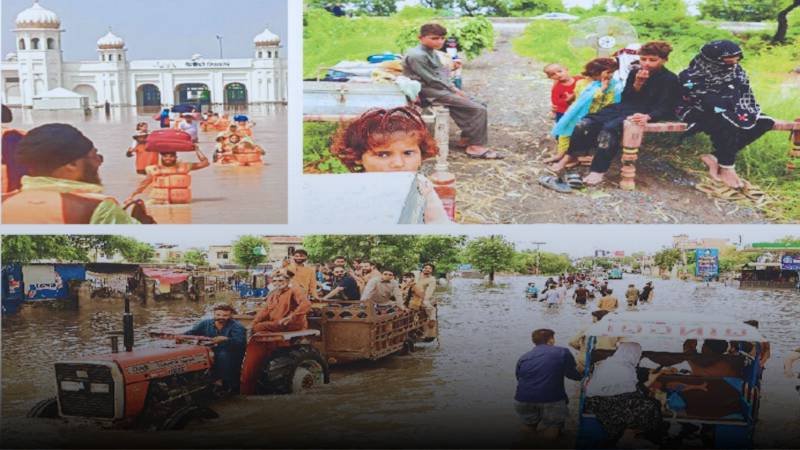
For centuries, rivers like the Ravi have been lifelines for Punjab’s agrarian society. Their waters once nourished fields of wheat and rice, sustaining families and communities. Today, those same waters, combined with melting Himalayan glaciers and relentless monsoon rains, have become forces of destruction, swallowing homes, roads, and entire fields. Recent floods have left behind not only submerged farmland but a deeper human and social toll that will be felt for years.
The immediate damage is visible: mud-brick homes collapse, fertile fields lie under brown, churning water, and roads vanish as if they never existed. But the aftermath is even more devastating. Floodwaters leave behind stagnant pools that breed cholera, dengue, and malaria. Wells are contaminated, and drinking water becomes unsafe for weeks. Children face disrupted schooling and heightened risk of disease, while families struggle with malnutrition and loss of income.
Women bear the heaviest weight. When rice and cotton fields are destroyed, they lose both wages and the food security their families depend on. They must walk farther for clean water, care for sick children, and manage households in relief camps where safety and privacy are scarce. In every flooded village, women carry responsibilities that are invisible in official tallies but critical to survival.
The land itself suffers. Silt deposits, salinisation, and prolonged waterlogging reduce soil fertility. Crops fail, livestock die, and fodder disappears. Agriculture, the backbone of Pakistan’s economy, faces long-term degradation. The economic consequences ripple beyond farms: food prices rise, rural incomes collapse, and export earnings dwindle, leaving the country more vulnerable to economic shocks.
Children are among the most affected. Beyond the immediate risk of drowning or injury, they face malnutrition, waterborne disease, interrupted education, and the psychological trauma of displacement. Floods disrupt childhoods in ways that can have lasting consequences for development and learning.
Decision-makers must prioritise upholding the social contract and representing the people who elected them, ensuring that policies and investments actually protect the vulnerable rather than merely signalling concern
These human and agricultural losses are compounded by institutional weakness. Disaster management authorities often respond late, local governments lack resources, and agricultural support systems fail to equip farmers for recurrent floods. When governance is reduced to slogans or performative speeches, the social contract (the promise that the state will protect its citizens in times of crisis) is hollowed out. Institutions must not exist only on paper; they must function, uphold accountability, and deliver substantive protection to those most at risk. Decision-makers must prioritise upholding the social contract and representing the people who elected them, ensuring that policies and investments actually protect the vulnerable rather than merely signalling concern.
Other nations have shown a different path. Bangladesh, also battered annually by monsoons, invests in community-based early warning systems, cyclone shelters, and flood-resilient housing. The Netherlands, living below sea level, has spent decades designing embankments and spillways that turn potential catastrophe into controlled flow. Even within South Asia, Nepal has piloted glacial lake outburst monitoring, pairing technology with local governance. The lesson is clear: floods are not only about water. They are about institutions and the choices of those in power.
Rivers will flood again, glaciers will continue to melt, and monsoon rains will fall with increasing intensity. Pakistan cannot treat this as a mere misfortune. Proactive governance is essential: maintaining embankments, ensuring functioning drainage, delivering early warnings, and providing long-term support for affected communities. Upholding the social contract requires more than words. It demands sustained investment, accountability, and institutions capable of protecting women, children, and farmers from predictable disasters.
If authorities fail to act as stewards of resilience, these floods will continue to destroy lives, land, and livelihoods, leaving the most vulnerable women, children, and rural communities to bear the heaviest toll.