

It was a relatively pleasant September day in 1988 as I heard the musical pitter-patter of parting monsoon over the corrugated iron-sheeted roof of the office barracks of the engineer battalion at Lahore. The mundane hubbub of the peacetime routine was a nice counterpoise to the earthy smell of wet soil and the freshly cut grass; a heady olfactory treat, only felt in the lap of a subcontinental monsoon. The whirr of the office phones in the adjutant’s chair got progressively louder as the reports from a higher formation monitoring flood situation started pouring in thick and fast.
Soon, the tone and tenor of the communication changed from routine exhortations and sharing of data to emergency warnings. The unit was placed on two hours’ notice and told to mobilise in support of the civil administration in flood-fighting and rescue mode, in keeping with our peacetime-prepared flood-fighting scheme. The continual rain and the darkening penumbra of monsoon clouds indicated that something was different this time with this sustained rain spell. There were worrying reports pouring in from Shahdara, Muridke and Balloki Headworks. The two field companies of the engineer battalion that had been deployed at Shahdara and Muridke, each a day before, were communicating on wireless in those pre-mobile phone days about an unprecedented river flow around Shahdara Ravi Bridge.
A record 345,000 cusecs of river flow was recorded at Shahdara, which was 100,000 cusecs above the design capacity of the irrigation structures and caused widespread destruction due to accidental breaching of the flood protection earthen embankments in Shahdara and Muridke. A Commander Lahore Army Corps Engineers, who landed near Shahdara to observe the flood-fighting work of the army engineer battalion, was marooned on an embankment where accidental breaches had cut off the road links of retreat and had to spend the whole night there with the troops, only to be ferried back the next day through a helicopter.
Surreal scenes were witnessed with the houses in the flooded area caving in and the people clamouring for help. The army engineers used their outboard motor-operated boats meant for river assault to good effect under raging currents to save human lives. The civil administration of Lahore was completely overwhelmed as there was a critical shortage of rescue boats and trained OBM operators who could operate such boats in flooded waters. The army troops, especially the boat operators, played a heroic role in providing succour to marooned flood-affected people, saving precious lives. In those days, there was no organisation like NDMA or PDMA, yet the civil administration did its best within its limited resources. Faced with the grim prospects of the Ravi flood reaching Balloki and Sidhnai Headworks in strength, our engineer battalion was tasked to send a field engineer company to Balloki to operate the breaching sections of flood protection bunds i.e. Right Marginal Bund and Madhodas Bund.
The engineering field company’s convoy, along with necessary bund breaching equipment like explosives, detonators, detonating cords and detonating circuitry, etc., made way for Balloki under rainy conditions, reaching there by the afternoon
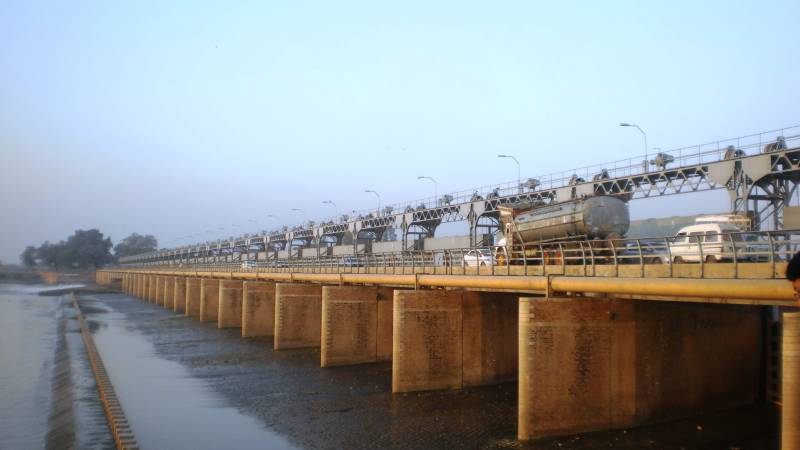
The breaching sections are the areas on flood protection embankments that are prepared during normal times to explode the earthen embankments using explosives, to divert the flood waters in a controlled manner to already designated areas, in order to relieve hydraulic pressure on the barrages and headworks. Balloki Headworks, which regulated the canal flow in such vital canals as Lower Bari Doab (LBDC) and Balloki Sulaimanki Link (BSL) canals, had a designed capacity of 2.25 lakh cusecs to safely regulate the water flow, whereas the actual flow recorded on 27th September 1988 was an all-time high record of 399,356 cusecs, which is still unbeaten.
Confronted with the emergency, I was told to wear another hat, i.e. of the company commander, and take over the command of the company affiliated with the Balloki area of responsibility forthwith. I doffed the adjutant’s cap and wore the regulation Khaki field beret to take command of the company. The engineering field company’s convoy, along with necessary bund breaching equipment like explosives, detonators, detonating cords and detonating circuitry, etc., made way for Balloki under rainy conditions, reaching there by the afternoon. Balloki Headworks presented a Dunkirk-like image with motorcycles, vehicles, and animal-driven wagons crowding the headworks site in a bid to make their way to safety.
Another engineer battalion that had just completed its bridge training was starting to move back, and when its officers, especially the CO, spotted a field engineer company under a greenhorn Captain sent to operate the breaching sections under extremely hazardous conditions, he called me over and passed some valuable tips about safety under these hazardous conditions. The only person who welcomed us with effusive exuberance there was the local XEN, a tall and energetic young fellow who wasted no time in settling us down. He wore a palpably worried look due to the information in his possession. He told us that the water warning gauge had almost reached its dangerous recorded level and that he did not know what damage might already have been caused to the main structure of the barrage.
As we stood there planning our next move, a harried-looking senior irrigation officer arrived and introduced himself as Superintendent Engineer (SE) LBDC Circle. He, being a senior and experienced irrigation official, wore a saturnine countenance and asked after our state of preparedness about the intended breaching operation. After my reassurance, he broke the grim news that the Headworks was under imminent danger of collapse due to an all-time high-water discharge approaching Balloki that night. He told us that the Balloki Headworks, which was constructed initially in 1915 by the British under the famous Triple Canal Projects and irrigated the arid lands of Sahiwal and Okara districts and below, and if damaged, would cause desertification of all the irrigated lands with incalculable economic consequences for several years to come.
Despite low visibility due to the night, I could see the billowing dust and water with a few clods of wet earth striking the windscreen of my jeep and a Dodge standing nearby
The irrigation officials were visibly irritated at the procrastinating attitude of the provincial authorities that had not yet signed the breaching order due to the political pressure of the local MNA, who wanted to avoid his lands being flooded. The consequences of the delay were ominous as the raging torrents of Ravi could have damaged the barrage besides creating uncontrolled and accidental breaches which, compared to the planned controlled breaches, could cause uncontrolled devastation and widespread flooding till as far as Jaranwala. The brave men of the engineer field company waited in their jeeps and dodges all geared up in combat Khaki field service marching order, with explosives and associated accoutrements carefully packed while the government and the irrigation officials waited for the demolition order.
As night approached, our higher formation headquarters got in touch on wireless and were relayed the grim assessment of irrigation officials who were still waiting while the accidental breaches were probably already happening. An intervention from army formation resulted in the signing of the breaching order and we were given the written order by the XEN who bade us farewell on the main headworks. As the convoy made its way slowly on unpaved road along the flood protection bund, the grim visage and sounds of the water currents lapping the embankment indicated the grave danger the men were exposing themselves to.
While en route to our breaching location, we saw an accidental breach occurring in the embankment. This was a very bad omen as the accidental breach meant that the water had already reached a dangerous level and that our line of retreat could be cut by that accidental breach, effectively marooning us all, along with our vehicles in an uncontrolled expanse of flood waters. I tried to communicate on wireless to relay the news to the irrigation officials and my formation, but could make no contact due to movement and the communication dead zone. The breaching party eventually reached the breaching site and spent the whole night charging the holes in embankments with the explosive and linking those with the demolition electrical circuit through detonating cord.
A stage came during the charging of the holes when the water brimmed over the inner embankments, filling the trough in between the twin bunds of the embankment, making the connection of the detonating cords a very difficult and risky proposition. We selected a couple of intrepid swimmers who swam in those currents to connect the detonating cords to the row of holes. Those daredevils, without regard to their safety, swam in flood currents to make the embankment ready for breaching under extremely hazardous conditions. As a commander, I was naturally worried as, due to damp conditions and the surging water, the detonating circuit could come unstuck, making the demolition a failure. The eerie quiet of the night was periodically broken by loud thuds of collapsing houses that were regularly collapsing under the implacable pressure of water currents.
At long last, the moment came when the demolition button was to be pressed from a safe distance. A thunderous explosion shook the entire area and the embankment for quite a distance, with the shock waves experienced by irrigation officials waiting impatiently for the breach at the main road of the barrage. Despite low visibility due to the night, I could see the billowing dust and water with a few clods of wet earth striking the windscreen of my jeep and a Dodge standing nearby. The gushing sound of the water rushing through the breach was a sight to behold as the breach created by us progressively widened. After this successful breach, we retreated in a rush, only to find our way back blocked by an accidental breach. Mercifully, that breach had not widened enough to make the track impassable as the jeeps and dodges trudged back using four-by-four gears’ traction, just in time before water made the track impassable.
At the headworks, we were received like triumphant warriors by the XEN irrigation and his team, who were over the moon due to the successful breaching operation. A total of 186,000 cusecs of water was diverted through the breaching sections operated on the Right Marginal Bund on that September 1988 night, relieving pressure on the Barrage. A day later, when a minister, along with a large entourage and press, visited the headworks, the SE LBDC told him during his briefing that “Sir, these are men of steel whose timely action has saved this barrage.” The men who saved Balloki headworks that September night after risking their lives deserved recognition, but no citations were forwarded by us, as in those days of the heady idealism of youth, one thought one was just doing one’s duty, hence no hankering for appreciation baubles. The issue was highlighted in the press, also in those pre-internet and digital media days, and the record of those climactic few days should also be maintained by the Punjab irrigation authorities.
Water, being a precious resource, needs to be securitised as a national security imperative and water governance depoliticised
A few days later, another protective bund was breached to divert a very high flood at Sidhnai, where another all-time high record of 325,000 cusecs of river flow was experienced. The objective of recounting the 1988 flood, apart from paying tribute to those brave soldiers and diligent irrigation officials who saved the vital irrigation structures from the depredations of the flood, is to highlight a few lessons which are applicable to the current flood scenario. It is September again, and 37 years after 1988, I observe the same visuals being played out on the TV screens showing the residential colonies flooded, the crop lands destroyed, and the mud houses of rural Punjab engulfed in flood waters. One cannot miss the eerie resemblance to the 1988 flood, as River Ravi has come alive to claim its river course.
Despite a much lower quantum of flood waters compared to 1988, the devastation caused by the 2025 flood waters has been more in terms of cropland destroyed and people affected. What is the reason for this mismatch? One simple yet very important reason is our inability to keep people away from the river plains. A lot of attention of late has been lavished on climate change, which became a fad of sorts. Climate change is a reality just as it has been for millennia in the Indus River Basin. While Pakistan can do little by way of climate mitigation due to its puny contribution of greenhouse gases, a lot could be done on the adaptation front. Our forebears have been adapting to changing climate and hydrology for millennia, and so should we.
Instead, what we have done is to cast away our inhibitions while encroaching in river plains, leaving little for the rivers to live their lives in their main stems as well as palaeo-channels, like they did for centuries. We have disregarded the fact that the rivers need space around their main course for spillage and meandering, which the hydrologists call the rivers’ right of way. With wanton disregard to the environment or human safety, our greedy town planners and real estate developers have encroached upon the river course, while a dysfunctional governance system and corruption contributed to the rot. The blocking of the natural drainage channels and the main river courses has prevented proper river regulation through strong flood protection embankments, channelisation spurs and robust hydraulic regulation structures.
The second lesson is the same underinvestment in early warning and flood-fighting means that the civilian disaster management agencies are ill-equipped and unprepared for the scale and magnitude of flood disasters that are periodically encountered. The state has also failed to stop the unplanned urban sprawl and the rural encroachment into the floodplains, due to weak enforcement of law and corruption. When we tempt fate and court disasters by allowing human habitation inside the flood plains and fail to construct proper protective embankments aligned to the topographical and hydrological realities of nature, nature will keep venting its anger on us.
We need a massive overhaul of our water regulation structures, i.e. weirs, barrages and canal off-take point regulators, besides investing heavily in flood protection and drainage infrastructure, after scientific studies by credible internal as well as international hydrology, civil engineering and irrigation experts. The first step in the above endeavour should be a survey conducted by international consultants, facilitated by the government and army, to identify the encroachments on natural drainage channels of rivers and nullahs and meander plains. No political pressure should be brooked as several existing housing schemes and projects like RUDA that were started without a proper environmental impact assessment study should be reviewed and stopped or scaled back in deference to hydrological realities, regardless of the political pressure.
The above campaign should not be restricted to the Lahore and Ravi catchment area but also extended to the Western rivers, including smaller rivers like the Swan, that flow through Rawalpindi and have also been encroached upon at several places. Water, being a precious resource, needs to be securitised as a national security imperative and water governance depoliticised. A Central Water Resource Development Commission should be created at the national level, including provincial representation, which should be autonomous and empowered to take vital water governance decisions independently of political pressure, including water resource development.Organisations like WAPDA, the Federal Flood Commission and water research institutes should be subsumed under it. This commission should take vital decisions like the construction of dams and initiation of big irrigation canal and drainage infrastructure projects, based on international standard technical feasibility studies that could neither be challenged nor politicised.
Through better governance, technology and water regulation, we should make flood waters our strength, not man-made disasters.