

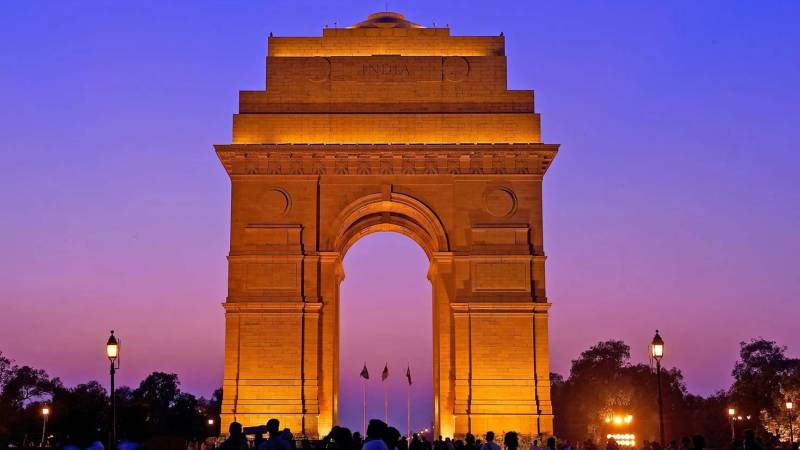
Delhi is getting its ninth capital. Nearly a hundred years after the British shifted their seat of power from Calcutta to Raisina Hill, Prime Minister Narendra Modi has moved India’s administration into a brand-new complex on Kartavya Path.
For almost a century, governance in independent India flowed through the twin iconic sandstone structures known as North and South Block. Designed by British architects and completed in 1929 at a cost of 17 million rupees, the buildings housed the Prime Minister’s Office as well as the Defence, Home, Finance, and External Affairs ministries. Over more than a thousand rooms and corridors, history was made — and often hidden.
The Secretariat bore witness to some of India’s most consequential moments. It was here that Lord Mountbatten, the last Viceroy, read out the 34-page partition plan to leaders of the Congress, the Muslim League, and Sikh representatives.
As chronicled in Freedom at Midnight, everything from banks to stamps, railways to universities, was divided within these walls. Later, independent India’s leaders operated from the same premises: Jawaharlal Nehru shaped the nation here, and in 2016, Narendra Modi announced the demonetisation of the Indian rupee. In 2012, the same blocks became the rallying point for nationwide protests after the Delhi gang rape, and year after year, the space between them hosted the Beating Retreat ceremony.
Now, the government has declared them relics of a colonial past. Plans are underway to convert the Secretariat into Yuge Yugeen Bharat, a museum showcasing artefacts from 2000 BC to the 11th century. With the relocation, only Rashtrapati Bhawan — once the residence of the Viceroy and now the home of India’s President — will remain in active use from the Raj era.
The move marks the centrepiece of Modi’s Central Vista Project, which has already produced a new Parliament building. The project envisions 10 new secretariat blocks bringing all ministries under one roof, along with new residences for the Prime Minister and Vice President. The colonial-era “Rajpath” has been renamed “Kartavya Path,” in keeping with the government’s emphasis on duties over rights.
Since 1947, independent India has adopted the British capital as its own, but Modi’s project marks the first time in 75 years that a new seat of government has been built from scratch
The transformation has not come without criticism. Environmentalists, heritage experts, and opposition parties have denounced the project as extravagant, poorly planned, and destructive of open spaces. Parts of the National Archives, the Indira Gandhi National Centre for the Arts, and the National Museum were demolished or relocated. Over 200,000 artefacts and manuscripts from the National Museum, many lacking a complete inventory, were reportedly boxed and stored in a Delhi hotel basement. Curators and historians worry that ordinary office buildings lack the controlled lighting, ceiling height, and storage conditions required for museums.
“Museums are known for making a political statement,” said historian Nilanjan Mukhopadhyay. “This government is known for taking unilateral decisions. The way it wants to portray India as a Hindu nation as our only heritage, we might lose our medieval past.”
He said that Modi wants to leave an architectural legacy, which is opaque and authoritarian. He adds that these structures and names are a constant reminder of how the Rashtriya Swayamsevak Sangh and the Bharatiya Janata Party view this country. It endorses the RSS-BJP idea of duties of the citizens sans rights. While the office of the Prime Minister will be called Sewa (service) Bhawan, for the rest, it is kartavya (duties/responsibilities). Reading between the lines, he adds, “There is so much emphasis on kartavya. While what the prime minister would do is service, and the rest have to perform duties. We fail to find any mention of rights of the citizens,” he adds.
Senior journalist Vivek Shukla counters that every statesman seeks to leave his mark. “These buildings are nearly a century old. The old always makes room for the new,” he said.
The National Museum is over 70 years old and has over 200,000 artefacts. The museum announced recently that it does not have an updated inventory list. Absence of an inventory list would mean a hindrance in the relocation and research process.
“British secretariat was meant to be office spaces with multiple rooms. Museums have their own unique architecture, which has to take care of some very basics like the height of the ceiling, required natural light, regulated temperature and areas for storage. How the government plans to do it in office spaces, we have no idea,” said Sohail Hashmi. Hashmi is a historian and a heritage conservationist and is amongst the group of activists wanting to know from the government the future of the museum.
A capital’s layered past
Delhi’s constant reinvention adds gravity to Modi’s gamble. Over the last thousand years, the city has seen eight capitals rise and fall: the Pandavas’ Indraprastha, the Tomar and Chauhan strongholds, the Delhi Sultanate’s series of citadels including Siri and Tughlakabad, Shahjahanabad under the Mughals, and finally the British seat at Raisina Hill.
Each, in turn, carried a shadow of decline. The Pandavas abandoned Hastinapur for Indraprastha, only to lose their kingdom soon after. The Purana Qila, near today’s Supreme Court, is a reminder of that downfall. The Mughals saw their power collapse after shifting from Agra to Delhi. The British, who moved their capital from Calcutta in 1911 and inaugurated Raisina Hill in 1929, lost India within two decades.
Since 1947, independent India has adopted the British capital as its own, but Modi’s project marks the first time in 75 years that a new seat of government has been built from scratch.
The question remains whether Modi can escape Delhi’s jinx.
Rulers who sought permanence in architecture often saw their rule cut short. Modi has cast the Central Vista as part of shedding colonial baggage and projecting a self-confident India. But as Delhi gets its ninth capital, history whispers its warnings: building anew in this city has rarely ended well for those in power.