

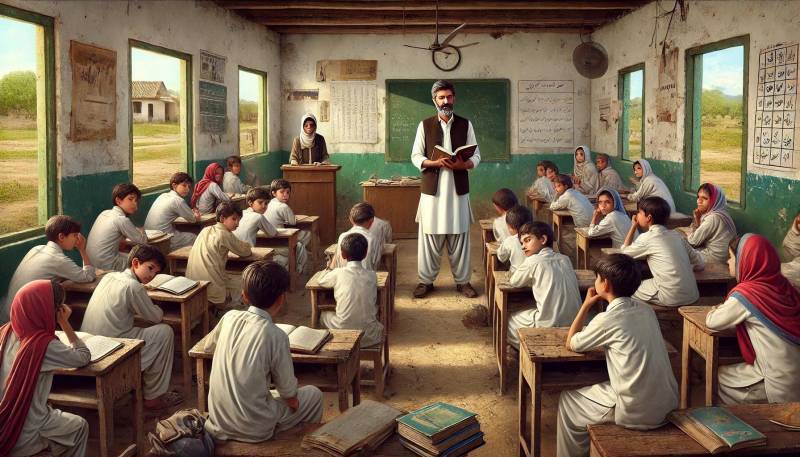
Last month, as I sat in a bustling café in Lahore, I overheard a group of teachers debating Pakistan’s Single National Curriculum (SNC). One argued passionately that it could unify a fragmented education system; another worried it might stifle diversity. Their conversation echoed a national debate that has simmered since the SNC’s rollout began in 2021, aiming to bridge divides across public, private, and madrasa schools. Pakistan’s education system, long marred by inequality, faces a pivotal moment with the SNC. But has this ambitious reform delivered progress, or has it merely exposed deeper challenges?
The SNC, introduced under former Prime Minister Imran Khan’s government, seeks to create a “uniform education system” by standardising curricula, instruction, and assessments across Pakistan’s diverse educational landscape. With over 22.8 million children out of school and a literacy rate of 62%, the need for reform is undeniable. The SNC promises to level the playing field, ensuring students from rural public schools to elite private institutions learn the same core content. This vision aligns with Pakistan’s constitutional mandate for free education for all children aged 5–16 and aims to reduce socio-economic disparities that have long plagued the nation.
The curriculum’s phased implementation—covering grades 1–5 by 2021, 6–8 by 2023, and 9–12 by 2024—has shown early signs of progress. In Punjab, urban schools report higher success rates (mean score of 4.1 on implementation surveys) compared to rural ones (3.5), suggesting some traction in better-resourced areas. The SNC emphasises critical thinking, moving away from rote memorisation, and incorporates modern skills like ICT, aiming to prepare students for a globalised world. For madrasas, which educate around three million students, the SNC offers a chance to integrate secular subjects, potentially opening new career paths.
The SNC could unify Pakistan’s fractured education system, but only if it bridges resource gaps, respects diversity, and prioritises access over ideology
Yet, the SNC’s lofty goals face formidable hurdles. A key challenge is the disparity in resources and teacher preparedness. In District Khushab, a study found 90% implementation in private schools but highlighted teachers’ struggles with inadequate training and resources. Rural schools, often one-room setups with underqualified staff, grapple with the SNC’s demands, especially its Urdu-medium instruction for subjects like social studies. Teachers in these areas report technical difficulties, particularly when Urdu isn’t students’ mother tongue. Meanwhile, private schools, accustomed to English-medium Cambridge curricula, find the SNC’s content less rigorous, risking a “lowering of standards” for their students.
The SNC’s heavy emphasis on religious content has also sparked controversy. Critics argue that mandating Islamiat from grade 1, with added Qur’anic recitation and hadith, burdens young learners and may alienate non-Muslim students, despite provisions for minority religious education. A Lahore-based study found 9–23% of English textbook content in grades 3–5 violates constitutional safeguards for religious freedom. This focus risks prioritising ideology over cognitive development—a concern echoed by physicist Abdul Hameed Nayyar, who notes that public schools now teach more religious content than many madrasas.
Beyond curriculum design, structural issues loom large. The 18th Constitutional Amendment devolved education to the provinces, yet the SNC is federally driven, causing friction. Sindh has rejected it outright, while Balochistan and Khyber Pakhtunkhwa cite unpreparedness. This central–provincial tug-of-war undermines uniform implementation. Moreover, the SNC does little to address deeper societal barriers like poverty and gender inequality. With a 22.7% primary school dropout rate—higher for girls due to early marriages and cultural norms—the curriculum alone cannot ensure access. In Balochistan, 78% of children lack educational opportunities, a gap the SNC barely addresses without infrastructure investment.
The SNC’s vision of “One Nation, One Curriculum” is compelling, but its success hinges on execution. First, Pakistan must invest in teacher training—only 2% of GDP is spent on education, far below the 4% needed to meet Sustainable Development Goal targets. Programmes like Punjab’s School Improvement Programme show promise, combining infrastructure upgrades with professional development. Second, the government should engage provinces collaboratively, respecting their autonomy while aligning standards. Finally, addressing out-of-school children, especially girls, requires tackling poverty and cultural barriers alongside curricular reform.
The teachers in that Lahore café were right to be both hopeful and sceptical. The SNC could unify Pakistan’s fractured education system, but only if it bridges resource gaps, respects diversity, and prioritises access over ideology. Without these, it risks becoming another well-intentioned policy lost in the quagmire of implementation. Pakistan’s future depends on educating its youth equitably—now is the time to turn ambition into action.