

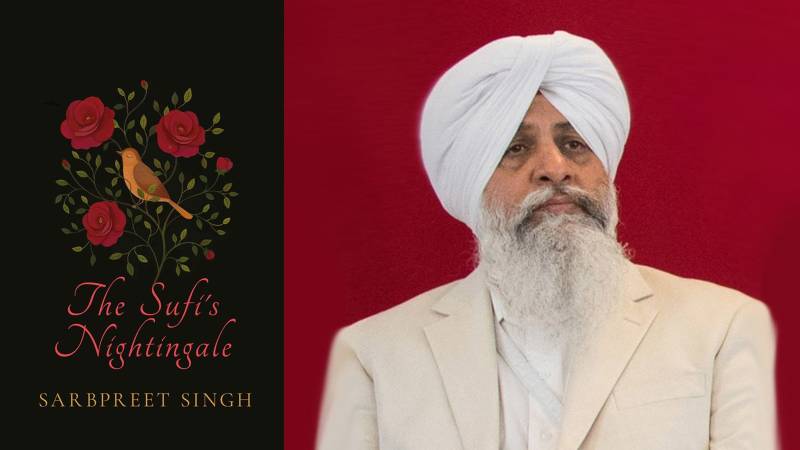
The author of The Sufi’s Nightingale, Sarbpreet Singh, is a writer, playwright and podcaster known for his work on Sikh history and historical fiction. He is also the founder of The Gurmat Sangeet Project, a nonprofit dedicated to preserving Sikh sacred music. The Sufi's Nightingale is a historical novel by author Sarbpreet Singh and I am told that it took him eight long years of research to write this book. It is a fictionalised retelling of the life of the 16th-century Sufi poet Shah Hussain, focusing on his notorious and rather controversial love for a Brahmin boy named Madho. The title of the novel is a reference to Maqbool, Shah Hussain's devotee/mureed and “bulbul” (nightingale), who narrates portions of the story. The novel explores the theme of interfaith and inter-caste love, and how spiritual love is far above it all, and how love doesn’t see colour, class or background. It details how Madho’s parents were at first against Shah Hussain and Madho being in each other’s company, but with time and miracles happening they too became supporters of Shah Hussain.
The novel is narrated to us from two different perspectives: that of Shah Hussain and his devoted follower, Maqbool. The story moves in an exceptionally rhythmical way through each chapter as one is narrated by Maqbool’s perspective and another by Shah Hussain’s and the two points of view seem to merge into one. The main story revolves around Hussain’s love for Madho, which scandalises 16th-century Lahore and tests the devotion of his growing followers, particularly Maqbool. Throughout the tale, Maqbool’s utter dislike for Madho is clear and openly expressed yet the two seem to have a functional relationship because both are in love with Shah Hussain. Maqbool is jealous of the fact that Madho has displaced him and taken his place as Shah Hussain’s number one mureed, closer to him that anyone else, in fact Shah Hussain loves Madho like he loves no other and writes poem after poem for him and when Madho leaves him for several years he is tragically sad. Out of the many Ragas, one that captured me was the following:
“The road that my beloved takes
A sacrifice to it I will be
I’ll fling the weaving basket
I’ll spin no more, I’ll be free.
From this Heer’s heart a spark will fly
And my Ranja will come to me
Hussain the lovely dervish says
My Lord will bring my love, you’ll see!”
The book is filled with many such kafis sung by Maqbool in his melodious voice and written by Shah Hussain. In fact, the entire tale is peppered by the author’s English translations of Shah Hussain's kafis (short, rhymed poems). Singh's historical literature brings us back to life to 16th-century Punjab and includes meetings with historical figures like Emperor Akbar and Guru Arjan.
How does a writer capture the life of a Sufi poet? For Sarbpreet Singh, the answer lay in peppering his narrative with stunning English translations of Shah Hussain's kafis
The three central characters of the book are Shah Hussain (Lal Hussain), a real historical figure and 16th-century Sufi poet from Lahore. The novel portrays him as a malamati, a type of Sufi who rejects worldly approval in his devotion to God. Then there is Maqbool, a fictional character created by Singh. Maqbool is Shah Hussain's original “nightingale,” blessed with a beautiful voice for singing his master's poetry. He narrates the story and struggles with jealousy when Madho enters his master's life. Finally, there is Madho who is the real-life love interest of Shah Hussain, and a key character in the story. The love of Lal Hussain and Madho was such that his name was eventually merged with Hussain’s, and the two are known together as Madho Lal Hussain. When describing the way Lal Hussain and Madho danced together Singh writes beautifully: “In an instant, Madho and my master were dancing perfectly in unison. Neither of them seemed to be leading or following, but somehow, magically, they danced as if they had spent days perfecting their coordinated twirls and their graceful lunges.” Lal Hussain is constantly shown to be in deep love with Madho and captivated by the boy as he asks Maqbool to sing:
“Free of sorrow is the one
Whose master is by his side
Beautiful my lover’s face
In my eyes known to reside
Not for a second do we part
How can we? He dwells inside
Says Hussain, the Lord’s faqir
In this world none will abide.”
But it is not just matters of the heart and kafis that the book touches, Lal Hussain also quotes ayats and touches religion, for example, the one below touches Allah and the hereafter:
“What is this life if it is not sport?
Are we not here all to play?
What is to come is better still
For those who follow Allah’s way.
Oh foolish one, you take no heed,
Had you sense, you would obey.”
In this way Lal Hussain explains that this ayat is about the joys of the hereafter, which are true and abiding and compared to them our life on earth seems trivial. This extremely detailed book explores the intersection of love and faith, contrasting worldly and spiritual devotion, and tackling themes of caste, gender, and sexuality in pre-colonial South Asia. It was an easy read with no difficult vocabulary, yet the kafis and historical data made it riveting and I thoroughly enjoyed the process of learning more about Sufi Islam. For those interested in Sufism, I’d say put this one in your shopping cart for sure.