

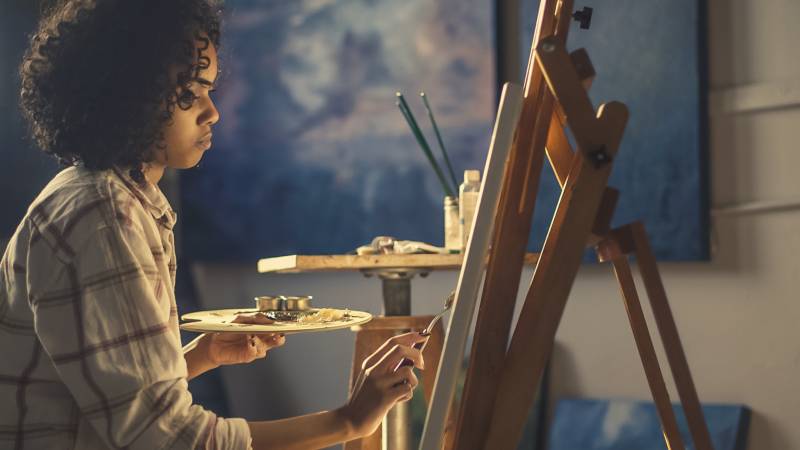
In a quiet room somewhere in Karachi, a woman paints with her fingers. Another one colours furiously until her lines bleed outside the paper. No one tells them what to draw. No one tells them to explain. It’s the first time in years they’ve done something just to feel, not to fix, not to please, not to prove.
This is not therapy in the traditional sense. But for many women in Pakistan, it’s the first time they’ve breathed without guilt.
In many households, girls learn early how to disappear in plain sight. They are praised for being obedient, quiet, accommodating, not for being honest, angry, or hurt. By the time they become women, most have mastered the art of holding everything in. The tears that didn’t fall. The words they swallowed. The weight they carried for everyone else.
When a woman loses a child, she’s told to move on. When she’s betrayed, she’s told to forgive. When she’s overwhelmed, she’s told to be grateful. But no one asks what all that swallowing does to the soul.
Therapy is rare. Expensive. Stigmatised. Even when available, many women don’t feel safe enough to ask for help, or don’t have the words to explain what’s happening inside them. And so, the grief settles quietly.
It shows up as back pain. As silence at dinner. As irritability mistaken for bad temper. It shows up as sleeplessness. Headaches. Fatigue. Or simply the numbness of going through the motions.
We’ve taught women to survive. But we haven’t taught them how to feel. And that, too, is a form of loss.
Healing doesn’t always come in the form of a therapist’s office, sometimes, it comes through a paintbrush
This is where art finds its way in, not with grand promises, but with quiet presence. Not as a luxury, but as a lifeline.
Sometimes a woman sits with a blank page and doesn’t know where to begin. So she picks a colour that feels like the ache in her chest. She draws shapes that make no sense, but match the rhythm of her breath. She paints without needing to explain.
No one interrupts her with advice. No one asks her to make it pretty. There are no wrong answers here, just movement, just feeling, just the slow unwinding of something she didn’t even know she was holding.
This isn’t therapy in the clinical sense. But it is healing. It is expression without judgement. A space where emotions don’t have to be named to be real.
In that quiet, with paint on her fingers and breath in her lungs, she begins to return to herself, not all at once, but stroke by stroke.
In community-based art and breath work workshops, the impact is quietly profound. Women cry while drawing. They laugh nervously, then deeply. They say things like “I forgot how to feel safe in my own body” or “No one ever asked me how I am, like this.”
These aren’t isolated stories. This is a pattern: when given space to express, women begin to return to themselves. Not all healing needs to begin in a clinic. Sometimes, it begins with colour.
It’s time we stopped treating emotional wellness like it’s a luxury, something reserved for the rich, or something borrowed from the West. The truth is, the need to feel safe inside your own mind, to rest inside your own body, is not foreign. It’s human.
Women don’t need more slogans. They need spaces. Spaces where they can exhale without being judged. Where their grief isn’t rushed. Where their softness isn’t mistaken for weakness.
Healing doesn’t always come in the form of a therapist’s office, sometimes, it comes through a paintbrush. Sometimes, it comes through breath. Sometimes, it’s simply someone saying, “It’s okay to feel this.”
But these spaces shouldn’t be left to chance, found only in crisis, or stumbled upon after breaking. They should be built with intention. Made visible. Made safe. Made ours.
Healing won’t always look like a couch and a clipboard. Sometimes it looks like a woman holding a paintbrush for the first time in decades. Sometimes it sounds like a breath held too long, finally released.
When the system offers silence, women will find their own language. Sometimes, it’s colour.