

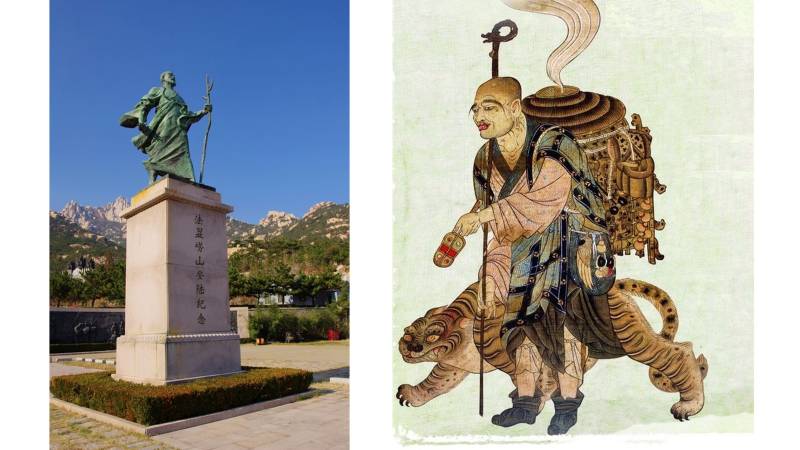
Faxian wasn’t the first Chinese monk to travel west in search of Buddhist wisdom, but his account stands out for its detail. At a time when travel meant enduring harsh deserts, bandit-ridden roads and political instability, his determination was extraordinary. He and his companions survived the treacherous Silk Road, crossing into what is now northern Pakistan – then known as Gandhara.
For Faxian, this was sacred ground. Gandhara wasn’t just another stop on his journey; it was a living part of Buddhism’s golden age. The monasteries here were filled with monks debating philosophy, artists carving intricate Buddha statues, and pilgrims paying homage at towering stupas. His writings capture the awe he felt upon seeing these marvels – it is a feeling that still resonates when visiting these sites today.
One of Faxian’s most striking accounts describes Purushapura, modern-day Peshawar, where the legendary Kanishka Stupa once stood.
Reading Faxian’s account today, it is not the historical detail that stands out most, but rather, the sense of connection
Imagine a massive tower, said to reach nearly 400 feet into the sky, adorned with gold and silver and crowned with a jewel-encrusted relic chamber. Faxian wrote that it was one of the most magnificent structures he had ever seen.
Today, nothing remains of the stupa except historical records and scattered artifacts, but its memory. Locals still point to a mound in Shahji-ki-Dheri, believed to be its ruins. Standing there, it is easy to picture Faxian gazing up in wonder, just as modern visitors do when they see the surviving Gandharan art in Peshawar’s museums. They see delicate Buddha statues with Hellenistic features, a reminder of the region’s unique blend of Greek and Buddhist traditions.
If Gandhara was the intellectual hub of Buddhism, then Swat (ancient Uddiyana) was its spiritual retreat. Faxian described a valley so dense with monasteries that it seemed like a “land of the gods.” Monks meditated in caves, students debated in courtyard schools, and stupas dotted the hillsides.
Walking through Swat today, traces of that past are still visible. Near Mingora, the Butkara Stupa stands as a silent witness to centuries of devotion. In the nearby mountains, caves where monks once meditated remain intact. No wonder that Swat earned its nickname, “The Valley of the Saints.”
No journey through Pakistan’s Buddhist past is complete without Taxila. In Faxian’s time, this was one of the world’s great centers of learning, a place where philosophy, medicine, and astronomy were studied alongside Buddhist scriptures. He described monasteries filled with scholars and libraries holding precious manuscripts.
Today, Taxila’s ruins, spread across rolling hills, still evoke that scholarly spirit. The Dharmarajika Stupa, with its intricate carvings, and the Jaulian Monastery, where students once gathered in lecture halls, are remarkably well-preserved. Walking through these sites, it is easy to see why Faxian was so impressed. Taxila wasn’t just a religious center; it was a university town, a place where ideas crossed borders long before globalization as we know it.
Reading Faxian’s account today, it is not the historical detail that stands out most, but rather, the sense of connection. The places he visited, the people he met, and the devotion he witnessed are all part of a shared heritage that transcends modern borders. Pakistan’s Buddhist past is often overshadowed by later history, but Faxian’s words remind us that this land was once a crossroads of faith and knowledge. For travelers, historians, or anyone curious about the threads that bind Asia’s spiritual traditions, following Faxian’s path through Pakistan is a journey into the heart of Buddhism’s legacy.