

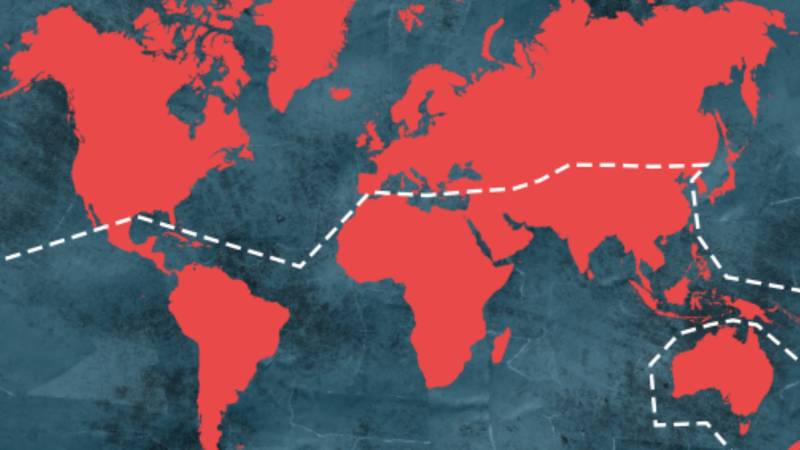
The title of this column is borrowed from The Empire Strikes Back: Race and Racism in 70s Britain, a collection of essays published by the Centre for Contemporary Cultural Studies at the University of Birmingham. I felt compelled to write under this title in light of the profound transformations currently unfolding in global affairs—particularly the shifting balance of power from the Global North to the Global South, from the United States to China.
This may have been open to debate a year ago, but time has since demonstrated that such a shift is indeed underway.
The following discussion took place on a television show, during which I challenged the widely held notion that international relations are governed purely and exclusively by the ‘interests’ of individual nations, and that no other factors shape or influence these relationships. In this context, I reminded the esteemed panel of Henry Kissinger’s distinction between the foreign policies of East and West, as cited by Edward Said in Orientalism.
Kissinger argues: “Cultures which escaped the early impact of Newtonian thinking have retained the essentially pre-Newtonian [primitive] view that the real world is almost completely internal to the observer.” Said observes that Kissinger maintained a fundamental distinction between Occidental and Oriental approaches to foreign policy: the former, he contended, is rooted in pragmatism (a consequence of its direct encounter with the Newtonian revolution), whereas the latter is characterised by prophecy—owing to its lack of that experiential transformation which the West underwent.
With this in view, one might be tempted to conclude that foreign policy, when rooted in a scientific worldview, is entirely rational—unaffected by emotion and guided solely by mathematical calculations of material gain arising from inter-state relations. However, if that were wholly true, then racism would no longer continue to shape the foreign policies of the United States, Europe, and other powers.
National memories, shared histories, and collective consciousness are driven by emotion, not by pragmatism
Kissinger’s argument also fails to account for the influence of collective consciousness, shared histories, and the deep-rooted memories that shape national identities. Indeed, these are the very elements that bestow upon a people their sense of nationhood.
Contrary to this position, some idealists from both India and Pakistan argue against the partition of India, claiming that the two countries share a common culture—what we eat, the music we enjoy, the clothes we wear—and that, therefore, the partition was unnecessary or even unreal. This, however, is frankly naïve. It is nostalgia and romanticism masquerading as political reasoning. If such cultural commonalities truly defined nationhood, then all countries where German, Arabic, Spanish, or English is spoken would have been united; or, for that matter, all those who wear jeans, eat pasta, or listen to pop music would constitute a single nation. Clearly, that is an untenable and rather absurd proposition. Nations and their identities are forged not through shared consumer habits, but through shared historical experiences.
The British preference for Hindus did, in fact, give the Muslims of India a distinct sense of identity—eventually culminating in the Two-Nation Theory.
Post-1947 Indian historiography, literature, and cinema are replete with both nostalgia and resentment over the partition of India. These two powerful emotions—resentment and nostalgia—are not rooted in pragmatism or scientific rationality, despite periodic efforts to suppress or transcend them. The exploitation of anti-Pakistan and anti-Muslim rhetoric for electoral gain in Indian politics—and even the orchestration of false-flag operations, from Mumbai to Pahalgam, to stir nationalist fervour—are actions far removed from any rational or scientific policymaking. A rational approach would have involved resolving outstanding issues with neighbours, rather than adopting an arrogant and aggressive posture.
Peoples who have faced a common adversary, who have suffered, resisted, and triumphed together—who have been scorned, subjugated, and treated in a particular way—such as those from the Global South at the hands of former European colonisers, or those whose nations were devastated and whose cultures were ridiculed, humiliated, and overwritten by the Americans in the post-1991 New World Order—develop a shared sense of history and a collective memory of oppression. These experiences inevitably draw them together, bound by the thread of common suffering and survival.
From a purely rational perspective, nations with impoverished populations should not be allocating vast sums to maintain large standing armies or to purchase exorbitantly priced weaponry, particularly when millions live in conditions of extreme poverty. And yet, history tells a different story. If the people of Pakistan accepted the notion of “eating grass” in order to acquire nuclear capability; if the peoples of Afghanistan, Iran, Yemen, Syria, Iraq, Libya, Ukraine, Armenia, Bosnia-Herzegovina, and Palestine have endured immense suffering and death in defence of their freedom and national pride—then such actions cannot be reconciled with Kissinger’s idea of foreign policy as pragmatic or purely interest-driven in the sense of material gains.
These choices are not made through cold calculation alone. They are animated by a deeper sense of identity, resistance, and historical grievance—forces that continue to shape the modern world in ways scientific rationality cannot fully explain. National memories, shared histories, and collective consciousness are driven by emotion, not by pragmatism. These, I argued in my turn, are what guide international relations. And these, I posit, lie far beyond the cold, calculated logic of a so-called ‘pragmatic’ foreign policy.
We were recently reminded by Chinese policy thinker Dr Victor Gao that China does not recognise the borders with India as drawn by British colonisers. It is evident that many of today’s border disputes—whether Israel–Palestine in the Middle East, India and Pakistan over Kashmir, or the more recent skirmishes between Thailand and Cambodia—stem from arbitrary boundaries imposed by departing European colonial powers.
The choice of title for this column, therefore, captures more than a passing historical allusion. It points to an emerging collective response of the Global South to its former colonisers—a slow, deliberate, emotionally charged reckoning with a past that refuses to remain buried. The time, it seems, is fast approaching when history shall be repaid in kind—not as pragmatically as the West might prefer, but in ways that reflect the deeper emotional and historical truths that continue to shape our world.
The empire, indeed, is ready to strike back.