

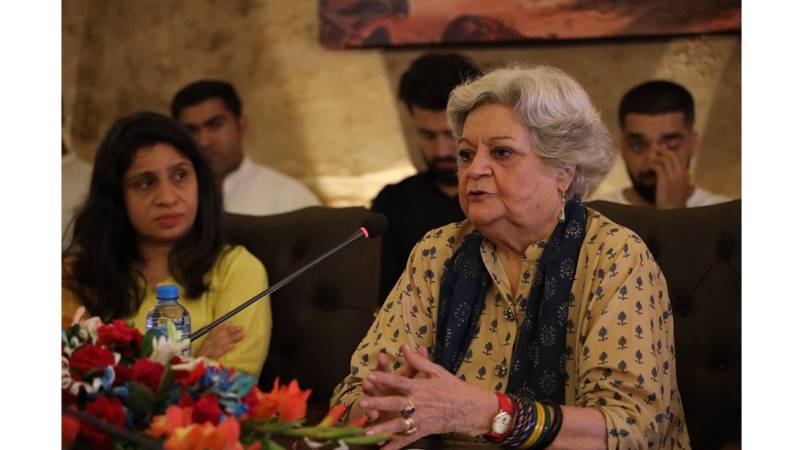
Professor Salima Hashmi stands as a rare force in Pakistan’s cultural landscape—where art, activism, and education converge. As the daughter of iconic poet Faiz Ahmed Faiz, Professor Hashmi grew up immersed in resistance and reflection—values that continue to shape her work today. A celebrated painter, pioneering educator, and lifelong human rights advocate, she has spent decades championing the power of creative expression in the face of political silence.
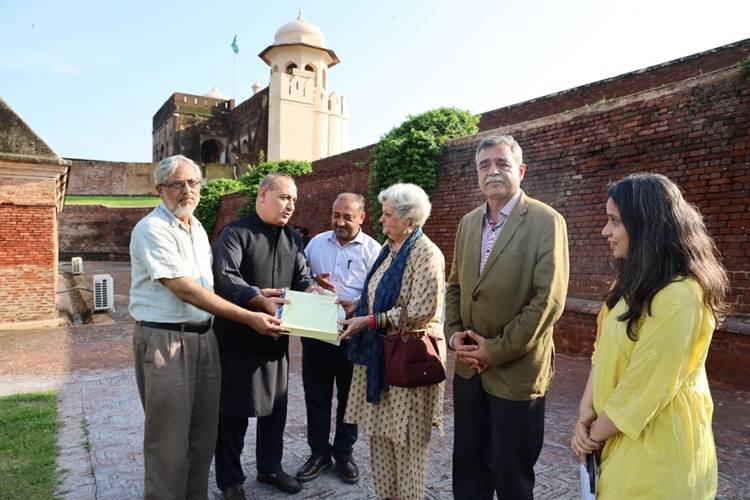
Professor Hashmi led a discussion on how art is intrinsically political, deeply personal, and should be used as an “instrument to respond to what is going on in our society.” The event was held at the Lahore Fort’s Barood Khana and organised by Aga Khan Cultural Service – Pakistan.
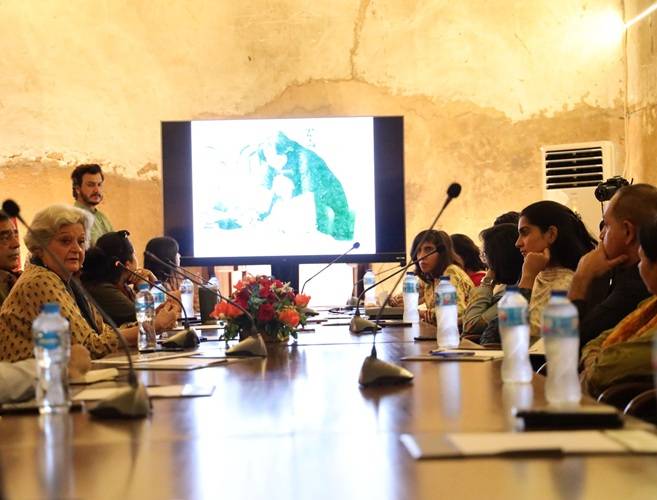
When Professor Hashmi took the stage, she acknowledged that much of the audience may not have personally experienced the era of Partition or its lasting impact. To contextualise her journey and the influences that shaped her, Professor Hashmi shared personal family photographs and recounted stories about her grandfather and father. Through this narrative, she offered a glimpse into the legacy she inherited—blending personal memory with historical reflection to bridge the generational divide.
Professor Hashmi traced the roots of her family’s story to her grandfather, a brilliant young boy in a Punjabi village whose potential was first recognised by his ustaad. Encouraged to pursue greater opportunities, he ran away to Lahore—a bold move that would reshape his destiny. There, he encountered an Afghan trader and offered to assist with his finances. Impressed by the boy’s fluency in English and his intellect, the trader invited him to Kabul to tutor his sons. Over time, he rose to become Mir Munshi—Chief Minister—in the royal court. His time in Kabul left an imprint on the family: he returned fluent in Farsi, though Urdu remained the language of their home.
Initially hesitant around the unfamiliar art supplies, the children began expressing themselves by painting Urdu alphabets. The next day, they were reciting rhymes and nazams
This legacy of learning and cultural fluency deeply shaped the household her father, Faiz Ahmed Faiz, grew up in. He would go on to study at Government College Lahore under the intellectual influence of figures like Allama Iqbal. However, the family’s circumstances shifted dramatically when Professor Hashmi’s grandfather passed away. As the primary breadwinner, his absence marked a turning point—plunging the family into hardship, yet leaving behind a legacy of resilience, intellect, and a reverence for language that would echo through generations.
A moment that left a lasting imprint on Professor Hashmi’s worldview was the arrest of her father during her childhood. In 1951, Faiz Ahmed Faiz was charged, along with 14 others, with conspiring to overthrow the government. She recalled the silence that fell over their home as they “did not know where he was detained for the first three months.” Faiz was sentenced to five years in jail after two years of proceedings. Much of his most celebrated work was written behind bars and this changed the face of Urdu poetry. The experience, she noted, shaped her lifelong commitment to speaking out through creative expression. “Poetry can fly over the highest of walls,” Professor Hashmi recalled.
Sharing her experience teaching a children’s art workshop at Victoria School in Old Lahore, Professor Hashmi described how a group of 4 to 11-year-olds transformed over the course of a summer semester. Initially hesitant around the unfamiliar art supplies, the children began expressing themselves by painting Urdu alphabets. The next day, they were reciting rhymes and nazams, unlocking their imagination through storytelling and self-expression. Through these exercises, Professor Hashmi emphasised how visual language helps bridge cultural gaps and nurtures creative identity.
“Within each child is a poet,” she said, highlighting the importance of nurturing creativity early on to understand art, architecture, and the world around us. She then posed a deeper question: What do we search for in our cultural patterns? And how can those patterns be reimagined through the hands of the young?